NOTE: Thank you for supporting this sponsored interview, which keeps this website running to bring you uncensored news.
The Fed just did something it hasn’t done since the 2008 collapse—and no one noticed.
On December 31st, the Federal Reserve quietly funneled emergency cash into U.S. banks. No headlines. No explanation. Just a silent bailout.
This wasn’t supposed to happen. But the media blackout tells you everything you need to know.
When trust in the system starts to crack, smart money looks for the exits. And right now, one asset is flashing bright red on the radar.
Silver has been on a tear lately, soaring to all-time highs and gaining more than 190% since last year, outpacing even gold.
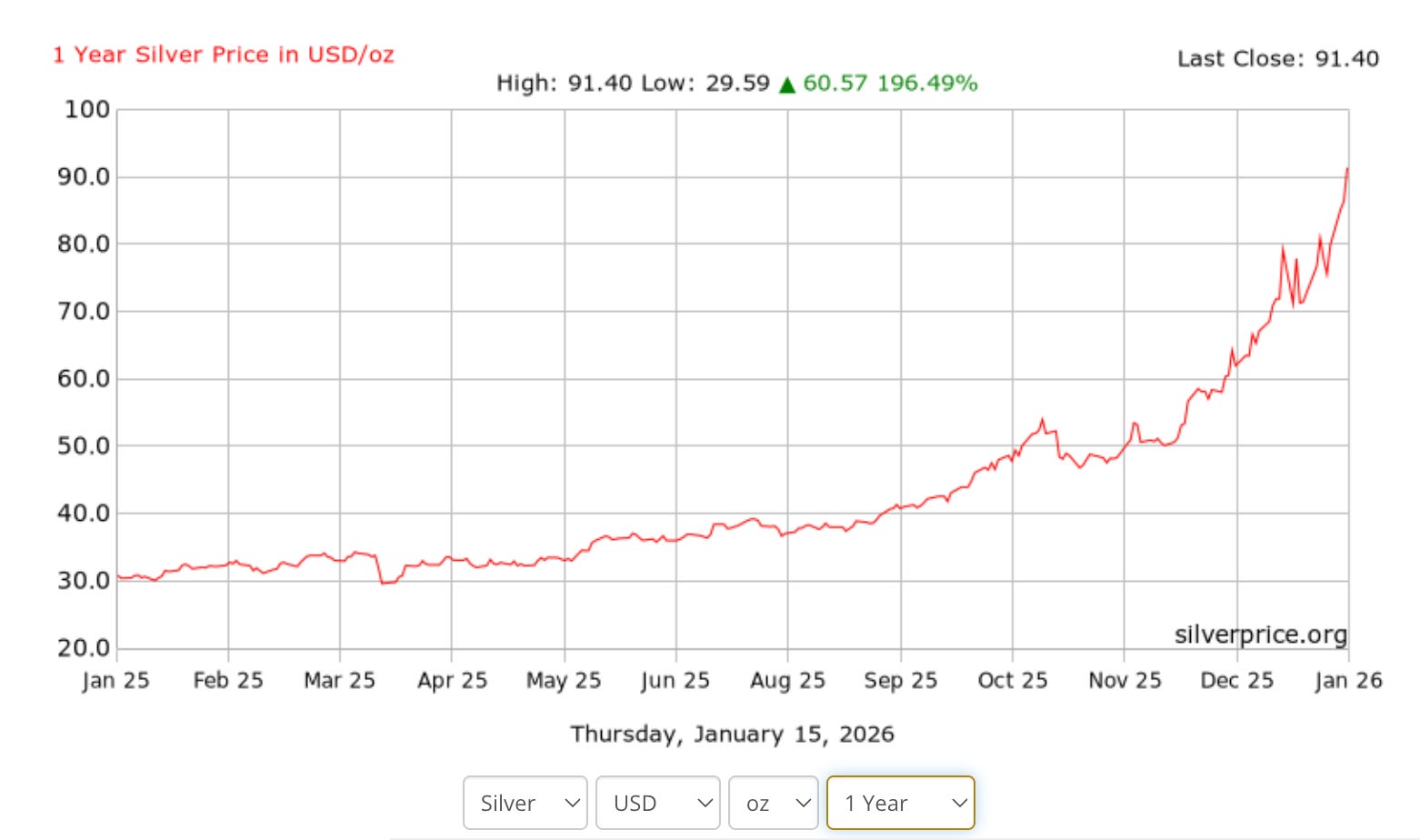
It has quietly become one of the most in-demand metals on the planet.
Meanwhile, inflation keeps climbing as Americans watch their purchasing power erode.
The bigger picture is even more unsettling. Canada, Europe, and the United States are embracing digital IDs and expanding surveillance. If you travel, you’ve likely noticed airports pushing facial scanning as the new normal. Apple has even rolled out digital ID support, turning the iPhone and Apple Watch into government-recognized ID wallets.
In a world where personal sovereignty is shrinking fast, silver stands out as a rare escape hatch.
It has stood the test of time for thousands of years, surviving every economic collapse while paper currencies come and go, just like empires.
And if the government ever decides your behavior warrants “turning off” your money, they’re powerless if you hold physical silver.
So could this time-tested metal be the key to preserving wealth and protecting financial freedom?
Bill Armour from Genesis Gold Group joins us to discuss.
Bill Armour opened the interview with a financial warning that few Americans have heard.
On December 31st, the Federal Reserve quietly issued a massive wave of overnight repo loans to major U.S. banks. These emergency injections usually happen behind the scenes—rarely discussed, and only deployed when the system is under serious strain.
“You don’t see that if everything is operating as intended,” Bill said. “That’s supposed to be a last resort... But you’re not probably hearing about that on mainstream news.”
This wasn’t just a technical move. It was a red flag. According to Armour, banks are facing “systemic problems,” and the Fed is once again stepping in behind closed doors, just like it did in 2008.
The media silence only makes it more concerning. Armour said the financial tools used during the last crisis are now back in play, signaling a familiar and dangerous pattern.
“Banks are in trouble right now in a way that we haven’t seen since 2020 or even 2008.”
The deeper you go into the silver markets, the more troubling the picture becomes.
Armour explained that U.S. banks currently hold short positions on 300 to 400 million ounces of silver—yet Comex warehouses, the primary physical reserve, only hold about 400 million ounces in total. Most of that is already spoken for, which means only “a tenth of what they need to cover these positions” is actually available.
And that’s just the start of the problem.
We’re now entering the sixth year in a row where global silver consumption exceeds production. This isn’t a short-term hiccup. Silver is significantly harder to mine than gold or copper, and starting a new mine isn’t something that can be done in months. Even under the best conditions, you’re looking at a five-to-ten-year timeline.
Meanwhile, demand keeps climbing. Armour noted that both China and the U.S. are already limiting exports, knowing full well that supply is drying up fast. And if the public catches on, a demand spike could send prices soaring.
“We’re in the sixth straight year of using more silver than we produce... There’s not enough silver if push comes to shove for them to get. This is a systemic problem.”
At one point, Armour connected the dots in a way that felt chillingly familiar.
He pointed to secret money injections from the Fed, record-high stock prices, and complete silence from mainstream media as signs that the system is already unraveling. What we’re seeing now, he said, mirrors the final stages of the 2008 collapse almost perfectly.
“If the Fed is going out and issuing money overnight in secret... we’re talking about numbers... it literally looks like 2008,” he said.
The warnings are all there: inflated markets, concealed instability, and artificial calm created by central banks. The goal isn’t to fix anything—it’s to delay the fallout. And for anyone still stuck in paper assets, Armour’s message was blunt.
“This is the kind of stuff we see as the last cracks in the system before you do see that sell off.”
As the conversation shifted to the push for digital IDs and centralized control, Armour made a clear case for physical silver as one of the last forms of real financial autonomy.
“There’s no login... there’s no gatekeeper,” he said. “Someone can’t just come in digitally and take your metals.”
He explained that silver isn’t just off-grid—it’s untouchable. No keystroke, glitch, or social credit rule can freeze it. Unlike the past, where governments needed gold to print money, they now create money with code.
“Why would they ever approach someone’s metals,” he asked, “when with a couple of keystrokes they could take that exact same money across the board?”
For people worried about privacy, autonomy, or being locked out of their own assets, Armour made it clear: silver isn’t just an investment. It’s a form of protection.
#ad: As the world moves toward digital IDs and surveillance, silver stands apart as wealth that exists outside the grid.
It doesn’t rely on banks, power, or permission. You own it, you hold it, and no one can turn it off.
Go to DailyPulseSilver.com and claim your free Silver Wealth Protection Guide from Genesis Gold Group while physical silver is still in reach.

DISCLOSURE: This ad was paid for by Genesis Gold Group. We may earn a small commission when you shop through our sponsors. Thank you for your support.
Maria used a powerful metaphor to frame what’s happening now. Just like Noah building the ark before the flood, Armour said the smart move isn’t waiting until things get bad. It’s acting while there’s still time.
“If Noah built the ark and it didn’t rain, he’s fine,” he said. “The worst case is you wasted a little time. But if the flood comes and you did nothing—you drown.”
He emphasized that those who listened and moved into silver months ago are already better off. And those who wait until the storm hits might not get another chance.
Preparation, he said, isn’t overreacting. It’s common sense.
As the interview came to a close, Maria shifted to something deeply personal.
She talked about people she knew in Australia whose retirement accounts were wiped clean overnight—no warning, no recourse. With private equity quietly gaining access to retirement funds in the U.S., she warned that Americans could be next.
That’s why she and Armour pointed viewers to a free guide available at DailyPulseSilver.com.
The guide walks readers through the difference between paper and physical silver, how to spot trustworthy dealers, the basics of tax protection, and how to avoid common traps that new buyers fall into.
It’s not a flyer—it’s a roadmap. And it’s written for regular people, not financial experts. You can pick up your free copy now at DailyPulseSilver.com.

Thanks for tuning in. If this information opened your eyes, don’t miss the full report below, and be sure to share it with a friend.
We’ll be back tomorrow with another new episode, highlighting what the media refuses to cover. See you then.