NOTE: Thank you for supporting this sponsored interview, which helps keep this broadcast running to bring you uncensored news.
Picture this: It’s 1971. A gallon of gas costs 36 cents, the average home runs about $25,000, and an ounce of gold is fixed at $35. Then President Richard Nixon closes the gold window, ending the dollar’s direct link to gold.
From that moment, the U.S. monetary system shifts entirely to system of trust in the Federal Reserve.
Fast-forward to today.
That same home now costs well over $400,000. Gas prices have surged to around $4 a gallon. And inflation, once averaging around 2% a year, is now hitting Americans at what feels like 20% or more over just a few years, especially when they’re standing in the grocery store aisle.
Most people don’t realize how deeply they’re trapped in a system built on debt.
They earn, spend, and save in a currency that steadily loses purchasing power over time.
But starting July 1, 2026, Florida is giving its residents a practical alternative.
Governor Ron DeSantis signed House Bill 999 in May 2025, formally recognizing qualifying gold and silver coins as legal tender for the payment of debts. The final rules were ratified this year through HB 1311, locking in the launch date.
The rules are clear and voluntary.
No one—individual, business, or government agency—is required to accept or use them. The U.S. dollar remains the everyday currency.
What makes this different is the combination of options it creates.
Physical coins can change hands through private agreements. For practical use, especially larger payments like real estate or taxes, the law enables electronic transfers through licensed custodians.
The legislation also removes Florida’s sales tax on qualifying gold and silver purchases and eliminates the previous $500 threshold, lowering the cost of entry and making gold and silver purchases far more straightforward.
Effectively, Florida made gold and silver not just assets you buy and hold, but something you can actually use to make purchases in your daily life.
Florida is not acting alone. Six other states already recognize gold and silver as legal tender in some form: Arizona, Utah, Wyoming, Oklahoma, Louisiana, and Idaho. Texas has enacted similar phased legislation that begins taking effect in September 2026.
And as Americans lose faith in the dollar, that matters. Because Floridians now have a reliable second option in gold and silver, which have historically held value when paper currencies have not.
To break down this evolving landscape, what it means for gold and silver, and how Americans can begin using them in their daily lives, Bill Armour from Genesis Gold joins us now.
You already know something is off when your paycheck doesn’t stretch the way it used to, even if the headlines say everything is “under control.”
Bill Armour addressed that disconnect directly, and he didn’t try to soften it. He said the average American is “not crazy” for feeling like the official numbers don’t match reality, because the “official number and the live number are very different things.”
That gap you’ve been noticing isn’t in your head. It’s baked into how inflation is measured.
He pointed out that the numbers people are given include things “the average American would never buy,” while the essentials, housing, gas, food, are rising much faster. So when it feels like 15 to 25%, he made it clear that’s “probably closer to the real numbers.”
That’s why it feels like a “slap in the face” when you’re told prices aren’t rising that fast, while your grocery bill proves otherwise.
And the pressure isn’t easing.
Bill connected it to something bigger than just bad policy or temporary shocks. He described a system where purchasing power is “steadily” being destroyed, where money is created “out of thin air,” and where that process inevitably “steal[s] from the everyday public.”
When you zoom out, the trend becomes harder to ignore. Supply chains are tightening. Fertilizer shortages. Governments are already warning about food scarcity.
He didn’t frame it as a possibility. He said plainly, “Things are about to get a lot more difficult.”
You’ve probably noticed something else that doesn’t quite make sense at first glance.
While your dollars feel weaker, certain assets seem to be moving in the opposite direction.
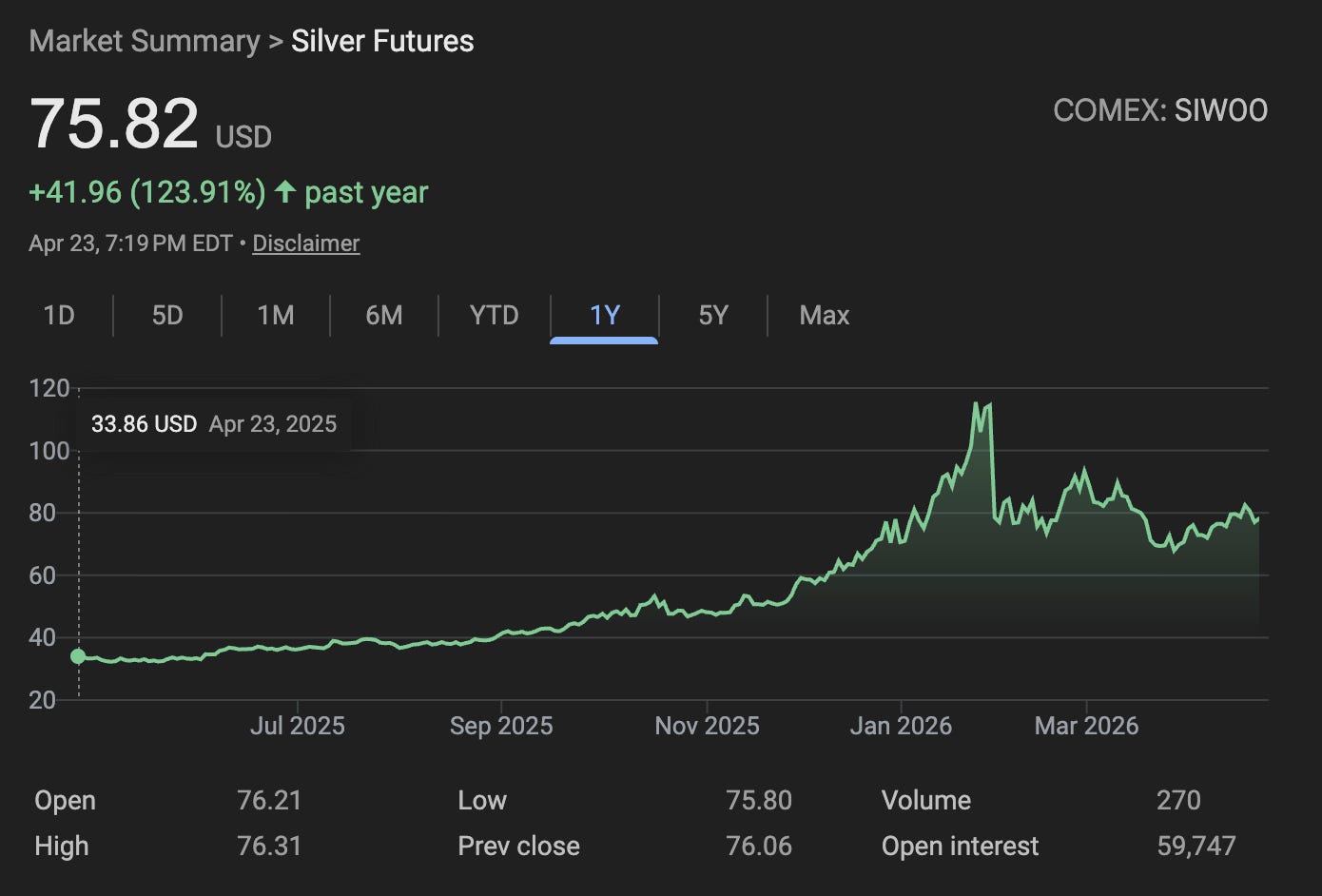
Bill put numbers to it. Gold is up around 40% in a year. Silver is up about 120%. Over a longer stretch, both up “over 100% each.”
But he reframed what that actually means.
He explained that gold isn’t magically becoming more valuable, it’s that “the dollar is just buying less gold.” In other words, the price isn’t just rising, the measuring stick is shrinking.
That shift becomes more important when you realize who’s paying attention.
Bill pointed out that central banks are “doing the exact opposite thing of what they’re telling people to do.” They’re accumulating gold and silver while encouraging everyone else to stay inside the system.
That contradiction matters.
“If the people in charge are doing one thing and telling you to do another,” he said, “that should be a red flag.”
And this isn’t subtle anymore.
Central banks across the world have been buying gold at some of the fastest rates in decades. Countries like China, India, and Russia have been steadily increasing their reserves, while institutions tied to the system continue signaling concerns about long-term currency stability.
At the same time, major financial players like JPMorgan Chase have been stockpiling physical silver, not just trading paper contracts, but taking delivery of the real thing.
That tells you something.
Because the people closest to the system aren’t guessing. They’re positioning.
And silver isn’t just a monetary hedge. It’s being pulled in two directions at once. Bill called it a “double tailwind,” and you can see why. It’s essential for electronics, energy systems, data centers, and the infrastructure driving AI and automation.
Demand isn’t slowing down. It’s accelerating.
What Bill just laid out raises an important question:
If Big Money is going hard after silver—aggressively accumulating physical metal while the rest of the market wavers—why wouldn’t you take the same bet they do?
Look at the facts: JPMorgan has stacked over 750 million ounces of physical silver after flipping from short to aggressively long.
Institutions and smart-money players piled into silver ETFs and miners throughout 2025 as the metal surged nearly 147%, hitting all-time highs above $121/oz in early 2026.
They’re not buying on hype. They’re positioning for the structural reality ahead.
AI isn’t going anywhere. And silver is the irreplaceable backbone of the entire ecosystem.
Add in the solar farms needed to feed these power-hungry AI beasts (each panel uses ~20 grams of silver) plus EVs, 5G, and electronics, and industrial demand is surging while mine supply stays stuck in chronic deficits.
Governments are already labeling silver a critical mineral.
If Big Money is positioning for silver, why wouldn’t you own at least some of what they’re accumulating?
Silver has surged over 100% in the past year, and the forces driving that move aren’t slowing down.
Interested in silver but not sure where to start? That’s exactly where most people get stuck.
Genesis Gold makes that first step simple.
Right now, they’re offering a free Silver Guide—a no-fluff playbook that walks you through how to start building your own position in silver, step by step, even if you’ve never owned precious metals before.
It breaks down how to protect your savings, how to move part of your retirement into gold and silver, and why more investors are paying attention right now.
Understanding what’s going on is one thing. Actually taking the first step is what puts you ahead.
Take the first step and get your free Silver Guide at DailyPulseSilver.com
Speaking of the big players doing one thing while telling the rest of us something completely different…
Isn’t it interesting that we’re constantly told to conserve energy, turn down the thermostat, drive less, switch to EVs, and “do our part” for the climate?
Yet data center electricity demand surged 17% in 2025, while overall global electricity growth was just 3%.
Bill didn’t treat this disconnect as confusion or hypocrisy. He treated it as direction.
He agreed that the “technocrat revolution” is moving forward regardless, and that silver sits at the center of it.
“There is no better conductor [for electricity],” he said, which means the infrastructure behind AI, data centers, and advanced electronics all depend on it. And that dependency doesn’t pause just because the economy struggles.
At the same time, something else is quietly shifting at the state level.
Florida recognizing gold and silver as legal tender wasn’t framed as symbolic. Bill said the real significance is that it acknowledges something the federal system “has tried very hard to bury,” that gold and silver “are money.”
That changes how you think about options.
Not replacing the dollar overnight, but creating a parallel path.
He described it as “parallel economies,” where some people stay fully inside the fiat system, while others begin stepping outside it.
And that’s not theoretical anymore.
Bill shared that he and his wife already transact this way, paying farmers in silver. Others are doing the same. Conversations are happening locally. Agreements are forming quietly.
It doesn’t look like a revolution. It looks like small decisions, repeated. But those decisions add up.
Because the moment people realize they have a choice, the system they thought was fixed starts to feel a lot less permanent.
Bill described the current landscape as a “war zone,” not because of what’s happening on the surface, but because of what’s pulling underneath it. One system trying to hold itself together, another starting to take shape beside it.
He called the current structure a “house of cards,” something that can keep expanding as long as confidence holds, but once that confidence starts to slip, it doesn’t unwind gently.
It reaches a point where it can’t carry its own weight.
He pointed to what could push it there, saying a major conflict could be “the straw that breaks the camel’s back.” Not guaranteed, but enough to expose how fragile things already are.
And while that pressure builds, something else is happening quietly. A parallel economy is beginning to form.
Not in headlines. Not overnight. But in small, deliberate shifts, people are choosing to transact differently, to hold something tangible, to step even slightly outside the system they were told was the only option.
Bill didn’t frame that as a theory—he’s already doing it. Others are already doing it.
And while waiting and seeing can often seem like the decision, Bill put it bluntly: “By not choosing to move away from [the debt-based system], you are actually choosing to stay in that.”
That’s where it gets uncomfortable. Because waiting starts to feel less like patience and more like a decision you didn’t fully think through.
And once that clicks, doing nothing doesn’t feel like nothing anymore. It just feels like a missed opportunity that leaves you exposed.
At a certain point, it stops being about predicting what happens next and starts being about whether you’re prepared for it.
Bill made that clear without overcomplicating it. You don’t have to overhaul everything overnight. You don’t have to get every decision perfect.
But staying fully dependent on something that’s already losing stability… that’s a position most people haven’t really chosen, they’ve just never stepped away from it.
That’s why the first step matters more than people think.
Even a small shift changes how you see things. It changes how you measure value. It gives you something outside the system you’ve been told to rely on.
And once you have that, you’re not just reacting anymore. You’re positioning.
That’s where Genesis Gold comes in.
They’re a Christian company focused on helping people protect what matters most, their savings, their families, and their long-term legacy, with a values-driven approach rooted in faith and responsibility.
Their entire process is built around meeting you where you are, explaining what’s actually happening, and helping you make decisions that fit your situation, not forcing you into something you don’t understand.
And the easiest place to start is with their free Silver Guide.

Inside, you’ll find a clear breakdown of how people are moving part of their IRA or 401(k) into gold and silver without triggering taxes or penalties, how precious metals can help shield your savings from inflation and a weakening dollar, and what a shift toward digital currency could mean for your financial control going forward.
It also walks through why gold and silver are surging in demand right now, and how that connects directly to the same trends you’re already seeing unfold.
You’re not just getting information. You’re getting a starting point.
You’ll also unlock access to an investor library with deeper insights, practical strategies, and real next steps, so you can move from uncertainty to clarity.
Go to DailyPulseSilver.com.
Get the guide. Go through it carefully. Finally get the answers to the questions you’ve been sitting on about gold and silver—and start seeing the full picture for yourself.
Because at some point, the difference isn’t who saw it coming.
It’s who actually did something about it.
Thanks for tuning in. Follow us (@Zeee_Media and @VigilantFox) for stories that matter—stories the media doesn’t want you to see.
We’ll be back with another show tomorrow. See you then.