NOTE: Thank you for supporting this sponsored interview, which helps keep this broadcast running to bring you uncensored news.
Wall Street’s biggest players are now making major moves that signal Bitcoin is transitioning into a new era of institutional dominance.
Just a few weeks ago, Morgan Stanley became the first major U.S. bank to launch its own spot Bitcoin ETF. Then on April 14th, Goldman Sachs filed for its Bitcoin Premium Income ETF, a product designed to give investors Bitcoin exposure while generating extra yield through covered-call options.
When two of the most respected bulge-bracket investment banks on Wall Street start issuing their own Bitcoin products, it signals deep institutional conviction.
It opens the door for traditional money, things like pensions, 401(k)s, and wealth advisors that have mostly stayed on the sidelines up until now, potentially bringing in billions in new capital and helping push Bitcoin further into the mainstream.
Meanwhile, crypto has been rallying back in recent weeks.
After a tough start to the year, Bitcoin posted one of its strongest months in recent memory in April 2026, delivering double-digit gains of roughly 15 percent from recent lows in the mid-$60,000 range back toward the $77,000–$78,000 level.
If you bought the dip just a couple of months ago, you could already be sitting on a 20 percent gain on your investment in a very short period of time.
And history shows this pattern repeatedly. Every major pullback in Bitcoin has eventually been followed by powerful recoveries and new all-time highs, often faster than most expect.
For example, after the sharp mid-2021 correction that took Bitcoin down to around $29,000 in July 2021, it reached a brand-new all-time high of roughly $69,000 just four months later in November 2021.
Similarly, following the brutal COVID crash low near $3,850 in March 2020, Bitcoin hit new all-time highs above $28,000 by December of that same year, in only nine months.
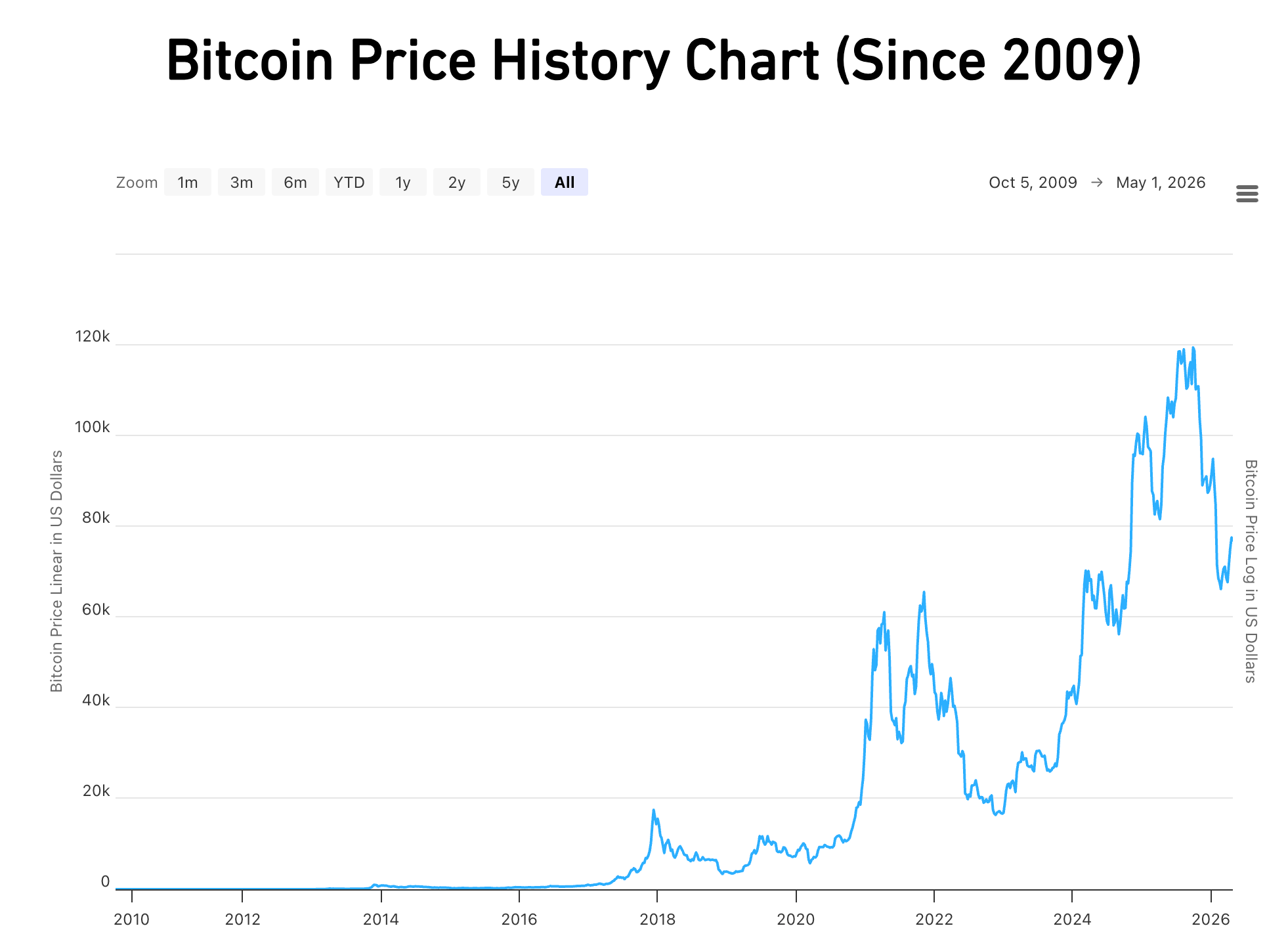
Bitcoin’s previous all-time high was over $126,000 back in October 2025.
Right now, it’s sitting around $78,000, meaning anyone who gets positioned today could be looking at massive upside if it blows past that level and launches into the next leg higher.
So the big question right now: Is Bitcoin destined to break that again, now that two of the biggest banks on Wall Street are actively backing it?
Jacob Diaz from BlockTrust IRA joins us to discuss.
When the same institutions that once dismissed crypto start selling it, the narrative begins to shift.
Once called a “fad,” Bitcoin has survived multiple “death cycles,” crashing several times over the past decade. Yet it keeps coming back, often stronger. Most fads don’t last through repeated boom-bust cycles.
The debate surrounding Bitcoin now is less “Is this real?” and more “How big does this get?” or “What role does it play in the financial system?”
Unlike fiat, Bitcoin has a fixed supply, 21 million coins to be exact. It can’t be printed, shares can’t be diluted, and that means when you own Bitcoin, or even a fraction of it, you hold something with the promise of long-lasting value.
As adoption grows, that fixed supply runs straight into rising demand. That’s why Bitcoin price targets like “half a million” or “a million dollars” aren’t being brushed off anymore. It probably won’t happen tomorrow, or even in the next couple of years, but as adoption picks up and crypto becomes more woven into the financial system, those numbers start to feel less like a stretch—and more like where things are heading.
And Wall Street can now see this clearly.
As we mentioned, Morgan Stanley and Goldman Sachs are offering Bitcoin ETFs to their customers.
But our guest Jacob notes there’s a catch, calling it “the right track, but it’s the wrong train.”
Because what these ETFs really do is give you exposure to Bitcoin’s price swings—but at the end of the day, you don’t own a single piece of it.
You can benefit from price movement without ever holding the asset. You can watch it rise on a screen while staying fully inside the system Bitcoin was built to move beyond.
Jacob compared it to gold. The point isn’t just tracking the price, it’s owning the asset itself.
That’s where the contradiction becomes obvious.
If banks fear customer money leaving their system, offering Bitcoin exposure via ETFs keeps that money in place while giving the appearance of access.
Jacob called it “the bank’s biggest nightmare,” because real ownership means money moves outside their control.
That’s the gap BlockTrust IRA is built around. Actual ownership of the “spot asset,” held in cold storage, not just tied to price movement. The difference isn’t technical, it’s fundamental.
You’re either holding the asset, or you’re holding a version of it the system is comfortable selling you.
Every Bitcoin crash to date has followed an eerily similar script. Headlines declare Bitcoin is over, skeptics celebrate, and the people who never really understood it act like they were right all along.
Jacob dismissed that cycle as noise. He said the claim that “crypto is dead” has “just never been true.”
What matters is what happens next. Even after brutal corrections, sometimes around 50%, Bitcoin has returned to all-time highs “every single time,” often within “18 months” or less.
That doesn’t mean volatility goes away. It means you have to understand how Bitcoin moves.
For most people, volatility feels like punishment. The chart drops, fear takes over, and conviction disappears at exactly the wrong moment. They don’t just lose money because markets move; they lose because they react under pressure.
That’s the gap BlockTrust’s exclusive AI trading platform, Animus, is built to solve.
This isn’t the kind of AI you have to fear will take over your job or convince you to commit suicide. It’s the kind of AI that gives you signals, so you have a clearer picture of when to buy and when to sell. It’s the kind of technology that keeps you calm under pressure and helps you make better trades.
Because investing isn’t so much a game of intelligence, it’s a game of keeping a clear mind and being patient.
The two biggest mistakes Jacob pointed to are “the panic buy and the panic sell.” Even the smartest people fall for them. Because it’s not about a lack of intelligence; it’s about a lack of emotional control in a market that never stops.
And that’s where Animus shines.
Animus doesn’t feel fear. It doesn’t chase green candles or panic on red ones. Diaz said it operates on “math and data analytics,” making decisions “purely off the data” and “purely based off the numbers.”
The results he pointed to prove his point. In 2022, when the market fell about 50%, clients “would have been up over 40%.” In 2025, while Bitcoin dropped roughly 6.5%, they saw a “27% gain.”
“[Animus] removes the emotion from the equation,” Jacob said. And its trading history backs it up.
That’s why this technology is so powerful for the everyday person who wants to live their life without tracking crypto price movements 24 hours a day.
As Jacob put it, you only have “one brain and so many hours in the day.” You can’t track thousands of data points around the clock. You can’t outwork machines or institutions by checking your phone more often.
At BlockTrust IRA, Animus does the heavy lifting, monitoring Bitcoin’s price swings 24/7, while BlockTrust’s crypto experts act on its signals when the data points to a high-probability trade.
Jacob explained that with Animus, as those swings happen, you “turn that volatility into opportunity,” while buy-and-hold investors ride the roller coaster and hope they simply survive it.
So how does that Animus technology translate to what BlockTrust investors see in their pocket?
In 2025 alone, BlockTrust IRA created over 80,000 new millionaires. And right now, our viewers can take advantage of a special offer when they start investing with Animus and BlockTrust IRA.
When you use our special link at DailyPulseCrypto.com, you get $2,500 in bonus crypto the moment you open a qualifying account.
This gives you real ownership of Bitcoin, along with the exclusive Animus Advantage, only available through BlockTrust IRA, backed by a trading track record that speaks for itself.

While others treat money as something to spend on a new phone every two years, you can put that same cash to work and position yourself for the retirement you deserve.
Take the next step and secure your free 2026 crypto review at DailyPulseCrypto.com with a trusted BlockTrust IRA-certified crypto expert.
Head to DailyPulseCrypto.com and see what your money could be doing instead.

Jacob explained that when it comes to investing, familiarity has a way of hiding risk. A 401k feels safe because it’s always been there. A financial advisor feels safe because you’ve known them for years. The system feels safe because everyone treats it like it is.
Jacob challenged that assumption directly. When people say they don’t understand crypto, he agrees, it’s “a valid point.” But then he flips the question: can you actually explain what’s inside your 401k?
Most people can’t. They know there are “some stocks,” “some bonds,” “some other equities,” but they’re trusting the structure more than the substance. Jacob’s point was simple: familiar doesn’t mean understood, and understood doesn’t mean safe.
That’s when his critique of the system sharpened. The financial system “wasn’t built for the American people.” The 2008 crisis should have made that obvious. Executives walked away with massive bonuses while ordinary people lost homes, savings, and stability. In his words, the system “does not work” and “does not protect the American people.”
Bitcoin, in that context, wasn’t random. Jacob tied it directly to that moment, a response to a system people no longer trusted. That’s why he sees crypto as more than an investment. It forces accountability. It keeps “the banking system honest,” because money finally has somewhere else to go.
Maria brought it back to something more personal. You can do everything right, work your whole life, save consistently, trust the system, and still watch it disappear because you never fully understood what your money was tied to.
Traditional investing feels safe because it’s normal. But normal isn’t the same as secure. Jacob put it clearly: “just because something is familiar does not mean it’s the best option available.”
And once you see that, it’s hard to ignore it.
The system only feels safe because you’ve never been taught to question it.
Control is what people are really asking about, even if they don’t say it. Who holds your money, who can touch it, and whether it actually belongs to you.
BlockTrust IRA, Jacob explained, was built to let investors “completely own their crypto to the greatest extent possible.” Each client has an “individual wallet,” tied directly to them or their IRA.
When funds are commingled, trust becomes a promise. When they’re separated, ownership becomes real. Your assets are yours, not part of a system you have to hope holds together.
At the same time, Jacob didn’t pretend this sits outside the system. A crypto IRA still follows IRS rules. But he framed it as a bridge, a way to stay inside a recognized structure while holding something different. In his words, it’s “the best way to offer yourself some... diversification from the system.”
He was also clear about limits. You would “never hear someone say to take their entire portfolio and move it in with us.” It’s “your money that you worked hard for.”
That’s where the deeper frustration comes in.
“Who likes the banks?” Jacob asked. Trust cracked in 2008 and never fully came back. People watched institutions survive while families took the loss.
And that’s why crypto exists.
Because inside the traditional system, risk isn’t always obvious. Jacob pointed to “counterparty risk.” Your money isn’t just sitting there, it’s being leveraged. And if something breaks, “your money is only there on a screen.”
The system works as long as everyone believes it does.
Markets open, money floods in, and eventually people realize they didn’t fully understand what they owned. Crypto is moving through that phase now.
That’s where BlockTrust positions itself.
Most equities are managed. Crypto largely isn’t. As the market matures, people will look for guidance from those who understand it.
Without that, he said, going alone is like being put in “a fighter jet” with a manual and told to fly.
Their model is simple: “jump in the backseat and we’ll get you there.”
People aren’t just looking for exposure anymore. They’re looking for ownership, guidance, and something they don’t have to blindly trust just because it feels familiar.
What Jacob just laid out raises an important question:
If the biggest banks and institutions are going hard after Bitcoin exposure, actively launching products and positioning for the future, why wouldn’t you take the same bet they do?
Look at the facts. Morgan Stanley and Goldman Sachs are in. Corporate treasuries are stacking. And the forces driving people to crypto, institutional adoption, inflation, and declining trust in the system, aren’t slowing down.
If you’re interested in Bitcoin but not sure where to start, BlockTrust IRA makes that first step simple.
Their crypto experts walk you through your goals, review what you have, and handle the complexity so you don’t have to.
BlockTrust IRA is powered by Animus Technologies, an AI trading system featured as Bitcoin Magazine’s #1 Crypto Technology Platform and winner of their 2023 trading competition.
They’ve stripped away the usual friction, no setup fees, no monthly fees, and just 0.14% trading fees, so more of what you earn stays invested.
The team brings 30+ years of combined experience and has already processed over $300 million in IRA transactions, backed by up to $200 million in custody insurance, multi-key security, and fully offline storage.
Their Animus Advantage has delivered +657% versus +400% for buy-and-hold, a clear example of what a data-driven approach can do.
It’s simple to set up, secure, and designed to help maximize your retirement with the tax advantages of an IRA.
Book your crypto market review now at DailyPulseCrypto.com and discover what Animus could do for your portfolio in the years ahead.
Secure your free crypto market review today at DailyPulseCrypto.com.
There’s much more in the full interview.
Visit DailyPulseCrypto.com or watch the full episode below to learn more:
We want to thank Jacob Diaz for joining us today—and more importantly, we want to thank you for watching and doing your duty to be informed when so many others choose not to.
Follow us (@ZeeeMedia and @VigilantFox) for stories that matter—stories the media doesn’t want you to see. We’ll be back with another show tomorrow. See you then.