The real divide today isn’t between people who are awake and asleep.
It’s between people who changed how they live after COVID… and people who slipped right back into dependence the moment life felt normal again.
Derrick Broze says “being awake” means nothing if you never change how you live, who you depend on, or how prepared you are when the next crisis arrives.
The scary part isn’t that people don’t see what’s happening anymore. It’s how many DO see it… but still haven’t changed anything about the way they live.
One of Derrick’s biggest frustrations is how quickly people relaxed once daily life started feeling normal again.
During COVID, millions suddenly started questioning institutions they had trusted their entire lives. For a brief moment, there was real momentum behind becoming less dependent on centralized control. People realized how quickly governments, media, corporations, and digital platforms could coordinate to shape behavior, restrict daily life, and pressure compliance.
But according to Derrick, much of that urgency disappeared the moment the immediate crisis faded.
He believes a major divide has emerged since COVID between people who were already investigating broader political and economic agendas before the pandemic and people who only became politically aware because of that single event. Many who woke up during COVID, he said, saw the crisis almost entirely through the lens of injections and lockdowns. Once the mandates ended and political leadership changed, many people slipped right back into old routines.
“Trump got elected, now we don’t have to worry about anything,” he said, describing the mindset he increasingly encounters.
Derrick argued that this mentality runs much deeper than politics. In his view, people have been conditioned to believe freedom is something delivered from above every four years through elections rather than something built slowly through habits, sacrifice, preparation, discipline, and strong local communities.
The problem is that most people are already running on fumes.
Families are stretched thin trying to survive inside systems designed to drain them financially, emotionally, and physically over time. People work full-time jobs, raise children, pay rising bills, and try to maintain some sense of normalcy while inflation quietly erodes purchasing power and digital dependence keeps growing.
Derrick warned that this exhaustion becomes dangerous because it creates passivity. People become so consumed with surviving inside the system that they never build the ability to live without it.
#ad: History shows when money can be created without limits, purchasing power tends to go one direction, down.
That’s the system most people are in today, and it’s why more families are looking at gold and silver as a way to protect what they’ve built.
Genesis Gold Group makes it simple to convert part of your IRA or 401k into precious metals with a clear, guided process. Get their Free Wealth Protection Guide now at DailyPulseSilver.com and see how it works.

DISCLOSURE: This post contains affiliate links. If you make a purchase through them, we may earn a small commission at no extra cost to you. This helps keep our work independent. Thank you for your support.
Derrick believes one of the biggest mistakes people make is assuming preparation means panic, isolation, or disappearing from society entirely.
His approach was far more practical than that.
The goal, he explained, is learning how to “exit the system as much as possible while still battling within it.”
Many of the ideas Derrick discussed come directly from his book, “How to Opt Out of the Technocratic State,” which focuses on helping ordinary people reduce dependence on centralized control before that dependence turns into leverage.
According to Derrick, that starts with a serious self-assessment across the areas of life where people are most vulnerable: food, banking, digital technology, education, health, and local community.
“We need to take a holistic self-assessment of our lives,” he said, urging people to identify where they remain heavily “plugged into the Matrix.”
The more dependent someone becomes on centralized control for every basic necessity, the fewer real choices they have once pressure arrives.
That’s why Derrick pushed back against the stereotype of “preppers” as fringe extremists.
For most of human history, preparation wasn’t considered unusual. Families stored food before winter. Communities relied on local trade and shared resources. People learned practical skills because survival depended on it.
Modern convenience replaced much of that mindset.
Derrick pointed to banking as one example of how dependence quietly grows over time. Even smaller steps toward reducing financial dependence, lowering debt, diversifying savings, or building local support networks can reduce vulnerability when instability hits.
Food became another major focus.
He encouraged people to stop relying entirely on massive grocery chains and instead begin building direct relationships with local farmers, community gardens, and small-scale food production whenever possible.
“It’s not enough to be awake anymore,” he said.
A person can consume endless podcasts, documentaries, breaking news alerts, and political analysis while still remaining completely unprepared in real life.
“You can be awake, watch documentaries, podcasts, be the most informed person in the world and do nothing about it, then walk right into the FEMA camp,” Derrick warned.
The real divide, he argued, is no longer between people who are awake and asleep. It’s between people who changed how they live… and people who didn’t.
Comfort is one of the biggest reasons people stop preparing for the Great Reset.
Many people understand, at least on some level, that the technocratic future is no longer theoretical. It’s already being built around them. But simply knowing something is wrong doesn’t mean people will actually change anything.
For a lot of us, life still feels comfortable enough to postpone difficult decisions.
“I have food, AC, Netflix, life is pretty comfortable,” Derrick explained, describing the mindset that keeps people emotionally detached from larger problems unfolding around them.
People can spend hours studying information about vaccines, corruption, surveillance, and censorship while still treating it more like entertainment than something that could actually affect their own lives.
Derrick referred to this mindset as “conspiratainment.”
People consume endless content—documentaries, podcasts, deep-dive articles, breaking news—while never actually changing anything about the way they live.
At some point, the information stops functioning as preparation and starts functioning as emotional stimulation.
According to Derrick, hopelessness becomes dangerous the moment it turns into passivity.
“If you’re watching these programs and becoming black pilled to the point where you think nothing can be done, then they’ve already won,” he said.
Derrick rejected the idea that uncertainty is a reason to give up.
Yes, bad outcomes are possible. Centralized control may continue tightening. Economic pressure may worsen. Freedoms may continue eroding.
But he argued that surrendering psychologically before events even unfold guarantees defeat before any real pressure even arrives.
“I would rather pursue building a parallel world even knowing that we might fail than to do nothing,” he said.
The goal wasn’t fear or escapism. It was building stronger communities, stronger relationships, and greater resilience before crisis forces people into desperate decisions.
Maria said she encounters the same mindset constantly.
“I couldn’t agree with you more.”
#ad: Health insurance in America is broken.
Over 200,000 Americans go bankrupt because of medical bills every year—and many of them already had insurance. On average, 20% of claims are denied, leaving families stuck paying massive out-of-pocket costs after spending thousands on premiums.
But there’s an alternative.
CrowdHealth is a community-powered model helping members fund nearly 100% of their medical bills at a fraction of the cost.
More than 28,000 members have been helped so far, with a 99.9% funding success rate and over $56 million in medical bills saved.
CrowdHealth isn’t insurance. It’s a way to step outside the broken system and take control of your healthcare.
Get started today for $99 per member per month for the first three months.
Go to joincrowdhealth.com/pulse and use code PULSE.

DISCLOSURE: This ad was paid for by CrowdHealth. Thank you for supporting our sponsors.
After sixteen years in independent media, Derrick said one reality has become impossible to ignore: people are far more drawn to scandals than solutions.
Videos about Epstein, political chaos, corruption, and institutional collapse consistently outperform content about gardening, food production, homeschooling, local community, or self-sufficiency, even among audiences that claim they want real change.
People are deeply interested in uncovering what’s wrong with the world. The harder part is actually changing how they live because of it.
That’s one reason Derrick created his “45 Day Exit and Build Challenge,” an effort designed to push people away from passive doom-scrolling and toward practical action instead.
The core message was never about disappearing into the wilderness or becoming fully self-sufficient overnight.
Even for people living in cities, Derrick argued there are still practical ways to become less dependent: growing food in smaller spaces, supporting local farmers, learning practical skills, reducing reliance on Big Tech, and rebuilding real-world community.
A major reason Derrick decided to go back on the road was because too many people have become isolated behind screens.
During COVID, people were actively searching for alternatives, local networks, and solutions. But despite surveillance, digital control, censorship, and centralization continuing to expand, much of that urgency faded once life started feeling normal again.
The Activation Tour is Derrick’s attempt to turn passive awareness back into real-world action.
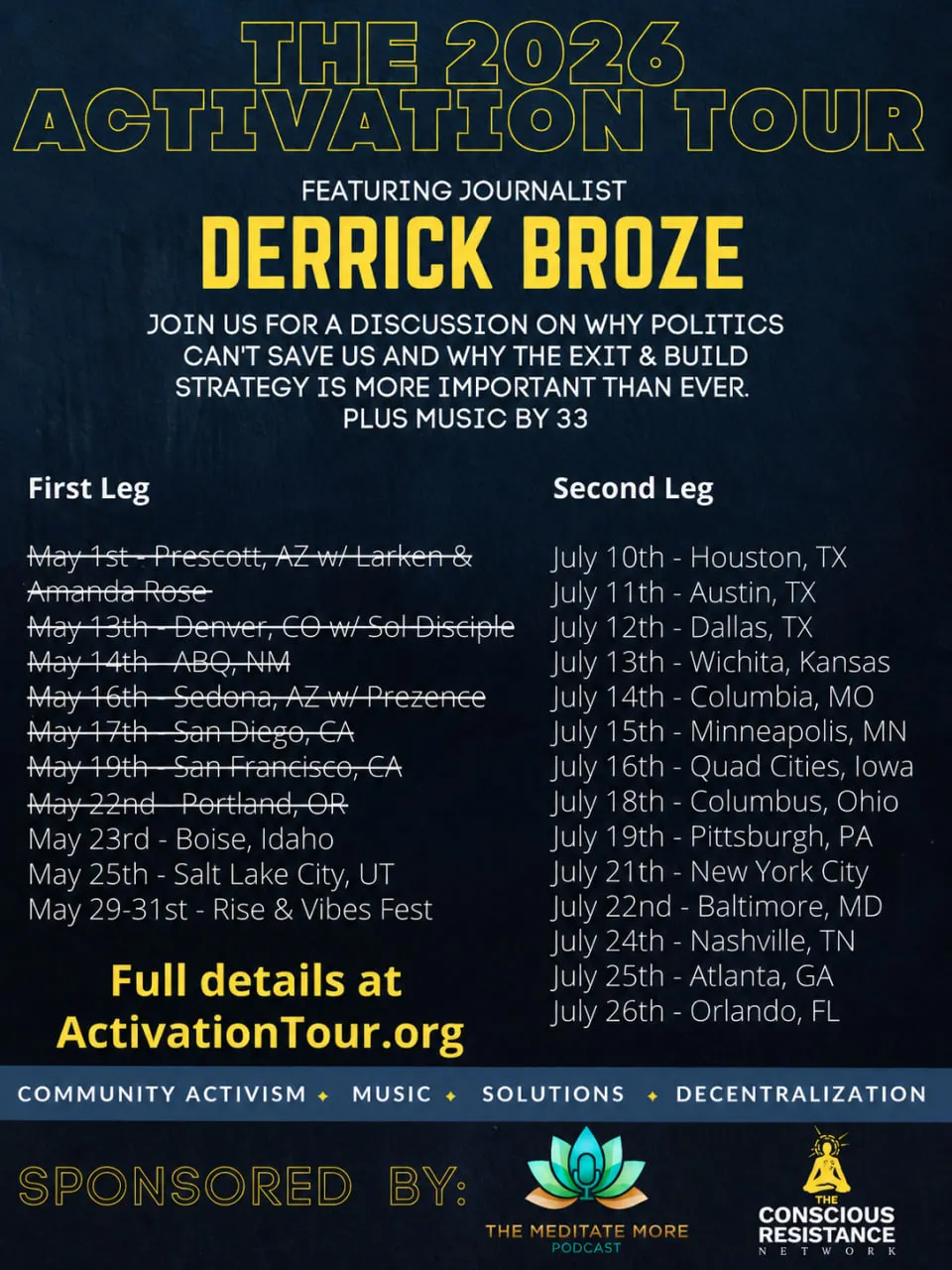
Some people come looking for advice about growing food or homeschooling. Others want to learn about privacy tools, alternative technology, local business networks, or how to reduce dependence on centralized infrastructure altogether.


One of the most encouraging parts of the tour, Derrick said, has been reconnecting with people he first met years ago who have now rebuilt major parts of their lives.
Some started homeschooling their children. Others bought land, built gardens, left Big Tech platforms, or created stronger local support networks that simply didn’t exist for them before.
What encouraged Derrick most was seeing people openly discuss both their successes and failures. They share mistakes, exchange ideas, offer practical advice, and help each other solve problems together in real time.
“The goal was never perfection. It was movement.”
The goal wasn’t waiting for some future political savior or endlessly consuming alarming headlines online. It was ordinary people slowly becoming harder to control by becoming less dependent.
Derrick believes those real-world relationships may matter more than ever in the years ahead.
“I know that us coming together and having these conversations is a big part of the solution.”
That belief is ultimately what the Activation Tour is built around: reconnecting people in the real world before isolation, dependence, and passivity become permanent.
For viewers interested in learning more, upcoming cities and event dates are being updated regularly at ActivationTour.org.
#ad: Want protection from surveillance, hacking, and even electromagnetic threats?
Escape Zone’s elite Faraday bags block GPS, Bluetooth, RFID skimming, and EMF—perfect for phones, laptops, wallets, and more.
Their premium ballistic backpack even combines Faraday shielding with Kevlar armor, giving you the upper hand in an unpredictable world.
Want to shield your body, too? Try their EMF-blocking beanies and blankets—because protection shouldn’t stop with your phone.
Whether it’s for you, your family, or someone you love—don’t leave it to chance.
Shop now at escapezone.com/pulse and protect what matters most.
DISCLOSURE: This post contains affiliate links. If you make a purchase through them, we may earn a small commission at no extra cost to you. This helps keep our work independent. Thank you for your support.
We want to thank Derrick Broze (@DBrozeLiveFree) for joining us today—and more importantly, we want to thank you for watching and doing your duty to be informed when so many others choose not to.
Follow us (@ZeeeMedia and @VigilantFox) for stories that matter—stories the media doesn’t want you to see. We’ll be back with another show tomorrow. See you then.