
This article originally appeared on Jon Fleetwood’s Substack and was republished with permission.
Guest post by Jon Fleetwood
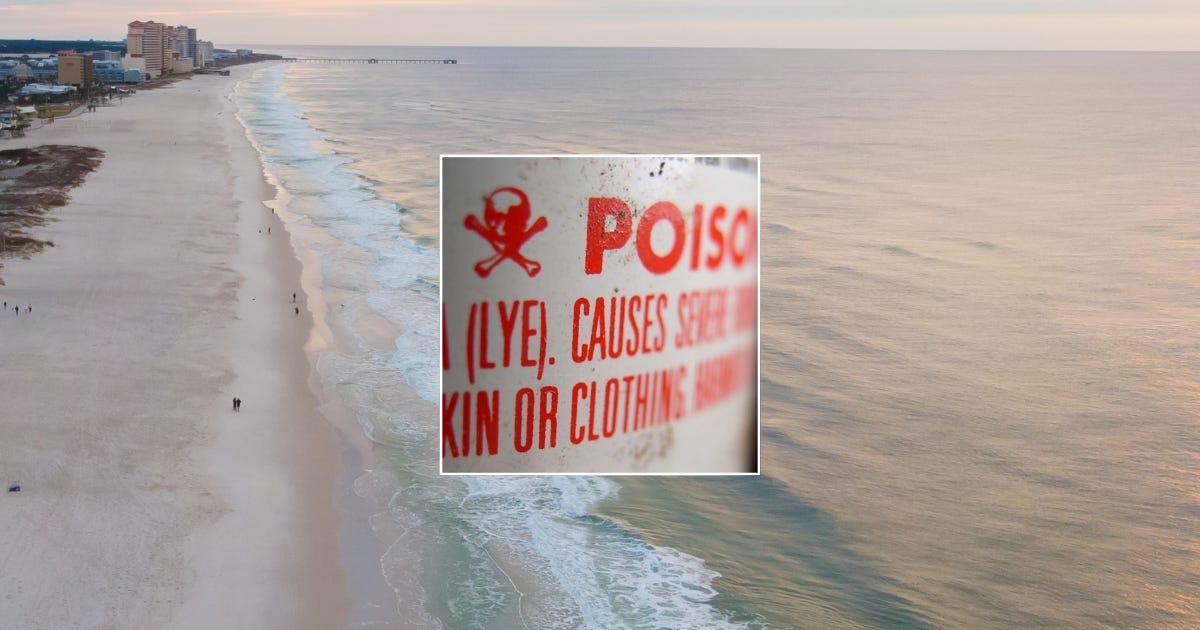
In a historic and deeply controversial federal action, the U.S. Environmental Protection Agency (EPA), alongside NOAA, NOAA Fisheries, and the U.S. Fish and Wildlife Service, authorized the first-ever permitted ocean geoengineering experiment involving the release of approximately 65,000 liters—roughly 17,000 gallons—of 50% sodium hydroxide solution, commonly known as caustic soda or lye, into U.S. federal waters off the coast of Massachusetts.
The LOC-NESS (Locking Ocean Carbon in the Northeast Shelf and Slope) experiment, led by the Woods Hole Oceanographic Institution, involved dispersing this highly corrosive chemical mixture into the Wilkinson Basin, approximately 38 miles off Cape Cod.
According to the group:
“In August 2025, the LOC-NESS team conducted an engineered, six-hour dispersal in the Wilkinson Basin area of the Gulf of Maine. Highly purified sodium hydroxide, commonly used to adjust the pH of drinking water, was introduced into the surface waters of the Wilkinson Basin area of the Gulf of Maine along with a red tracer dye known as Rhodamine Water Tracer (RWT).”
The move was an attempt to artificially increase ocean alkalinity and enhance carbon dioxide absorption as part of climate intervention research.
This marks a major escalation in government-sanctioned environmental intervention, directly implicating core health freedom principles: the public was not individually consulted on the chemical alteration of shared waters, fisheries, or potential downstream food systems, despite the ocean’s direct relationship to seafood supplies, ecological systems, and broader environmental exposure.
The EPA (contact) is headed by Lee Zeldin, NOAA (contact) by Neil Jacobs, and U.S. Fish and Wildlife Service (contact) by Brian Nesvik.
Federal Agencies Quietly Approved the Chemical Dump
According to EPA permit documents, the agency issued Permit No. EPA-HQ-MPRSA-2024-002 after public comment periods and consultations with NOAA Fisheries and the U.S. Fish and Wildlife Service, ultimately concluding that the experiment would not “unreasonably degrade or endanger human health.”
NOAA and NOAA Fisheries provided direct monitoring support and regulatory consultation under federal environmental laws, while Massachusetts state fisheries representatives and industry observers were also involved.
The project was additionally supported through broader federal marine carbon dioxide removal strategies, effectively creating government legitimacy for future ocean chemical intervention programs.
Sodium Hydroxide: CDC Documents Severe Corrosive Hazards
While framed as a climate mitigation tool, sodium hydroxide is not benign.
According to CDC/ATSDR toxicological guidance:
Sodium hydroxide is “very CORROSIVE”
Causes severe burns to skin and tissues
Can permanently damage eyes and cause blindness
Inhalation can trigger swelling of the larynx and fluid accumulation in the lungs
Ingestion can perforate the gastrointestinal tract, induce shock, and even death
No antidote exists for sodium hydroxide exposure
The CDC further warns:
“Spilling sodium hydroxide over large areas of the skin or swallowing sodium hydroxide may cause shock and even death.”
Although researchers diluted and tracked the release, the chemical itself remains an industrial drain cleaner-grade alkaline compound with well-established hazardous properties.
Ecological & Food Chain Unknowns Remain
Preliminary project data claimed no immediate measurable short-term harm to plankton or larvae in the tightly controlled test zone, but critical uncertainties remain:
Adult fish impacts were not fully assessed
Long-term seafood contamination risks remain unknown
Trace metal release and mineral residue accumulation remain potential concerns
Large-scale replication would require vastly larger quantities of chemical deployment annually
Critics warn this could establish precedent for future large-scale federal environmental modification without meaningful democratic oversight.
Health Freedom & Environmental Consent
The core health freedom issue is broader than direct toxicity alone.
The operation represents federal agencies authorizing deliberate chemical modification of public environmental systems—waters, ecosystems, fisheries, and potentially food chains—without direct public consent.
For many Americans, health freedom is not limited to vaccines or pharmaceuticals, but extends to bodily autonomy regarding environmental exposures, food systems, and chemical interventions that may indirectly affect public health.
By approving this experiment, federal agencies effectively treated U.S. waters as a live geoengineering laboratory.
Bottom Line
The EPA and NOAA’s approval of 17,000 gallons of caustic lye dumped into U.S. federal waters marks a major precedent: federal regulators have now formally greenlit chemical geoengineering deployment in American oceans under the banner of climate intervention.
Whether presented as scientific progress or environmental necessity, the move raises questions about government authority, informed consent, ecological safety, seafood security, and the expanding normalization of large-scale environmental manipulation.
Copyright 2026 Jon Fleetwood

First chem-trails & now this. They couldn’t model climate change but think they can control it. Messing with nature is a good way to get burnt because there is so much involved that we don’t truly understand
All the more reason to drink R-O (Reverse-Osmosis) or distilled water only, instead of tap water.
You can put back removed minerals in other ways