
This article originally appeared on The Defender and was republished with permission.
Guest post by Michael Nevradakis, Ph.D.
In a Dec. 30, 2025, memo to state health officials, the Centers for Medicare & Medicaid Services said it “does not tie payment to performance on immunization quality measures in Medicaid and CHIP at the federal level.” U.S. Health Secretary Robert F. Kennedy Jr. said the new policy protects medical freedom and informed consent.
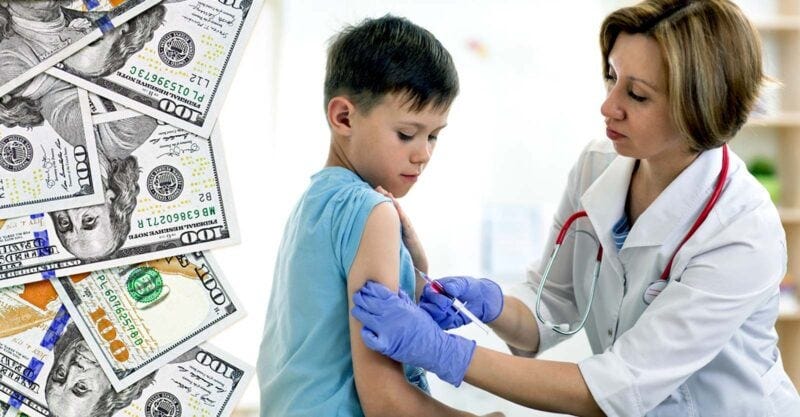
The federal government will stop paying physicians based on the number of patients they vaccinate, and is urging state health agencies to stop using similar financial incentives.
In a Dec. 30, 2025, memo to state health officials, the Centers for Medicare & Medicaid Services (CMS) said it “does not tie payment to performance on immunization quality measures in Medicaid and CHIP [Childhood Health Insurance Program] at the federal level.”
Under the new policies, CMS will no longer require states to report how many children are vaccinated, but states may continue to voluntarily provide the data.
CMS stated it will explore options to more strongly encourage informed consent before vaccination and “will also explore how religious exemptions for vaccinations can be accounted for in the data and the subsequent measures.”
U.S. Health Secretary Robert F. Kennedy Jr. welcomed the new policy in a post on X, stating that it protects medical freedom and informed consent.


“This directional change coming from CMS is welcome,” said Mary Holland, CEO of Children’s Health Defense. “It helps to put vaccines back into the category of every other medical intervention, which is where they should be.”

Writing on Substack, research scientist and author James Lyons-Weiler, Ph.D., called CMS’s new policy “the most consequential federal policy reversal on pediatric vaccine incentives” in recent years and “the beginning of a long-overdue rebalancing.”
Pediatrician Dr. Michelle Perro said the new policy restores ethics and trust in the practice of vaccinating children.
“Any time a clinician’s compensation is tied to a specific medical decision, especially one involving children, families reasonably ask, ‘Is this recommendation for my child, or for a metric?’ Even the appearance of a conflict can erode trust, and trust is the foundation of pediatric care and informed consent,” Perro said.
‘Financial incentives distort medical judgment’
Writing for the Gold Report, journalist Yudi Sherman of America’s Frontline News said the system of financial incentives tied to physicians’ vaccination rates “has long been controversial” and has adversely affected pediatric practice.
“Parents have complained for years that financial incentives distort medical judgment, leading to high-pressure tactics around childhood vaccinations. Some say doctors push shots parents believe are unnecessary or unsafe. Others report being dismissed from pediatric practices altogether if they decline vaccines,” Sherman wrote.
According to Sherman, the system of financial incentives for vaccinating children “could be surprisingly lucrative.” She cited CMS data showing that the agency paid physicians about $45 for each dose of the COVID-19 vaccine administered to a child through Medicare.
“Administer the shot at home, and that came with another $40. All told, a doctor could earn around $85 for a single COVID-19 shot, with the shot itself supplied at no cost by the federal government,” Sherman wrote.
“Roughly half of doctors” are beneficiaries of these incentives, “known as value-based contracts.” “They reward physicians with lump-sum payments for hitting specific metrics, such as vaccination rates. Because those rates are calculated as percentages, doctors who want to keep their numbers high sometimes avoid seeing unvaccinated children altogether.”
Pressure on physicians to accept such financial incentives is strong, according to a 2021 paper co-authored by Lyons-Weiler and Dr. Paul Thomas, published in the International Journal of Vaccine Theory, Practice, and Research.
According to Lyons-Weiler, that paper, based on a 30-day billing analysis at a large pediatric practice in Oregon, “where informed consent is genuinely respected,” showed that “refusal of CDC-scheduled vaccines by patients resulted in projected annual losses exceeding one million dollars in one practice — primarily from forgone administrative fees.”
“This was not hypothetical. It was a documented, measurable penalty for practicing medicine with integrity,” Lyons-Weiler wrote.
According to Dr. Meryl Nass, founder of Door to Freedom and a former internist, pediatricians often rely on these financial incentives to supplement their income, even though these incentives damage the doctor-patient relationship by prioritizing the needs of insurance companies and the government.
“I have been told that pediatricians rely on vaccine payments and bonuses to stay in the black,” Nass said. “Pediatricians are supposed to be the lowest paid of all doctors. This will eventually have a huge impact on the practice of pediatrics.”
Retired pediatrician Dr. Samara Cardenas said pediatricians receive financial incentives not just from federal and state government sources, but also from insurers. According to Cardenas, the incentives are designed to increase childhood vaccination rates.
“It has been since the late 90s, when HMOs were founded. They started doing that because they really wanted to get the patients vaccinated … so there was always a monetary incentive for doctors to do it because they get paid so little,” Cardenas said.
According to figures from Georgetown University’s Center for Children and Families, approximately 40% of U.S. children are covered by Medicaid. Cardenas said doctors who treat Medicaid patients “get paid a good amount for doing vaccinations” — approximately “25 cents on a dollar.”
“It doesn’t look like a lot, but when you have 2,000 patients and you do all your vaccinations, you get a good amount of money,” Cardenas said.
Cash incentives to vaccinate kids contributed to chronic disease epidemic
Tying payment to vaccination rates can harm pediatrics in several predictable ways, Perro said.
It can distort the clinical conversation by bypassing shared decision-making between physicians, patients and their families. It erodes trust in pediatric guidance more broadly. And it creates an administrative burden for pediatric practices that have to complete the paperwork required to receive reimbursements.
Perro added that pediatricians who opt out of these incentives face a “competitive disadvantage” compared to pediatricians who accept such incentives.
Holland said the incentives have contributed to the growing childhood chronic disease epidemic in the U.S.
“These perverse financial incentives to vaccinate children have warped the practice of medicine, putting bonus payments for meeting arbitrary thresholds over an individual child’s health,” Holland said. “We have seen the damage with an exceptional rate of childhood chronic disease.”
States would still be allowed to provide their own financial incentives to doctors. Internal medicine physician Dr. Clayton Baker said it is likely that “states with predominantly Democrat state politics and deeply Pharma–captured medical establishments” will ignore CMS by continuing to incentivize pediatricians.
However, “this change by CMS may … provide medical freedom-minded states greater impetus to stop this practice altogether within their jurisdiction,” Baker said.
Cardenas said pediatricians have a responsibility to provide quality care despite the elimination of federal financial incentives for vaccinating children.
“The good doctors will do a good job regardless of money,” Cardenas said.
Related articles in The Defender
‘Informed Consent Is Back’: New COVID Vaccine Recommendations Give Families More Say
‘I Will Not Do Harm’: Pediatrician Suing CDC Explains Decision Not to Give COVID Vaccines to Kids
MAHA Commission Outlines Sweeping Agenda to Target Chronic Disease
‘True Corruption’: Agency Capture Responsible for Chronic Disease Epidemic in U.S.
‘Dangerous Games’: States Defy Federal Agencies, Create Their Own COVID Vaccine Rules
Donate to Children’s Health Defense

MASSIVE amounts of money - paid to a very high-earning cohort and clearly corrupting the practice of medicine.
More waste/fraud by the government.
And I can guarantee you that Big Pharma plays a role here.
What an absolute disgrace. They were paying GP's in the UK to administer the poison covid shot initially.