This article originally appeared on The Defender and was republished with permission.
Guest post by Michael Nevradakis, Ph.D.
The WHO is partnering with Temasek, a firm owned by the Singapore government that participated in a $250 million investment in BioNTech in June 2020 — a few months before BioNTech released a COVID-19 vaccine in conjunction with Pfizer. Temasek will help the WHO develop “interoperable digital health wallets.”
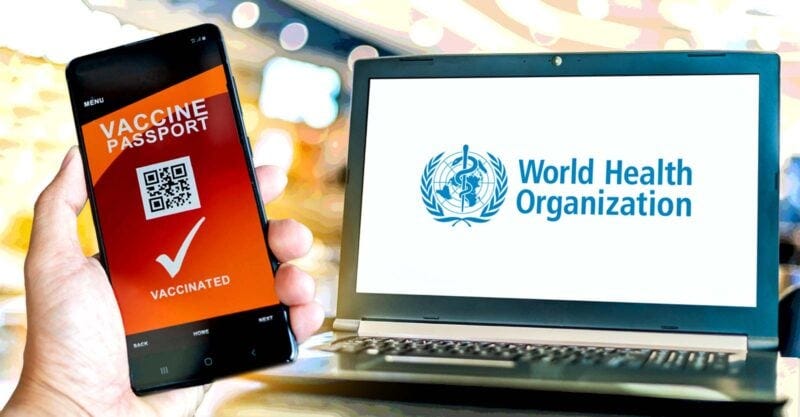
Five years after digital vaccine passports were introduced during the COVID-19 pandemic, the World Health Organization (WHO) is partnering with an investment firm linked to COVID-19 vaccine maker BioNTech and the Gates Foundation to roll out “interoperable digital health wallets.”
The WHO announced earlier this week that it is partnering with Temasek, a firm owned by the Singapore government that participated in a $250 million investment in BioNTech in June 2020 — a few months before BioNTech released a COVID-19 vaccine in conjunction with Pfizer.
The initiative “builds on lessons from the COVID-19 pandemic, which demonstrated the urgency of reliable, verifiable digital health documentation,” the WHO said.
The initiative will begin with digital international certificates of vaccination or prophylaxis and will later expand to “broader personal health summaries.” It will be piloted in the 11 member states of the Association of Southeast Asian Nations to develop a “replicable model” for potential export to other countries.
The initiative is a result of last year’s amendments to the WHO’s International Health Regulations (IHR), which called for “globally recognized digital health certificates.”
Kee Kirk Chuen, Temasek’s head of Health & Well-being, said the COVID-19 pandemic “showed how important it is for health records to be trusted, verifiable and able to travel with people across borders.”
But Natalie Winters, co-host of “Bannon’s War Room,” countered that the WHO is attempting to formalize what was once touted as a temporary response to the pandemic.
“During COVID, digital health verification systems determined whether people could travel, work, or enter public spaces based off vaccination status,” Winters wrote on Substack. “Those systems were justified as temporary. Now they are being formalized into something much broader and far more durable.”
Dr. David Bell, a public health physician, biotech consultant and senior scholar at the Brownstone Institute, said private interests are driving the WHO’s initiative.
“The WHO is required to concentrate on vaccine passports as they are important from an investment viewpoint to its major funders, who fund the WHO through voluntary specified funding — meaning the WHO is required to follow the directions of the funder.”
Bell said major WHO funders, including the Gates Foundation, “have direct financial interests in increasing the use of both vaccines and digital platforms.”
‘A clear conflict of interest’
Winters argued that Temasek’s involvement in the WHO’s initiative “adds a clear conflict of interest.”
In June 2020, Temasek and other investors poured $250 million into BioNTech, a German biotechnology company. According to a BioNTech press release, the investment would boost the company’s efforts to develop “patient-specific immunotherapies for the treatment of cancer and infectious diseases.”
Reuters noted at the time that BioNTech was developing an “experimental vaccine against the coronavirus with pharmaceutical giant Pfizer.’’
According to a 2021 Asia Business Council report, Temasek’s investment in BioNTech “is just one example of how the government-owned but private-sector-oriented company went full out as an investor and a steward to fight the coronavirus.”
On its website, Temasek states that “sustainability is at the core of everything we do.”
But the company’s current and former investment portfolio reveals an extensive history of investing in pharmaceutical companies and digital health providers.
In 2021, Temasek, through its digital identity subsidiary Affinidi, developed and piloted Unifier, a universal verification system for authenticating COVID-19 vaccination and test results across different QR code standards.
That same year, Temasek helped lead a $700 million investment round for Chinese pharmaceutical company Abogen Biosciences, with the funds used to advance the company’s mRNA COVID-19 vaccine candidate to late-phase trials.
In 2010, Temasek formed a joint venture with U.S. pharma company Emergent BioSolutions to develop a “broad spectrum pandemic flu vaccine and therapeutic.”
Temasek has investments in Clover Biopharmaceuticals, a Chinese company that developed candidate COVID-19 vaccines, Celltrion Inc., a South Korean biopharmaceutical firm that developed therapies for COVID-19, and Novotech, a clinical research organization that specializes in clinical trials for drugs and vaccines.
Temasek is also an investor in major tech and financial firms that are involved in health-related technologies.
This includes Amazon — which, through Amazon Web Services, is involved with the Vaccination Credential Initiative, a backer of the SMART Health Card, which several states and countries used as a vaccine passport during the COVID-19 pandemic.
Docket, a digital vaccine record app, also uses SMART Health Card technology in some states. Nathan Scott, Docket’s chief technical officer, was previously affiliated with Amazon and Amazon Web Services.
During the COVID-19 pandemic, BlackRock — one of the world’s “Big Three” asset managers and a shareholder in COVID-19 vaccine makers Pfizer, Moderna and Johnson & Johnson — was among the top 10 shareholders in dozens of corporations mandating vaccines for their employees.
One of those companies is Mastercard. During the pandemic, Mastercard supported the Good Health Pass vaccine passport initiative, with backing by the Gates Foundation-linked ID2020 Alliance. Temasek is an investor in Mastercard.
In 2021, Mastercard promoted technology to track people’s “personal carbon allowance.”
Bell said that while it is reasonable for an investment firm like Temasek to invest in pharmaceutical companies, “it obviously should exclude them from participating with WHO in activities that directly improve their subsequent return on investment.”
“This is a really basic conflict of interest that would be a no-go for any ethical public health program, as their duty as an investment house is to maximize return on investment from the companies they have invested in. This is obviously likely to be contrary to what populations need to improve health,” Bell said.
The Singaporean government was a “pioneer” in the development of COVID-19 tracking and tracing apps, according to a 2020 article in Media International Australia. The government later exported the technology to other countries.
Temasek’s ties to Gates Foundation, Gates-linked Gavi, the Vaccine Alliance
Temasek also maintains direct collaborative ties with the Gates Foundation — and the Gates-linked Gavi, the Vaccine Alliance.
For instance, the Philanthropy Asia Alliance — Temasek’s charitable arm — lists the Gates Foundation as one of its early core members, according to Bloomberg.
In 2022, Temasek invested in Select, a fund launched under Breakthrough Energy Ventures, a climate-focused investor founded by Gates. Yahoo! Finance reported at the time that Temasek was “already an existing co-investor to several other Gates-backed ventures.”
In 2024, Breakthrough led investment in “climate vaccines” to reduce carbon emissions from cows.
Last year, the Gates Foundation opened a Singapore office — which Gates announced at the Philanthropy Asia Summit organized by Temasek Trust’s Philanthropy Asia Alliance.
Temasek has also partnered with Gavi on vaccination programs in Southeast Asia. According to a 2025 Gavi press release, Temasek partnered with the Clinton Health Access Initiative and the UBS Optimus Foundation on a $4.5 million initiative “to reach zero-dose and under-immunized children” in Indonesia.
The Gates Foundation funded Gavi’s launch in 1999 and holds a permanent seat on its board. Gavi is listed by the WHO as an official “stakeholder.”
Last year, Temasek’s Philanthropy Asia Alliance helped launch the Climate and Health Funders Coalition — along with the Gates Foundation, Rockefeller Foundation and Bloomberg Philanthropies. In 2024, Temasek, the Rockefeller Foundation and BlackRock joined a new infrastructure investment initiative in Southeast Asia.
“Increasing sales of vaccines directly improves return on investment where such investments exist in vaccine manufacturers, such as is the case of the Gates Foundation and its owners,” Bell said. “And it improves profits for private pharmaceutical corporations that contribute to the public-private partnerships.”
Digital ID ‘the end of privacy, anonymity and liberty’
Before the U.S. exited the WHO, which was announced last year and formalized in January, the U.S. was its largest individual funder. The next two? The Gates Foundation and Gavi.
During the COVID-19 pandemic, the WHO repeatedly pushed for a pandemic agreement or treaty — which it achieved last year — and amendments to the IHR. The WHO passed a set of IHR amendments in 2024. They took effect in September 2025.
Those amendments included a recommendation for the development of digital health certificates. The WHO cited the amendments when announcing its collaboration with Temasek.
In 2023, the WHO and the European Commission — the executive branch of the European Union — launched a “landmark digital health partnership” marking the beginning of the WHO Global Digital Health Certification Network (GDHCN).
The digital passes that the WHO will develop in partnership with Temasek will use the GDHCN standard.
Independent journalist James Roguski said he warned two years ago that the WHO’s efforts to pass the IHR amendments would lead to a push for global health passes.
“Nations may be somewhat constrained in their abuse of their own citizens by their constitutions, charters of rights, or laws,” Roguski said. “But numerous articles within the IHR clearly state that sovereign nations are absolutely free to disregard and abuse the rights, freedoms and health of travelers who may be visiting from other countries.”
Tim Hinchliffe, editor of The Sociable, said that for Gates and other unelected globalists, globally interoperable vaccine passports serve a couple of purposes.
“First off, there’s a lot of money in getting everyone in the world to get injected with their products. It’s a great return on investment. Secondly, vaccine passports further the agenda to get everybody in the world pegged to a digital identity scheme,” Hinchliffe said.
He cited a 2022 World Economic Forum report acknowledging that vaccine passports are a type of digital identity.
“With that type of power and influence, the powerful interest groups then set up their digital control grid, because mandating proof of vaccination means mandating digital ID. When digital ID is mandated, it is the end of privacy, anonymity and liberty,” Hinchliffe said.
Related articles in The Defender
‘Defining Moment in Human History’: U.S. Rejects WHO’s International Health Regulation Amendments
WHO Passes ‘Watered-down’ IHR Amendments, Plans to Revisit Pandemic Treaty ‘Within a Year’
‘Death Sentence for Millions’: WHO, EU Launch New Global Vaccine Passport Initiative
‘Creating a Digital Prison’: WHO Rushes Ahead on Global Digital Health Certificates
UN Launches Gates-Funded Global Digital ID Program as Experts Warn of ‘Totalitarian Nightmare’
Corporate Vaccine Mandates and Vaccine Passports — Brought to You by BlackRock and Vanguard?
Donate to Children’s Health Defense