


The following information is based on a report originally published by A Midwestern Doctor. Key details have been streamlined and editorialized for clarity and impact. Read the original report here.
In 1982, an NBC affiliate station in Washington, D.C., produced a documentary called “DPT: Vaccine Roulette.”
It got such a huge reaction, the station re-aired it twice. The big NBC promoted it. It even won an Emmy.
All because it asked one vital question: Is the DPT vaccine more dangerous than the disease itself?
44 years later, a film like this would never win an Emmy, never be funded by mainstream television, nor receive positive media coverage. You can’t even watch the film on YouTube anymore.
The question we have to ask is: why?
Did the evidence change… or something else?
There was a time when vaccine injury wasn’t treated as a forbidden topic.
It was treated as news.
NBC, CBS, ABC, CNN, Fox, CNBC, local stations, talk shows, and even European broadcasters aired lengthy segments about paralyzed children, neurological injury, conflicts of interest, hot lots, mandates, regulatory failure, and more.
Most people forgot about it or don’t even know that used to be the norm.
Today, a single skeptical segment about vaccine safety can be framed as reckless and even deadly misinformation.
But for decades, mainstream TV interviewed injured families, challenged officials, and aired data the agencies did not want discussed.
This information comes from the work of medical researcher A Midwestern Doctor. For all the sources and details, read the full report below.
Vaccine Amnesia: Why Did The Media Stop Covering Vaccine Disasters?

This doesn’t mean every vaccine claim is settled or that no vaccine can ever have a role in public health.
This is about memory.
A society cannot evaluate risk honestly if one side of the risk ledger literally disappears from public view and from memory.
Benefit can exist. Harm can exist. Institutional failure can exist.
The problem begins when only one of those realities is allowed on television.

What happened with the media is fairly recent, but the bigger pattern is nothing new.
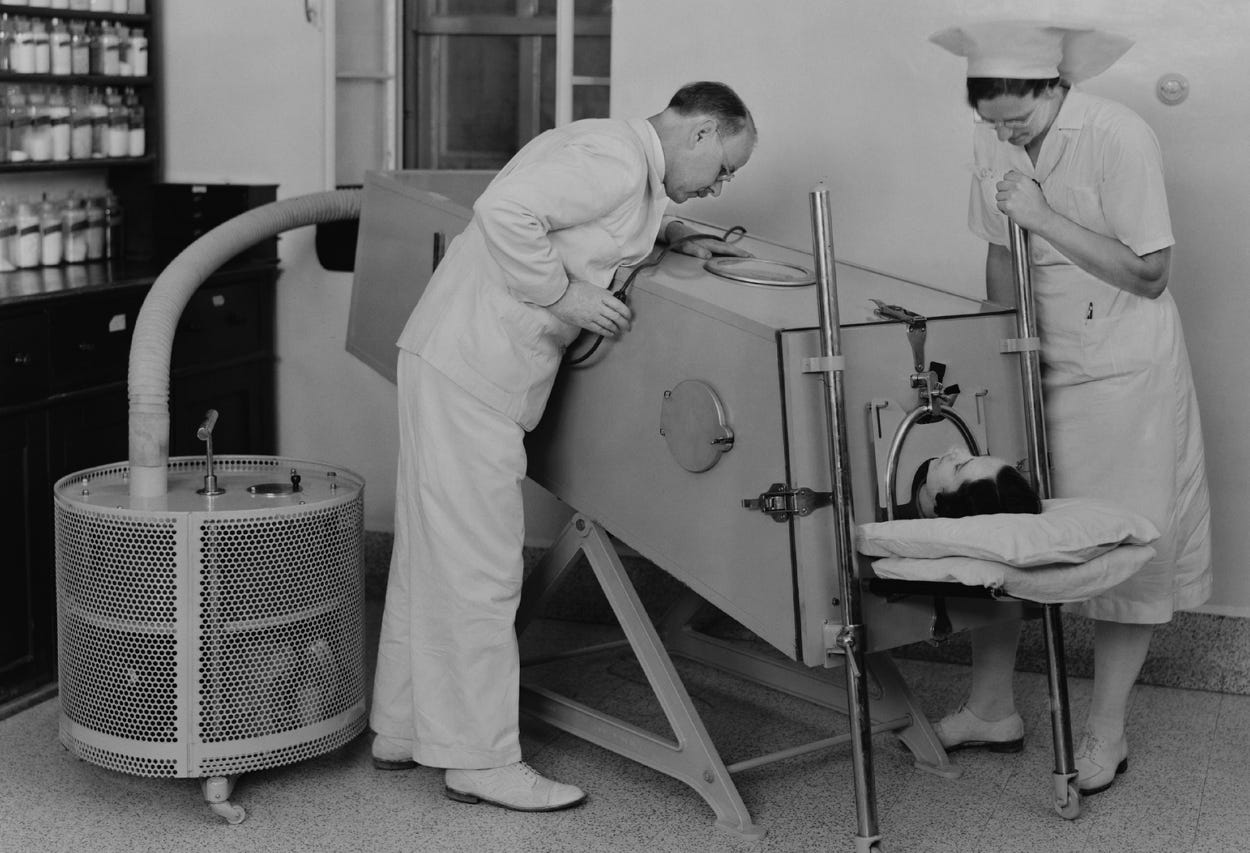
After the 1955 Salk polio rollout, reports emerged of children paralyzed in the limb that received the shot. The episode became known as the Cutter incident.
But the deeper issue was larger than one manufacturer.
Regulators had allowed companies to carry enormous responsibility for proving safety, production methods had changed during scale-up, and the public had been assured the vaccine was safe before the failures were fully understood.
That became the template.
Then came SV40.
A government scientist, Bernice Eddy, reportedly warned that polio vaccines were contaminated with SV40, a monkey virus she believed posed cancer risks.
She was told not to disclose it.
By the time the production process changed, estimated American exposure was 40 million to 98 million people.
Whatever one concludes about long-term causality, the public-health question is unavoidable: how does a contamination signal that large become something most Americans have never heard of?

The most disturbing part of the full breakdown is not one disaster.
It is the repetition: warning, denial, injury, media exposure, public outrage, institutional retreat—then forgetting.
Vaccine Amnesia: Why Did The Media Stop Covering Vaccine Disasters?
A key admission from that era matters. The concern was not only whether a vaccine was safe. It was whether public doubts about safety—valid or invalid—could reduce uptake.
That’s a very different incentive structure.
Once confidence becomes an operational requirement, safety questions stop being neutral questions. They become threats to the program.
And when a regulator becomes invested in public compliance, its role can quietly shift from independent watchdog to narrative manager.

Then 1976 happened.
Swine flu was framed as the next 1918 pandemic. A rushed national campaign followed.
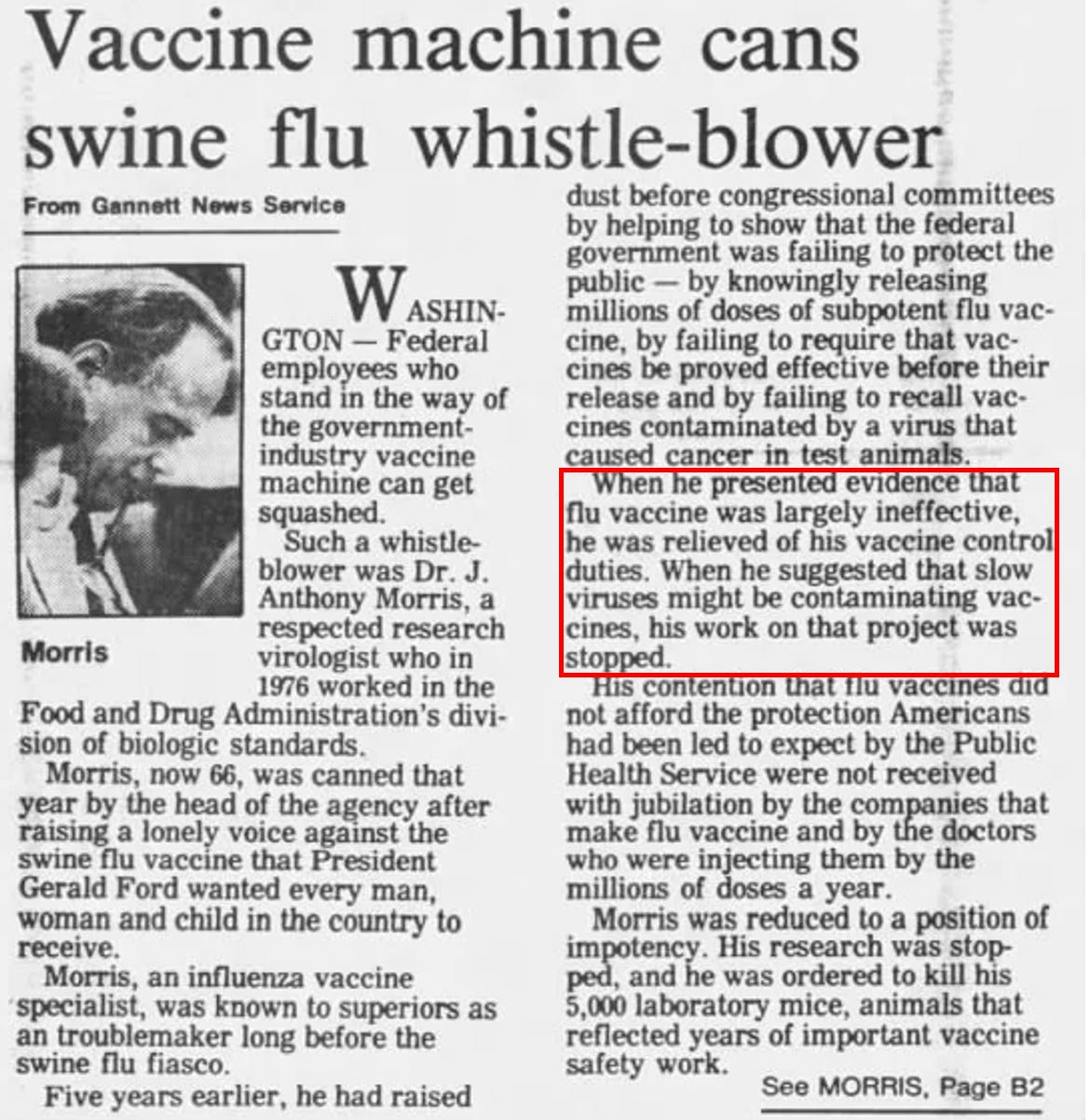
FDA vaccine officer Joseph Morris warned that the shot was unnecessary, weak, and unsafe. But his concerns were ignored.
After rollout, Guillain-Barré paralysis cases appeared. Deaths were reported. Thousands of lawsuits followed.
The disease threat faded. The vaccine campaign became the story.
That is why the 1976 swine flu fiasco remains one of the clearest examples of fear-based emergency medicine outrunning evidence.
What made the swine flu fiasco historically important was not just the injury count.
It was the media response.
In 1979, 60 Minutes openly questioned government decision-making, fear-based messaging, and vaccine safety assurances.
The segment did not treat injured people as dangerous anecdotes. It treated them as evidence worthy of investigation.
That kind of broadcast would be almost unimaginable now—not because the questions disappeared, but because the acceptable boundaries of journalism changed.
The same pattern appeared with DPT.
In 1982, NBC aired DPT: Vaccine Roulette, a program about seizures, brain damage, and parents who believed their children were harmed by the shot.
The broadcast did something modern coverage rarely allows: it gave families enough time to explain what happened, showed the human cost, and placed official reassurance next to parental testimony.
It didn’t ask viewers to blindly accept the government or blindly reject medicine.
It simply asked whether the public was being told the whole truth.
That is why these broadcasts mattered—why the truth matters.
These broadcasts didn’t merely report on injury.
They literally connected the injured with each other.
After Vaccine Roulette aired, families across the country contacted NBC because they realized their child’s reaction was not necessarily an isolated tragedy.
That changed everything.
Once parents could compare stories, the problem moved from private grief to public evidence. The PR problem was not just injury.
It was injured people discovering each other.
Through the 1980s and 1990s, the topic remained on air.
Donahue hosted a public debate. ABC and CNN aired DPT segments. NBC revisited hot lots. Lifetime covered vaccine injury. Barbara Loe Fisher became one of the rare recurring national voices challenging mandates and defending parental choice.
This matters because it shows the debate was not invented by the internet.
The controversy existed before social media, before alternative platforms, and before today’s misinformation framework.
Mainstream television once considered it legitimate enough to broadcast.
Then the issue grew.
ABC’s 20/20 covered hepatitis B concerns in newborns, including the obvious question of why a vaccine aimed at a disease concentrated in higher-risk groups was being universally given at birth.
A Dallas station investigated the pneumococcal vaccine, including seizures, deaths, non-inert placebo concerns, and financial conflicts among officials involved in recommendations.
Again, the key point is not that every allegation was proven.
The key point is that journalists once investigated the whole structure: risk, incentives, testing, conflicts, and mandates.
The military even has its own version of this story.
The anthrax vaccine program became tied to Gulf War illness claims and service-member resistance. Later, the smallpox push after 9/11 ran into myocarditis concerns and poor risk-benefit questions.
These campaigns followed a familiar emergency template: invoke a terrifying threat, rush institutional compliance, minimize dissent, then treat the injured as obstacles to the mission.
In civilian life, that template is called public health.
In the military, it becomes an order.
Either way, the human cost disappears behind the slogan.
The core question is simple yet important.
When did vaccine injury stop being a public-interest story—and become something reporters were trained to avoid?
Vaccine Amnesia: Why Did The Media Stop Covering Vaccine Disasters?
Flu shots show the transition clearly.
CBS aired a segment on CDC data suggesting flu vaccination had not delivered the expected mortality benefit for seniors. ABC covered public pushback against New Jersey flu-shot mandates for children. CNN covered healthcare workers resisting forced flu and swine flu shots.
That coverage is important because it treated mandates as debatable.
Reporters were still willing to ask: What is the evidence? Who benefits? What happens to workers who refuse? What level of risk justifies coercion?
Those basic questions have largely vanished from journalism.
Autism coverage is especially revealing because the timeline contradicts the easy story.
Concerns about vaccine-related regression were appearing on Fox, CNN, ABC, CBS, and local stations in 1999 and 2000—before the public narrative hardened around the idea that one discredited paper created the entire controversy.
That matters.
The older broadcasts show parents describing rapid developmental decline, journalists discussing rising autism diagnoses, and officials promising more research.
The controversy was already visible on national television before it was later compressed into a single villain narrative.
Again, the point is not that every televised allegation proved causality.
The point is that the question was considered legitimate enough for mainstream journalists to ask.
That is a major distinction.
A serious society can investigate vulnerable subgroups without declaring all vaccines useless. It can study regression without mocking parents. It can examine conflicts of interest without becoming “anti-science.”
Former NIH leadership even acknowledged that a susceptible subset of children might exist and that the topic deserved research.
Then the subject became nearly untouchable.
Gardasil shows what happened as the window narrowed.
HPV vaccine concerns did surface—NBC debated mandates, CBS covered adverse-event reports, and a daytime talk show segment triggered intense backlash.
But compared with DPT or swine flu, the US media response was thinner, more cautious, and shorter-lived.
That’s the shift.
Earlier vaccine controversies generated long investigations, public debates, and recurring follow-up coverage. By the Gardasil era, negative coverage itself had become risky.
The story was no longer just whether girls were injured. It was whether media outlets could afford to ask that question in the first place.
By the COVID era, the media environment was transformed.
FOIA records showed HHS had purchased vaccine advertising from major networks, cable news, legacy newspapers, digital outlets, and local stations. Pharmaceutical advertisers were already central to the business model but this was a whole new level.
Former hosts later described vaccine-risk coverage as something that could get shut down fast.
That doesn’t require some secret conspiracy. It only requires aligned incentives.
A network needs sponsors. A public-health agency needs compliance. A drug company needs confidence. A reporter learns the boundaries.
Soon, silence looks natural.
This is why the old clips matter.
They’re not just history.
They’re evidence that today’s media rules were constructed—not inevitable.
Vaccine Amnesia: Why Did The Media Stop Covering Vaccine Disasters?
The mechanism is not mysterious.
A network depends on sponsors. A regulator depends on public compliance. A public-health agency fears hesitancy. A manufacturer fears liability.
Each institution has a different motive, but all can converge on the same outcome: fewer stories about harm.
No single person has to order a blackout. The incentives do the work.
Editors know which segments create problems. Producers know which guests are safe. Officials know which questions undermine uptake.
And eventually, the absence of coverage gets mistaken for the absence of evidence.

That creates a dangerous feedback loop.
Injuries are not covered, so the public hears fewer stories.
Because the public hears fewer stories, officials call injury claims rare, anecdotal, or internet-driven.
Then the lack of coverage becomes proof that there was never anything serious to cover.
This is how institutional amnesia reproduces itself.
The archive gets buried. The families are isolated. The old broadcasts disappear. A new generation is told the debate never existed.
And when people rediscover the clips, they are shocked by how normal the questions once were.
The most important word in this story is amnesia.
Not everyone has to reach the same conclusion about every vaccine to see the problem.
A free society should not need forgotten broadcasts to remember that medical products can help, harm, fail, be oversold, be rushed, be protected by institutions, and deserve scrutiny.
The old media didn’t always get it right. But at least it asked the questions.
Today’s media refuses to ask them at all.
That’s not progress.

Thanks for reading! This information was based on a report originally published by A Midwestern Doctor. Key details were streamlined and editorialized for clarity and impact. Read the original report here.
Vaccine Amnesia: Why Did The Media Stop Covering Vaccine Disasters?
For a deeper dive into what modern medicine has overlooked—or intentionally buried—check out these other eye-opening reports by A Midwestern Doctor:
The Truth About SSRI Antidepressants
The Hidden Dangers of Hospital Births & How to Protect Your Family
What’s The Healthiest Water To Drink?

While you’re at it, give A Midwestern Doctor a follow. No one brings more research, clinical insight, or historical context when it comes to exposing the health myths we’ve all been fed. This is easily one of the most valuable accounts you’ll ever follow.
If you haven’t subscribed to this Substack yet, take a moment to read what some of the most powerful voices in the medical freedom/truth movement have to say:
“The Vigilant Fox has been putting in a lot of work to create a news platform that shares the stories we want to hear about and brings attention to the most important things to know about. If you want a daily newsfeed in alignment with our ...”
– A Midwestern Doctor, The Forgotten Side of Medicine
“The Vigilant Fox absolutely is on top of things. We must support our fighters, and the Fox is fighting with truth.”
– Tom Renz, Tom Renz’s Newsletter
“Excellent capture of key video presentations on evolving pandemic science.”
– Peter A. McCullough, MD, MPH, FOCAL POINTS (Courageous Discourse)

The old media did get it right.
What changed?
The takeover of Big Pharma's massive Ad Bucks, made possible by Clinton's changing the law in 1997 to permit Pharma to advertise directly to the consumer.
Soon Pharma became the largest advertiser on TV, and media corporations quickly came to realise which side their champagne and caviar lifestyles were buttered on.
When the law is reversed, so will the incentive to hide the truth dissipate.
Compliments to the Vigilant Fox for this very well documented article 👊 thank you