This article originally appeared on ZeroHedge and was republished with permission.
Guest post by Tyler Durden
Summary
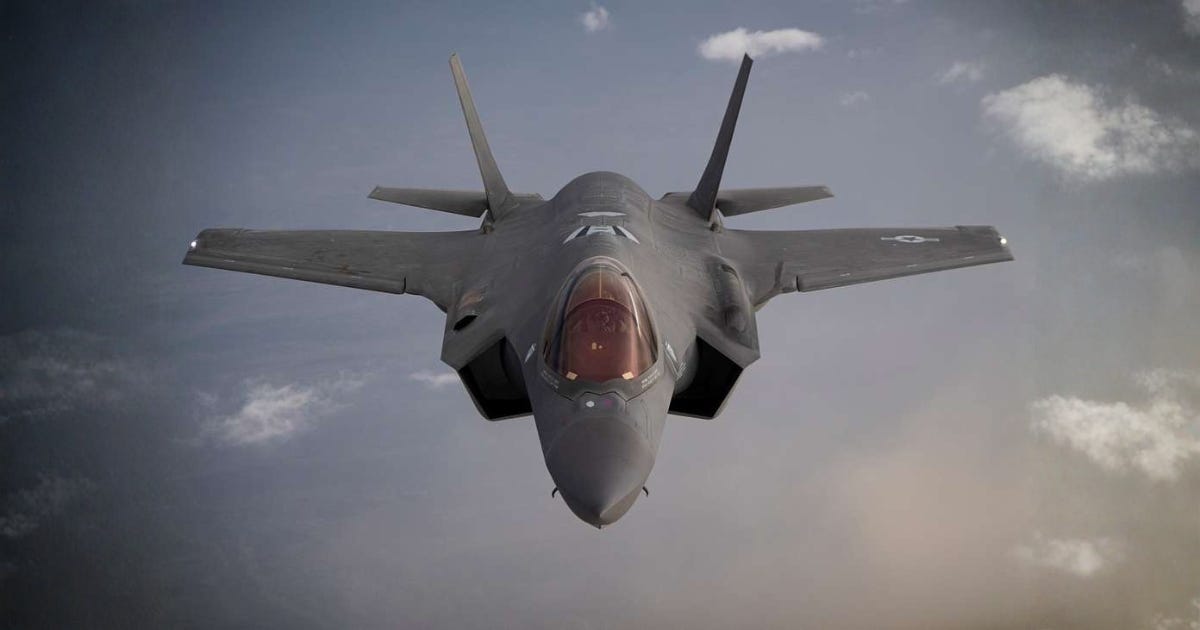
F-35 stealth jet takes on Iranian fire, emergency landing: CNN
Trump dials up threat, seeking leverage, denies approving Israeli Pars strikes; however, reports from The Wall Street Journal and Axios say the White House was aware. US sending more troops to region.
Energy war hits breaking point: Qatar’s Ras Laffan damaged, KSA, Kuwait, Bahrain sites attacked; Saudi trust in Iran “completely shattered.” Iran’s navy in the Caspian Sea reportedly destroyed. Missile strikes key Israeli refinery. Qatari PM confirms damage to 17% of Qatar’s LNG export capacity for three to five years.
Europe pushes off-ramp, refuses entry into conflict: Macron urges direct talks “reckless escalation,” while Friedrich Merz signals support for de-escalation—Brussels’ stance: “This is not our war.”
Iran signals not done exacting revenge: IRGC warns retaliation “not yet finished,” vowing escalating strikes across region as Gulf states, Iraq, and shipping lanes absorb widening fallout.
Strait of Hormuz a de facto economic war zone as prices rise at the pump with oil spiraling higher: Iran’s parliament is floating tolls on shipping - weaponizing control.
Europe’s Top Naval Powers See No Short-Term Path To Reopening Hormuz Chokepoint
European leaders are resisting Trump administration pressure to send warships to shadow tankers through the Hormuz chokepoint, citing the heightened risk of Iranian attacks and the lack of a clear U.S. strategy, according to Bloomberg.
UK Defense Minister Al Carns was quoted by the outlet as saying discussions on warship escorts in the Strait of Hormuz are in the “very early stages.”
Carns said allies are currently focused on “trying to conceptualize the totality of the problem and make sure that we’ve got a clear path toward the next stage.”
He warned that the conflict in the Middle East is raging on. The risk is that warship escorts aren’t enough to defend tankers from IRGC drone and missile attacks and naval mines. He said the situation requires a “deeply complex” multinational range of air, maritime, and strike capabilities.
UK Defense Secretary John Healey warned about Iranian naval mines in the Strait.
Earlier, President Trump said that Iran “is close to being demolished, the only thing is the strait: It’s very hard. You could take two people and they could drop little bombs in the water, and they’re holding things up.”
A partially paralyzed Hormuz has also been compounded with Israeli attacks on Iranian upstream energy assets, as well as retaliatory attacks by the IRGC on Qatar’s gas complex. Qatar has warned that its LNG export capacity could be severely hampered for years to come.
Qatar: Energy Strikes to Spark Serious Lasting Repercussions
Qatar’s Prime Minister Sheikh Mohammed bin Abdulrahman Al Thani confirmed on Thursday that there were no human casualties while assessing damages at the country’s main LNG export hub, Ras Laffan, which was struck by Iranian missiles. He went on to angrily dismiss Iran’s claim that it was actually targeting US bases, calling the narrative “rejected and unjustified”. Bloomberg: Iran’s strikes to this field has damaged 17% of Qatar’s LNG export capacity for three to five years. And a new alarming headline via Reuters:
QATARENERGY CEO TELLS REUTERS: WE MAY HAVE TO DECLARE FORCE MAJEURE ON LONG-TERM
CONTRACTS FOR UP TO FIVE YEARS FOR LNG SUPPLIES TO ITALY, BELGIUM, KOREA AND CHINA
US F-35 Hit By Iranian Fire, Damaged, In 1st of War
CNN is reporting that a US F-35 stealth fighter jet made an emergency landing at US air base in the Middle East, in an incident confirmed by the Pentagon.
Capt. Tim Hawkins, a spokesperson for US Central Command, said the advanced fighter was “flying a combat mission over Iran” when it was forced to make an emergency landing. CNN specifies it was based on taking fire from Iranian forces, while the Pentagon has been scant on details, only saying the warplane landed safely and the incident is under investigation.
“The aircraft landed safely, and the pilot is in stable condition,” Hawkins said. “This incident is under investigation.”
CNN underscores in its reporting, “The incident would be the first time Iran has hit a US aircraft in the war started in late February. Both the US and Israel are flying F-35s in the conflict; the aircraft costs upwards of $100 million.” However, March 1st saw three US F-16s go down over Kuwait, with six crew ejecting to safety, in what the Pentagon claimed was a ‘friendly fire’ incident. But it raised suspicions the Iranians shot them down.
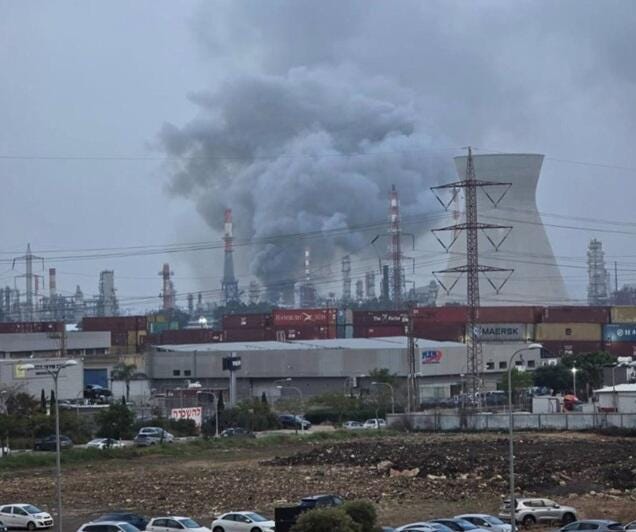
One regional war correspondent notes: “The Haifa refinery (Bazan) is the country’s largest and most critical fuel facility, supplying about 50–60% of national fuel (≈60% diesel, 50% gasoline).”
Pentagon: Operations Destroyed Whole Iranian Fleet in Caspian Sea; Key Israeli Refinery Struck
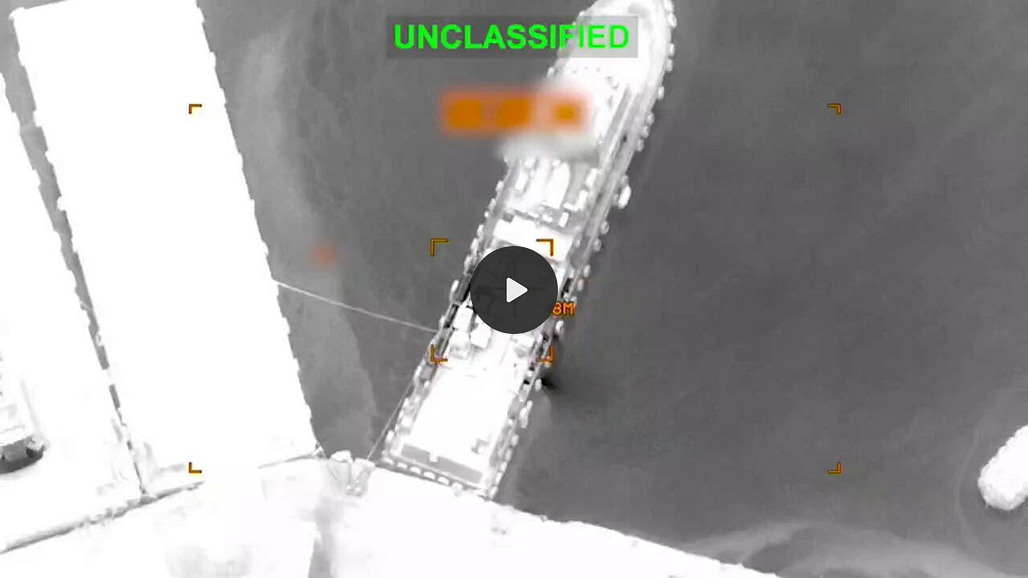
Hegseth announced in a Thursday morning Pentagon briefing that the US military - presumably alongside Israel - has completely destroyed Iran’s submarine fleet and significantly damaged the military ports of the Islamic Republic.
We reported earlier that Wednesday into overnight hours saw the first heavy Israeli attacks on vessels in the Caspian Sea, which marked a geographical expanse into the north. Meanwhile there are reports of a successful Iranian hit in the vicinity of Israel’s Haifa oil refinery:
ISRAEL’S BAZAN OIL REFINERIES HIT IN IRAN MISSILE BARRAGE: N12
US Sending More Troops To Region, Eyes Ultra-Risky Kharg/Hormuz Op
There remain few (or no) options for guaranteeing tanker traffic through Hormuz. After the Pentagon bombed some 90 military sites on Iran’s oil export hub Kharg Island last weekend, the US is running up against the obvious limitations of a purely air and naval campaign.
In a scenario that screams escalation, discussions now include deploying US troops directly to Iran’s coastline to secure the passage, per Reuters and others. The even more aggressive option is potential ground operations targeting Kharg - again given it is the nerve center handling roughly 90% of Iran’s oil exports. Of course, Trump strongly campaigned against such a scenario as ‘boots on the ground’ in a new regime change war. The admin has also been busy vowing ‘no quagmire’.
Trump Threatens To “Massively Blow Up” South Pars, Tries To Distance US & Israel Ops
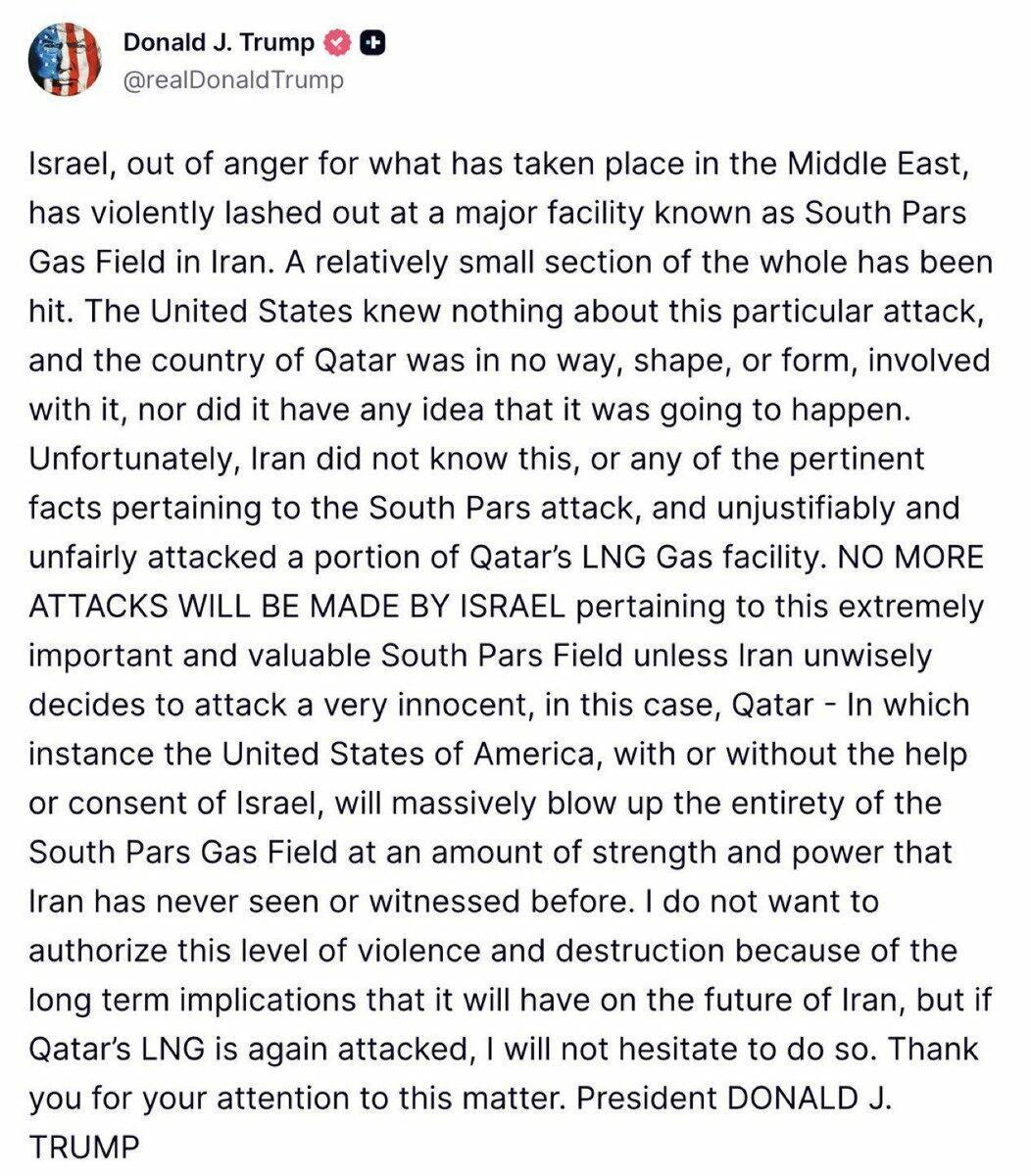
In a late-night Truth Social post, President Trump has once again cranked the rhetoric to eleven, warning he’ll “massively blow up” Iran’s crown jewel gas field if Tehran dares hit Qatar’s LNG infrastructure again. Trump insisted the US “knew nothing” about Wednesday’s Israeli strike on the shared South Pars field, claiming neither did Qatar, while simultaneously declaring “no more attacks will be made by Israel” there - unless Iran escalates.
Then came the kicker: “In which instance the United States of America, with or without the help or consent of Israel, will massively blow up the entirety of the South Pars Gas Field at an amount of strength and power that Iran has never seen or witnessed before,” he wrote.
However, US media reports have been quick to say otherwise - that the US did actually know about it and greenlit the risky escalation. The Wall Street Journal reports the White House was aware - and also Axios’ Barak Ravid insists so too, and he’s seen as very close to the Israeli government.
Heavy Air War Ongoing Amid Potential Energy Point of No Return
Meanwhile, the Gulf is still being lit up by tit-for-tat major attacks on energy, as Western populations brace for severe impact at the gas pumps. Iran’s retaliation is already hitting energy nodes across the region after Israel’s Wednesday South Pars strike, pushing tensions with neighbors past a potential point of no return. Qatar quickly expelled Iranian military attaches after missiles caused “extensive damage” at Ras Laffan - its main LNG export hub, while Saudi officials say “the little trust that remained in Iran has been completely shattered.”
The air war is continuing against Iran, with retaliatory strikes still raining down on Israel, but reportedly at slower pace when compared to the opening days of the war. A strike in western Iran’s Dorud county reportedly killed at least a dozen civilians, Al Jazeera has reported.
Iran Signals No Signs Of Stopping Revenge Attacks
Tehran, however, is signaling the opposite of de-escalation, perhaps seeing Trump’s latest Truth Social post claiming no foreknowledge of the Israeli attack on Pars as a sign of weakness. A spokesman for the IRGC Khatam has newly warned retaliation is “not yet finished,” adding:
“We warn the enemy that you made a major mistake by attacking the energy infrastructure of … Iran… the next attacks on your energy infrastructure and that of your allies will not stop until their complete destruction.”
Kuwait: Iranian drones attacked one of the largest oil refineries, Al-Ahmadi Refinery.

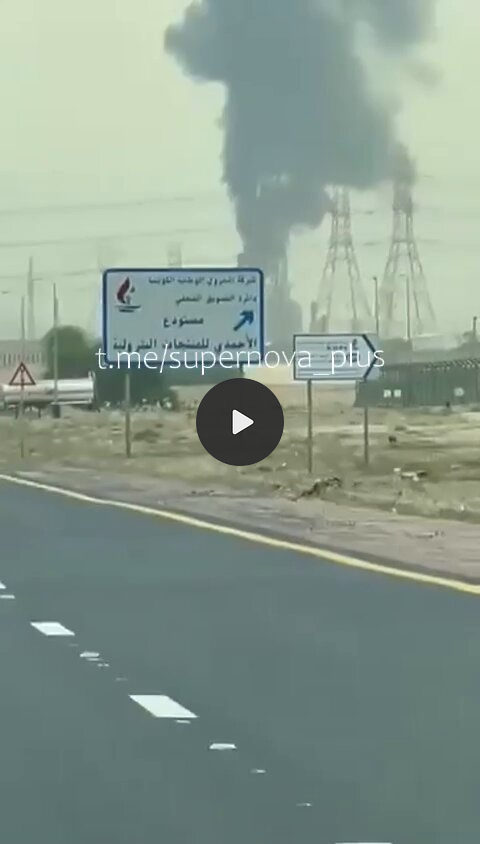
The last 24 hours saw unprecedented destruction on key Gulf energy sites, summarized in the following:
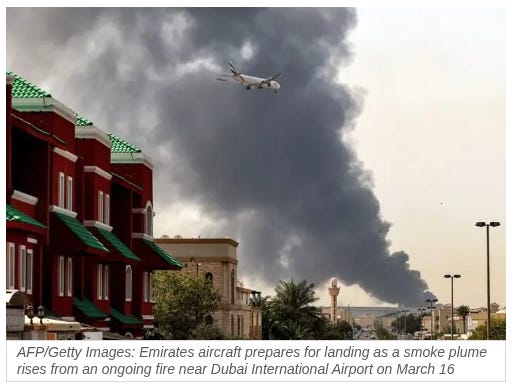
Separately, UAE authorities said they were responding to incidents at the Habshan gas facilities and at the Bab oilfield caused by falling debris from intercepted missiles. The Abu Dhabi Media Office said the facilities were shut down and no injuries were reported.
Saudi Arabia said it intercepted and destroyed four ballistic missiles launched towards Riyadh on Wednesday and an attempted drone attack on a gas facility in its east. On Thursday, Iran targeted the Saudi capital, Riyadh.
Attacks on Kuwait and Bahrain were also reported.
Elsewhere, Iraq has shut its airspace, vessels are taking hits in the Gulf, with on Wednesday Trade Winds having reported: “A ship is on fire after being hit by an unknown projectile near the United Arab Emirates deepwater port of Khor Fakkan.”
WTI-Brent Spread Explodes As U.S. Export Ban Priced In
RBC Capital Markets analyst Julian Triscott told clients, “Our boots on the ground in D.C. suggest the administration favors a crude export tariff over an outright ban, though a full ban remains a tail risk.”
Triscott said the Trump administration is likely weighing intervention in the oil market as gasoline and diesel prices at the pump surge, with a crude export tariff seen as more likely than an outright export ban, though the analyst said a full ban is still a major risk.
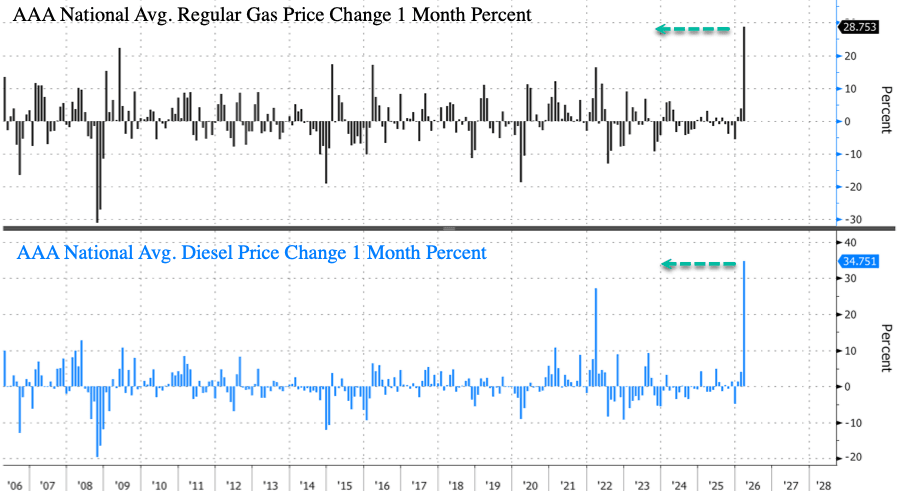
Triscott said the idea would be to shield U.S. consumers by making crude exports less attractive to foreign buyers, while potentially offsetting the impact with a pause or reduction in the federal fuel excise tax.
Triscott pointed out that traders are already beginning to price in this next intervention, with the WTI–Brent spread widening to its highest level since about 2012.
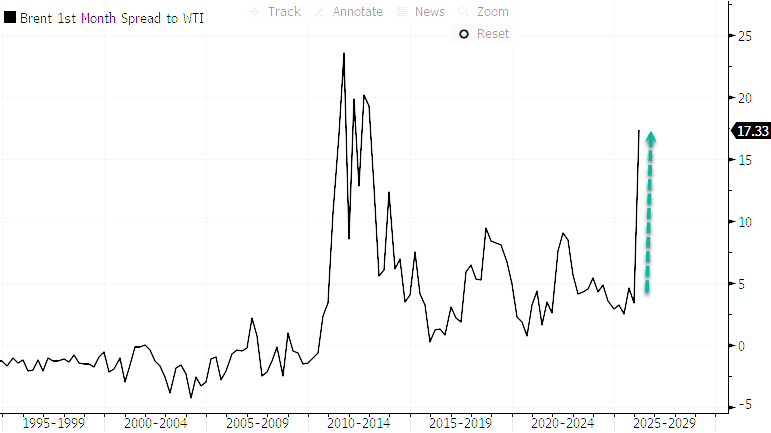


Triscott’s conversation with sources in D.C. about what the Trump administration may do next to combat surging pump prices comes as the Trump administration appears to be following the six-option playbook laid out by JPMorgan analysts last week.
On Wednesday, the Trump administration waived the Jones Act to allow foreign vessels to ship crude to US ports. That was Option 3 on the list, while last week’s SPR release was Option 1. Option 2 is export restrictions.
We suspect the administration is following the six-point playbook, and here’s what may come next (read the report).
Energy Market Shockwaves After Iranian Attacks on Gulf Energy Assets
Brent crude futures surged toward $120/bbl, while WTI remained muted around $96/bbl, as Wednesday marked a major escalation in the US-Iran conflict. Israeli fighter jets struck Iran’s giant South Pars gas field with air-delivered munitions, triggering a retaliatory chain reaction in which IRGC forces targeted critical energy infrastructure across the Gulf.
Iranian drone and missile strikes caused heavy damage to Qatar’s Ras Laffan LNG hub, while gas plants in Abu Dhabi shut down, Kuwaiti refineries were hit by drones, and Saudi refining assets on the Red Sea were targeted.
Unlike temporary shipping disruptions in the Gulf waters or the Strait of Hormuz, damage to upstream energy assets, such as production and LNG facilities, is far more serious and could take months or even years to repair, raising the risk of prolonged tight global supply.
Read overnight report:
Some 20% of global LNG exports originate from Gulf countries, and the latest round of Israeli and IRGC attacks on upstream energy assets shows how the conflict has entered an entirely new phase where energy infrastructure is being directly targeted.
Disruptions at Qatar’s LNG facilities threaten to tighten the global gas market, with ripple effects quickly spreading worldwide - across Asia, Europe, and even U.S. gas prices.
European natural gas benchmark futures jumped as much as 35% today, pushing prices to more than double their pre-war levels, as traders brace for what only appears to be a prolonged period of disruption from critical LNG hubs that account for a fifth of the world’s total supply.
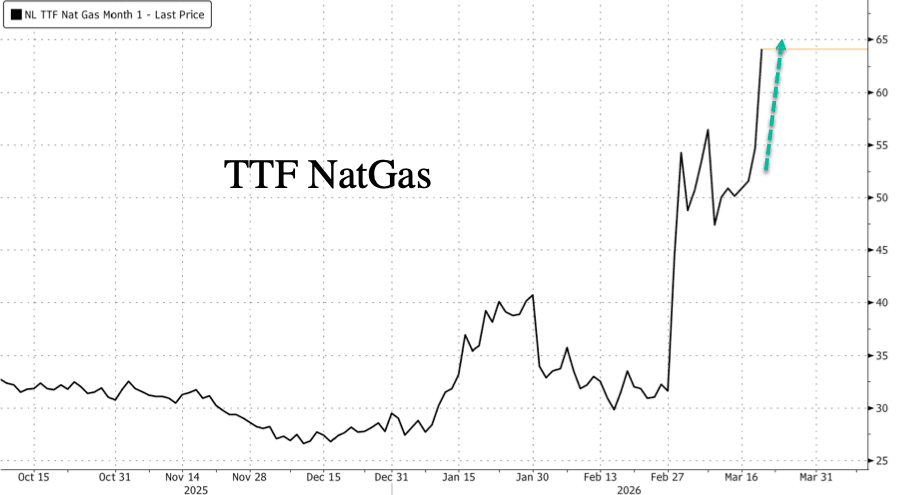
QatarEnergy warned earlier that LNG facilities inside its Ras Laffan Industrial City were attacked by missiles, “causing sizable fires and extensive further damage.”
“This could be a game changer for the LNG industry, akin to the attack on Nord Stream or possibly even worse,” Susan Sakmar, visiting assistant professor at the University of Houston Law Center, said, quoted by Bloomberg. “This is a sudden disruption, with no indication that Qatar could restart anytime soon.”
Global Risk Management analyst Arne Lohmann Rasmussen warned, “LNG from Qatar could in principle be offline for months and, in the worst case, for years. For the gas market, the crisis does not end simply because the war ends and the Strait of Hormuz reopens.”
UBS analyst Matt Salmon commented on the exploding energy risk premia due to overnight war developments:
Geopolitical risk premia in the energy complex rose further following attacks on energy infrastructure in the Middle East, after President Trump failed earlier this week to establish an international coalition to support the resumption of shipping through the Strait of Hormuz. In a clear escalation of hostilities, Iranian energy infrastructure was targeted for the first time in the conflict, with Israel striking the South Pars gas field, while the US claimed no prior knowledge.
Iran had warned early in the conflict that there would be “no red lines” around retaliatory actions, and it made good on this threat with two strikes in less than 12 hours on Qatar’s Ras Laffan Industrial City, home to the world’s largest LNG facility, with state operator QatarEnergy reporting “extensive damage.”
Trump subsequently pressed for de-escalation of attacks on gas facilities in Iran, but moves in Brent were muted, reflecting diminishing confidence that the US has a credible off-ramp. Brent crude is currently trading around $112/bbl, Asian LNG prices are above $20/bbl, and Asian refining margin proxies exceed $40/bbl, amid rising investor anxiety over disruptions to global fuel and gas supplies.
Macron Urges Direct Talks: ‘Return to Reason’
At a moment Gulf shipping lanes are freezing up with tankers idling in the Gulf of Oman waiting for a greenlight through what’s been for most a no-go zone, Iranian lawmakers have proposed a plan to impose tolls and taxes on ships passing through the strategic Strait of Hormuz - which of course would not include passage of US and Israeli ships, or others deemed participants of Operation Epic Fury.
Europe is watching nervously from the sidelines, itching for some kind of presentable offramp, also after NATO allies this week snubbed joining Trump’s coalition to seek to militarily open the strait back up to global shipping. Germany’s Friedrich Merz welcomed signals that Trump might dial things back, saying “I am particularly grateful that the US president sent a signal last night that he prepared to bring the fighting to an end“ - while France’s Emmanuel Macron warned of a “reckless escalation” as energy infrastructure becomes the primary battlefield, and so has called for direct talks between Washington and Tehran. Here’s what he said in part before an EU leaders’ summit in Brussels on Thursday:
“We will obviously defend a de-escalation, a return to stability in the Middle East,” Macron said, adding that he spoke to Qatari emir Tamim bin Hamad Al Thani and Donald Trump about the war on Wednesday night.
“I think that everyone should calm down and the fighting should stop at least for a few days to try to give negotiations a chance again,” the French leader added. “I hope that, in any case, everyone will return to reason.”
Brussels’ bottom line has consistently been over the last few days: “This is not our war.”
Copyright 2026 ZeroHedge