This article originally appeared on Focal Points and was republished with permission.
Guest post by Nicolas Hulscher, MPH
As the world has become increasingly reliant on mobile computing technology for work and entertainment, few people stopped to consider the downstream consequences.
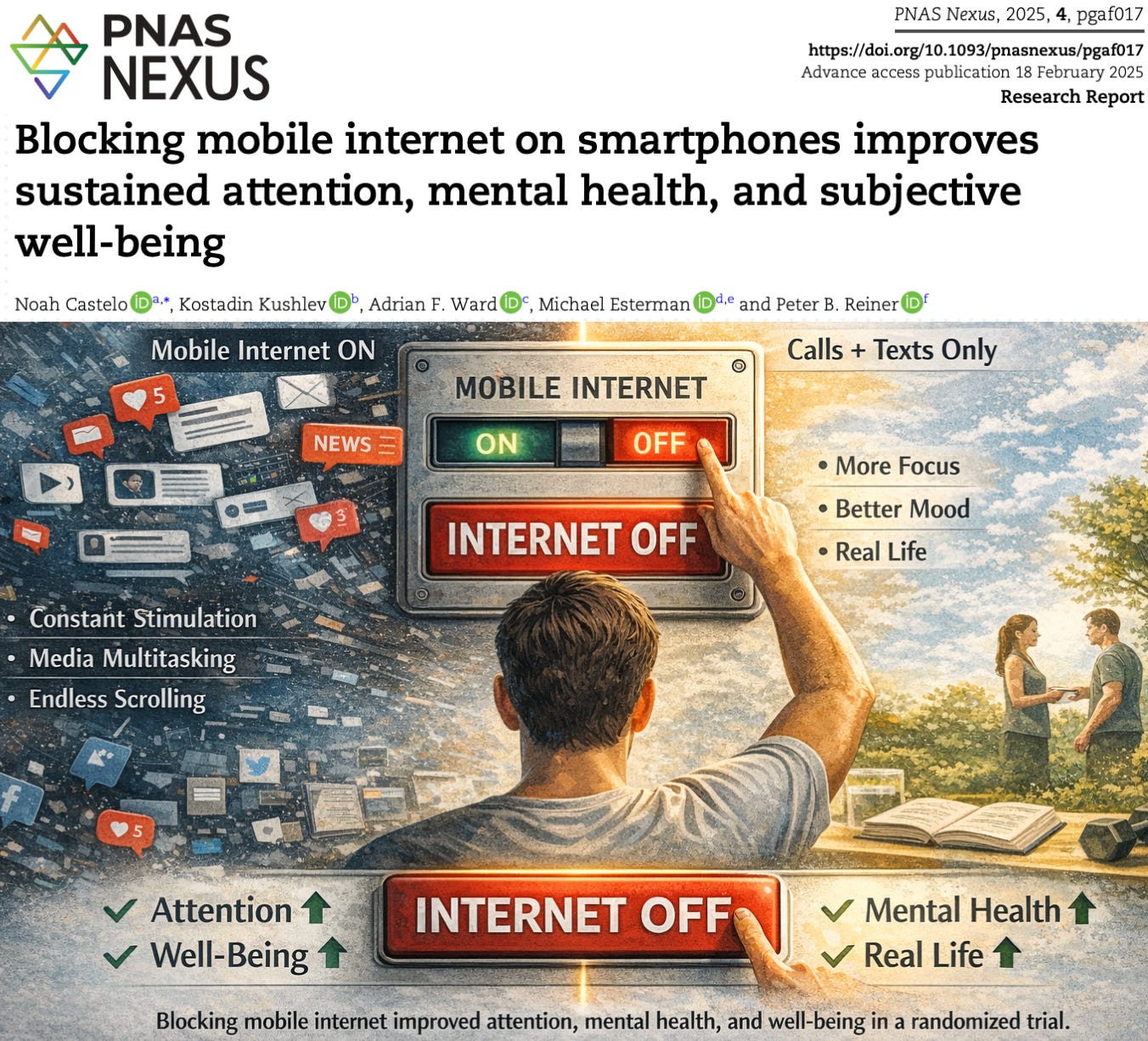
A recent randomized controlled trial found that simply removing mobile internet access—while still allowing calls and texts—can produce measurable improvements in psychological functioning in as little as two weeks. Researchers effectively turned smartphones into “dumb phones,” and the results were striking: improved sustained attention, improved mental health, and higher subjective well-being.
This was a month-long preregistered randomized controlled trial with a cross-over (waitlist) design, enrolling 467 iPhone users in the U.S. and Canada. Participants installed the Freedom app, which blocked all mobile internet access (Wi-Fi and cellular data) for two weeks, while still allowing calling, texting, and internet use on other devices like laptops or desktops. Outcomes were measured at baseline (T1), two weeks (T2), and four weeks (T3), allowing researchers to compare changes during restriction periods versus normal-use periods.
After two weeks without mobile internet, participants experienced significant improvements in subjective well-being (including life satisfaction and positive/negative affect), mental health (a combined index including depression, anxiety, anger, personality functioning, and social anxiety), and objectively measured sustained attention using the validated gradCPT task (d-prime accuracy). Notably, about 91% of participants improved in at least one of these core outcomes, suggesting that the effect was widespread rather than limited to a small subset.
Screen time dropped fast
Even though participants could still communicate normally through calls and texts, overall smartphone use fell sharply once mobile internet was removed.
Average daily screen time dropped from 314 minutes/day to 161 minutes/day during the intervention period
That’s roughly 2.5 hours per day freed up immediately
Attention improved in an objectively measurable way
One of the strongest aspects of this study is that attention wasn’t measured only by self-report—it was tested directly using the gradCPT, a well-validated sustained attention task.
Sustained attention improved after the mobile internet block
The authors note the magnitude was roughly comparable to 10 years of age-related attentional decline on the same framework
Mental health effects were large
Beyond well-being, the intervention produced meaningful improvements across a broad mental-health index. The authors also contextualize the effect size in a way that will surprise many readers.
The observed effect on depression symptoms was described as larger than meta-analytic effects of antidepressants
It was also described as similar to cognitive behavioral therapy (CBT)
The authors emphasize these are cross-study comparisons and not a direct head-to-head clinical trial comparison
Why it worked: people returned to the offline world
When mobile internet access was removed, participants shifted time toward activities associated with better mood, cognition, and resilience. Mediation analyses suggested that improvements in well-being and mental health were partially explained by changes in daily life patterns.
More time spent socializing in person, exercising, being in nature, hobbies, and reading
Improved social connectedness, self-control, and sleep
These factors partially mediated improvements in subjective well-being and mental health (though mediation cannot prove definitive causality for mechanisms)
Conclusion
This trial provides rare causal evidence that constant mobile internet access has measurable cognitive and mental health costs—and that dialing it back, even temporarily, can restore sustained attention, mood, and well-being in as little as two weeks, without cutting people off from calls, texts, or the internet altogether.
That matters because the next wave of technology isn’t aiming to be “in your pocket”—it’s aiming to be in your body. As implantable AI augmentation devices race toward commercialization, we are moving toward deeper and more permanent dependence just as we’re finally proving that always-on digital exposure is not neutral. If smartphones already reshape the mind this dramatically, permanently integrated AI may reshape it in ways we won’t be able to reverse.
Epidemiologist and Foundation Administrator, McCullough Foundation
Support our mission: mcculloughfnd.org
Please consider following both the McCullough Foundation and my personal account on X (formerly Twitter) for further content.
Copyright 2026 Focal Points