

This article originally appeared on Focal Points and was republished with permission.
Guest post by Nicolas Hulscher, MPH
Analysis of CDC nursing home data—now deleted from government servers—reveals COVID shots failed and backfired in the elderly, the very group these “vaccines” were claimed to protect.
A new peer-reviewed study analyzing 15,022 U.S. nursing homes found that COVID-vaccinated residents experienced a prolonged risk of death following infection compared to unvaccinated residents.
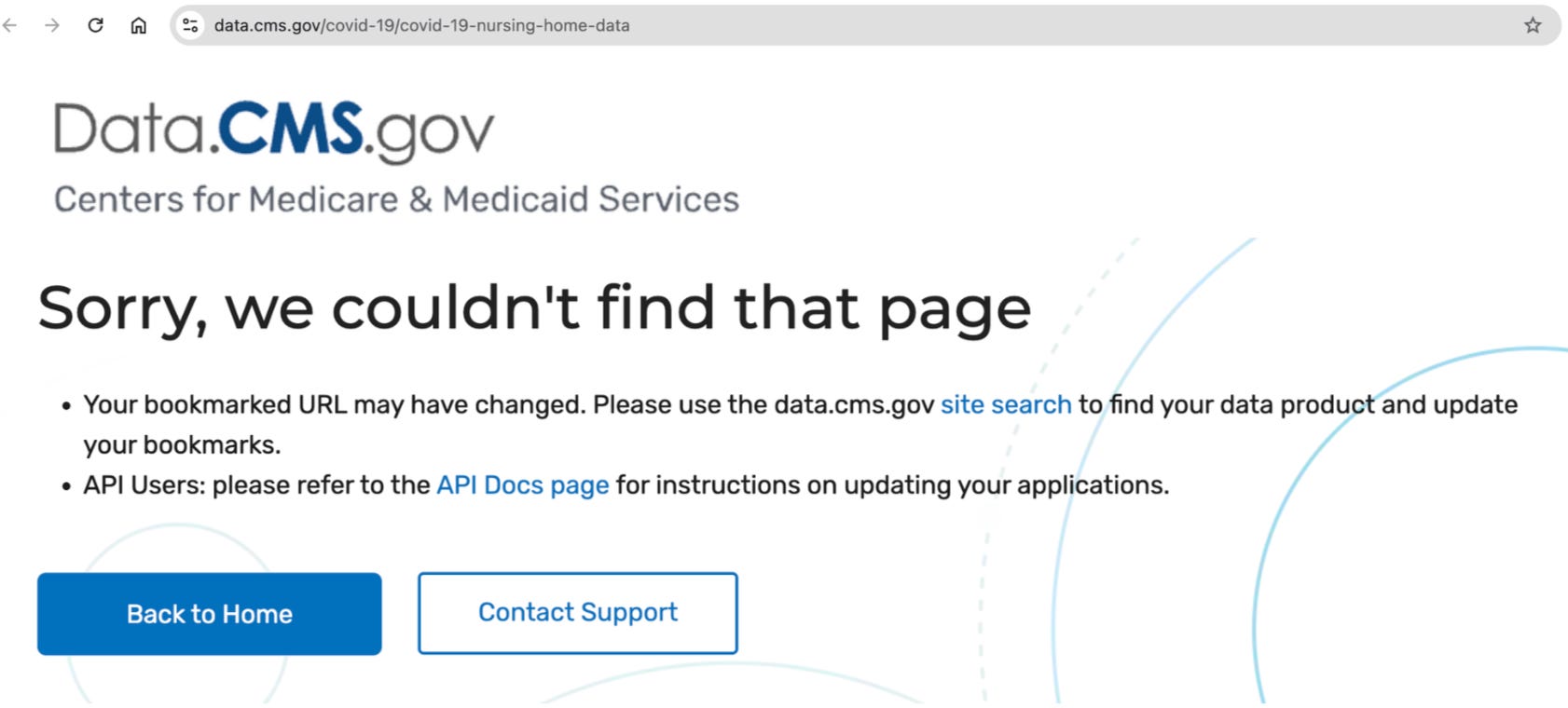
The dataset used in this analysis originated from the CDC’s National Healthcare Safety Network (NHSN), based on reporting from Medicare- and Medicaid-certified nursing homes. Strangely, this dataset was pulled from the CMS public website and is no longer publicly accessible. Thankfully, the authors were able to obtain the data before the government deleted the webpage. At present, this archived version is the only publicly available source of these data.
Using the now-deleted weekly facility-level Medicare/CDC data from May 2022 through June 2023, they examined all-cause mortality alongside confirmed SARS-CoV-2 infections, stratified by vaccination status. The analysis applied mixed Poisson regression models with adjustment for both time-invariant and time-varying confounders, along with lagged and reverse-lagged models to evaluate temporal directionality.
Mortality increased across all groups following infection—but the duration of elevated death risk differed dramatically:
Unvaccinated: ~1 week of elevated mortality
Partially vaccinated: ~3 weeks
Fully vaccinated: ~5 weeks
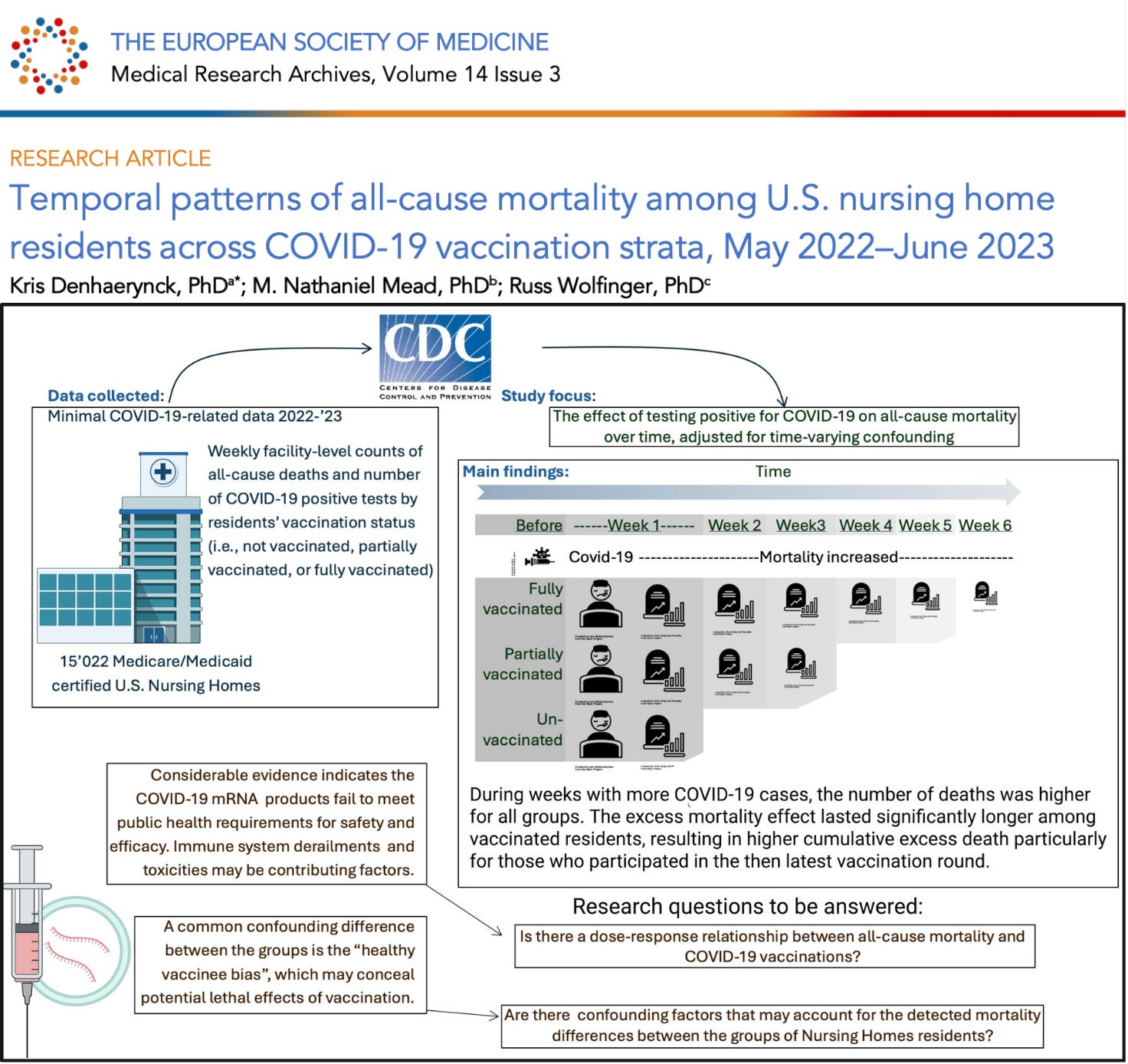
In other words, the more vaccinated the population, the longer the period of elevated death risk following infection.
McCullough Foundation Scholar Dr. M. Nathaniel Mead, co-author of the study, joined me to break down these data and implications of these findings.
As Dr. Mead explained, the study was designed to answer a fundamental question:
Did COVID vaccination actually reduce mortality burden in the most vulnerable population—elderly nursing home residents?
The answer, based on this dataset, appears to be no. While infection waves predictably increased deaths across all groups, vaccination did NOT shorten the mortality burden following infection. Instead, the data show a prolonged mortality signal in vaccinated individuals.
According to epidemiologist and lead author of the study Kris Denhaerynck, PhD:
“We cannot directly infer from these data that the vaccinated died in higher numbers without further individual-level verification. Nevertheless, if the vaccines were truly intended to reduce severe COVID-19 disease and mortality, then fully vaccinated residents testing SARS-CoV-2-positive should not show prolonged mortality. This is a safety observation that cannot simply be dismissed as an artifact of aggregated or otherwise biased data. On the contrary, it warrants urgent investigation; and if found to be robust, would fundamentally challenge current assumptions about the vaccine performance in frail elderly. The fact that such longitudinal signals are routinely marginalized suggests that a rigorous investigation of this possibility is seen as inconvenient, if not entirely unwelcome.”
This large-scale, real-world analysis of U.S. nursing homes provides one of the clearest temporal signals to date that COVID vaccination did not reduce—and actually extended—the period of mortality risk following infection in frail elderly populations, the very group these “vaccines” were claimed to protect.
Epidemiologist and Foundation Administrator, McCullough Foundation
www.mcculloughfnd.org
Please consider following both the McCullough Foundation and my personal account on X (formerly Twitter) for further content.
Copyright 2026 Focal Points

This data demonstrates that the "vaccines" worked as intended. Intention is reasonable to infer on the basis of the failure of CDC to announce the harms, the failure of the CDC to withdraw the vaccine from the market for endangered populations, the lack of apology, the failure of CDC or HHS more generally to provide restitution to the injured or to the families of victims of what can only be construed as murder, and the continuation of further mRNA research funded by the government.
Start the democide tribunal at the nursing homes.