
This article originally appeared on The Defender and was republished with permission.
Guest post by Brenda Baletti, Ph.D.
Citing disagreements about the vote’s language, the committee advising the CDC on vaccines today voted to delay until tomorrow a vote on whether to change the current recommendation that all newborns receive the Hep B vaccine within 12-24 hours of birth.
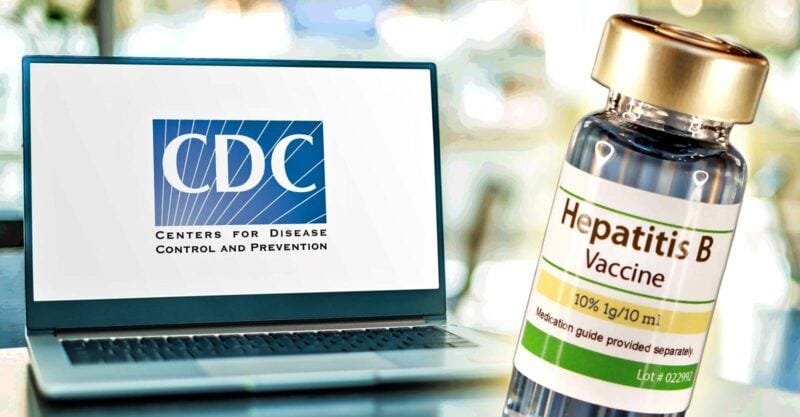
Citing disagreements about the vote’s language, the committee advising the Centers for Disease Control and Prevention (CDC) on vaccines today voted to delay until tomorrow a vote on whether to change the current recommendation that all newborns receive the hepatitis B (Hep B) vaccine within 12-24 hours of birth.
The members of the CDC Advisory Committee on Immunization Practices (ACIP) voted 7-3 to take more time to review the language of the vote.
Tomorrow’s proposed vote, divided into three parts, would change the recommendation for babies born to mothers who test negative for the illness, which represents over 99.5% of mothers.
If passed, the committee would recommend that parents of those babies decide individually, in consultation with their provider, whether and when to vaccinate their infants.
The proposed language recommends that infants who do not receive the birth dose get their initial dose no earlier than age 2 months.
For mothers whose hepatitis B status is unknown or who test positive, the birth dose recommendation would stand.
A third proposal recommends that the need for later doses be determined in consultation with a healthcare provider, who should consider whether serology testing should be conducted first, to see if a child has sufficient titers to provide immunity, which would eliminate the need for additional doses.
The proposed changes would not affect Medicaid or insurance coverage of the vaccine’s costs for anyone who wants the vaccine.
The proposed change is more substantive than the changes ACIP members previously considered, but tabled at the last committee meeting, and the change widely predicted to be taken up today, which had called for postponing the universal birth dose by one month.
#ad: Looking for high-purity DMSO you can actually trust?
Earth Harmony’s DMSO is USP Grade with 99.99% purity, non-diluted, with no added water, and stored in glass bottles to prevent plastic contamination.
NOTE: DMSO (Dimethyl Sulfoxide) is a powerful solvent. This product is for research and development purposes only. Only use as recommended by your healthcare provider.
Choose purity. Choose performance. Choose Earth Harmony DMSO.

DISCLOSURE: This post contains affiliate links. If you make a purchase through Earth Harmony, we may earn a small commission at no extra cost to you.
During today’s sometimes heated debate, committee members Dr. Cody Meissner and Dr. Joseph R. Hibbeln clearly opposed changing the existing recommendation, citing a lack of “evidence of harm.”
Critics of that position, including Retsef Levi, Ph.D., argued there is no “evidence of safety” and that the vaccines were approved based on “outrageous criteria.” The clinical trials were not placebo-controlled, and there was no follow-up beyond a week to assess adverse events in infants, he said.
Levi told the committee:
“I don’t know how we have the courage based on such slim evidence to come to parents and tell them that that’s okay to give to your zero-day baby, especially when the risk is so low. I honestly don’t understand where the courage is. Where does this courage come from?
“And the question is, if you have a safety culture, not if there is evidence of harm, but whether you know — are quite sure — that there is no harm. And that’s a fundamentally different question that we are not asking in the context of vaccines and specifically in the context of that vaccine.”
Changing the Hep B vaccine recommendations is possibly the most controversial issue yet considered by the new ACIP members. U.S. Health Secretary Robert F. Kennedy Jr. appointed the new members starting in June, after he dismissed all 17 members, citing conflicts of interest.
Leading up to today’s meeting, legacy media organizations, including The New York Times, The Washington Post, NPR and other outlets, ran a series of articles defending the Hep B vaccine as safe, effective and necessary for every baby born in the U.S.
ACIP to discuss CDC schedule, dangers of aluminum
Today’s discussions are part of a two-day meeting. Following the vote tomorrow morning, presentations will address the childhood immunization schedule as a whole and the dangers of aluminum, which is used as an adjuvant in several childhood vaccines and has been associated with immunological and neurodevelopmental issues.
On Friday, presenters will include noted vaccine attorney Aaron Siri and CDC researcher and epidemiologist Tracy Beth Høeg, M.D., Ph.D., who is an expert in regulatory policy. On Wednesday, the U.S. Food and Drug Administration appointed Høeg as acting director of the Center for Drug Evaluation and Research.
Today’s meeting convened with a new ACIP chairperson, pediatric cardiologist Kirk Milhoan, M.D., Ph.D., who joined the committee in September.
Former chair, Martin Kulldorff, Ph.D., left the committee to take a leadership role within the U.S. Department of Health and Human Services, the agency announced on Monday. However, because Milhoan is traveling, Dr. Robert Malone chaired the meeting.
At its last meeting, ACIP unanimously voted to recommend that all pregnant women be tested for hepatitis B, but postponed a vote to change the universal birth dose recommendation.
ACIP recommendations are not legally binding, but typically the CDC director endorses them and they become official policy.
Disagreements led to frustration, heated debate among ACIP members
Today’s discussion was heated from the start, with Meissner opening questions after the presentations, saying, “There are so many statements that I don’t agree with that it’s hard to be succinct.”
He underscored his position that there is no evidence of harm from the shot.
Levi shot back that Meissner was asking the wrong question. Instead, the committee should be asking how many babies born to hepatitis B-negative mothers have to be vaccinated to prevent a single case of the disease.
“I suspect that there is no answer to that question,” Levi said. “And the reason why there is no answer to that question is that the risk is so, so small that the numbers are probably in the millions,” he said, which leads back to the question of safety.
To recommend a vaccine, Levi said, “We will need to have a vaccine that has a number needed to prevent harm that is bigger than millions.”
Several speakers opposed to changing the recommendation raised concerns about testing, suggesting that false negative tests would mean many babies would fall through the cracks.
Høeg said the tests available today list consistency of results at 100%. “So I don’t think we are missing a lot with the testing.”
ACIP liaisons — who represent medical professional organizations — were at times hostile toward the data in the presentations, the proposal to change the vote and the committee in general.
Dr. Jason Goldman, a liaison to the ACIP for the American College of Physicians, accused the committee of failing to follow the science.
“You are wasting taxpayer dollars by not having scientific rigorous discussion on issues that truly matter,” Goldman said. “The best thing you can do is adjourn the meeting and discuss vaccine issues that actually need to be taken up.”
Representatives from some medical groups, including the American Academy of Pediatrics (AAP) and the American Medical Association, were disinvited in August from participation in the workgroups due to conflicts of interest.
Since then, the AAP has boycotted the ACIP meetings. It was not represented at the meeting today.
Watch the Dec. 4 meeting on CHD.TV:

Related articles in The Defender:
Medical Establishment Mounts PR Blitz Amid Reports CDC Plans to Scrap Hep B Vaccine for Newborns
Safety Data on Hepatitis B Vaccine for Newborns ‘Sadly Lacking’
CDC Plan to Review Hep B Vaccine for Babies Sends Mainstream Media into Tailspin
CDC Vaccine Advisers May Roll Back Recommendation for Hep B Shot at Birth
Hep B Vaccines Come With High Risk, Little Benefit — Why Does CDC Recommend Them for Every Newborn?
Key Takeaways From Last Week’s Meeting of New CDC Vaccine Advisers
Donate to Children’s Health Defense

Crazy. They don't have the valid research showing a benefit, lack controlled placebo testing, but are vociferously claiming that the vaccines are good.
How, as scientists, are you able to do that in good conscience?
Nmind - I know the $$ reason.
Clown world.