
This article originally appeared on the Daily Caller News Foundation and was republished with permission.
Guest post by Mary Rooke
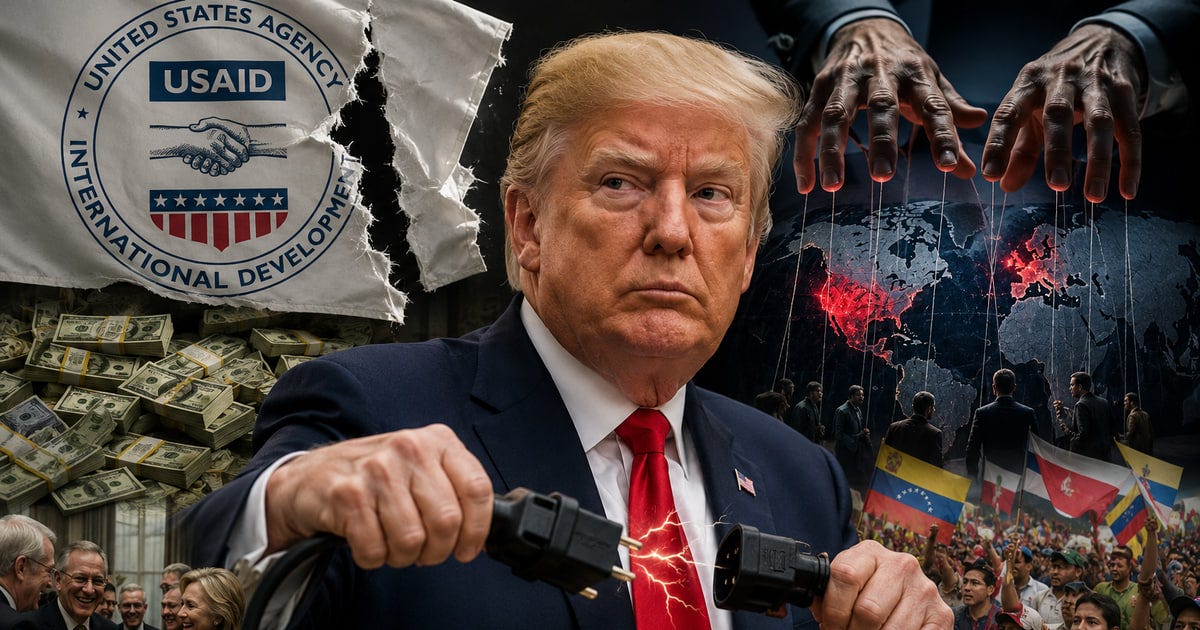
Following the Trump administration’s aggressive restructuring of the U.S. Agency for International Development (USAID), a striking pattern emerged across Latin America. Left-wing governments, long dominant in several countries, suddenly stopped winning national elections.
Center-right and conservative presidential candidates have swept to victory in Bolivia, Chile, Honduras, Costa Rica, Peru, and Colombia since Trump ordered the cancellation of the bulk of USAID’s programs. While it’s normal to see some political pendulum swinging, the speed and uniformity of the recent shift, coinciding with President Donald Trump neutering USAID’s democracy and governance funding apparatus, raise uncomfortable questions.
On day one of Trump’s second term, he signed an executive order pausing most foreign assistance as a first shot across the bow. USAID eventually ceased independent operations and was effectively absorbed under the State Department. Secretary of State Marco Rubio oversaw the cancellation of approximately 83 percent of USAID programs, which were worth tens of billions of dollars.
“After a 6 week review we are officially cancelling 83% of the programs at USAID. The 5200 contracts that are now cancelled spent tens of billions of dollars in ways that did not serve, (and in some cases even harmed), the core national interests of the United States,” Rubio said.

A substantial portion of these now-canceled contracts fell under the Democracy, Human Rights, and Governance (DRG) portfolio. These initiatives funded election support, legislative strengthening, local governance reforms, anti-corruption efforts, independent media, civil society capacity-building, and human rights advocacy. In short, this funding often helps prop up left-leaning social agendas in foreign countries.
Daily Signal’s Tyler O’Neil testified during the House Committee on Oversight and Government Reform in February 2025 that USAID had “troubling ties to the Left’s dark money network.”
“USAID spent millions propping up the Marxist ideology of ‘diversity, equity, and inclusion;’ the unfair and divisive transgender orthodoxy; and the climate alarmist movement,” O’Neil said, adding that “Some of these grants arguably undermine America’s standing in the world.”
USAID awarded a roughly $2 million cooperative agreement in 2024 to Asociación Lambda in Guatemala to help “strengthen” so-called gender-affirming healthcare. The agency also awarded funding to support other LGBTQ projects, such as transgender-themed artistic initiatives in Colombia and Peru. While framed as human rights work, USAID funded NGOs to promote far-left ideologies in culturally conservative countries, with DRG’s election integrity arm working alongside them.
And for decades, this funding coincided with a rise in left-wing governments coming to power in Latin America. Then the funding stopped, and remarkably so did the chokehold the left had on these governments. Several notable Latin American presidential contests provided zero left-wing victories after the core USAID cuts took effect.

Center-right senator Rodrigo Paz Pereira defeated candidates tied to the long-ruling socialist MAS party in 2025, ending nearly two decades of its dominance in Bolivia. Chile’s presidential race delivered a victory for José Antonio Kast’s right-wing coalition. Honduran voters chose conservative Nasry Asfura. Costa Rica elected right-wing populist Laura Fernández Delgado in February. Peru’s June contest produced a narrow win for Keiko Fujimori on the right. Colombia’s June runoff saw hard-right lawyer Abelardo de la Espriella prevail over the leftist candidate.

It wasn’t that the region hadn’t already seen the mood shift from left to right, as Javier Milei famously won the presidency in Argentina in 2023. Still, the post-Trump USAID restructuring stands out for the complete absence of left-wing political breakthroughs after its implementation. A shift happens slowly over time. And while correlation does not equal causation, the rapid acceleration of right-wing successes only makes sense if the entire left-wing support apparatus was astroturfed by USAID funding.
Traditionally conservative countries don’t typically elect far-left ideological candidates on their own. The U.S. saw the same thing happen here. In just two generations, the U.S. went from an overwhelmingly conservative nation to throwing PRIDE festivals with stripper poles for kids.
This wasn’t an organic shift in culture. It took the full weight of the major institutions (education, government, entertainment, etc.) to make this even somewhat socially acceptable. Thankfully, the pendulum is swinging back to reality. Americans are less tolerant of these behaviors than they were over the last decade, when support for them peaked.
Something structural shifted in Latin America when the Trump administration neutered USAID, and it can’t be ignored. As in the U.S., voter discontent with left-leaning governance found its voice again when it didn’t have to battle upstream against American funding. As a result, right-leaning and populist governments will have a chance to correct some of the damage that has been done.
Copyright 2026 Daily Caller News Foundation

Milei promoted a cryptocurrency called $LIBRA on X , which had begun trading minutes earlier. Its value quickly soared above $4 before falling below 50 cents.
Argentine forensic experts have detected coordinated communications between President Javier Milei, his sister Karina, and the lobbyists and promoters of the Libra memecoin that collapsed shortly after the token went live, according to Argentine media outlet La Nación.
And he is on video admitting to pushing $LIBRA on his personal X account and his Lawyer had to tell him to shut up about it because it was Illegal.
While prices have surged by 303.6% since Milei came to power in November 2023, wages have failed to keep up. For formally registered workers, salaries saw an average decline of 13% in real terms in the period to February 2026. This drop varies significantly between the private (-8%) and public (-22.1%) sectors, according to a report by the Center for Research and Training of the Argentine Republic (CIFRA).
And changed Laws to allow Israelis to buy up land in Argentina.