
This article originally appeared on The Defender and was republished with permission.
Guest post by Suzanne Burdick, Ph.D.
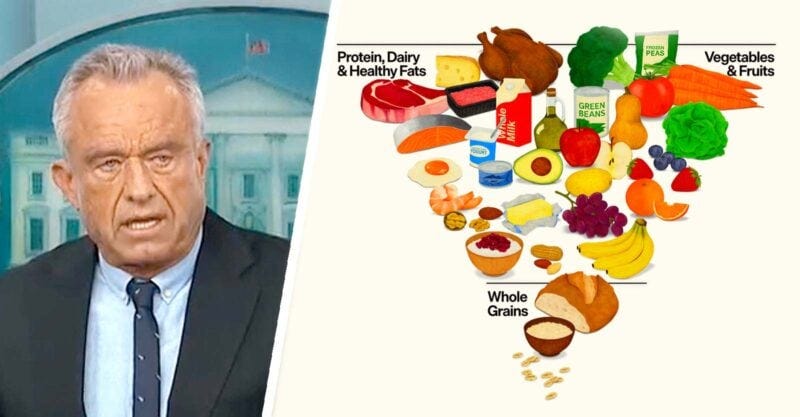
On January 7, U.S. Health Secretary Robert F. Kennedy Jr. unveiled new dietary guidelines for Americans. The new food pyramid is inverted, putting protein, dairy, healthy fats, vegetables and fruit at the top, with grains at the bottom.
At a White House press briefing, Kennedy called the changes the “most significant reset of federal nutrition policy in history.”
The guidelines, effective through 2030, will become the default for what’s served to schoolchildren, the military, veterans, the elderly and low-income families that participate in federal programs like WIC and Head Start.


Kennedy said:
“These guidelines replace corporate-driven assumptions with common sense goals and gold-standard scientific integrity. These new guidelines will revolutionize our nation’s food culture and make America healthy again.
“For decades, Americans have grown sicker while healthcare costs have soared. The reason is clear: the hard truth is that our government has been lying to us to protect corporate profit-taking, telling us that these food-like substances were beneficial to public health.
“Federal policy promoted and subsidized highly processed foods and refined carbohydrates and turned a blind eye to the disastrous consequences. Today, the lies stop.”
Food pyramid was upside down before — ‘we just righted it’
Kennedy said people may think the new pyramid is upside down, given that the prior pyramid allotted the largest area to grains and the smallest area to fats.
“But it was actually upside down before — we just righted it,” Kennedy said.
The earlier nutrition model “wrongly discouraged” healthy fats and protein. “We are ending the war on saturated fats,” Kennedy said.
Last year’s U.S. Dietary Guidelines limited saturated fats and recommended that people replace them with vegetable (seed) oils, according to Nina Teicholz, Ph.D., science journalist and author of “The Big Fat Surprise: Why Butter, Meat & Cheese Belong in a Healthy Diet.”
Unfortunately, the new guidelines contain the same 10% calories cap for saturated fats, Teicholz wrote in a Substack post Tuesday, despite Kennedy’s enthusiasm for ending the war on saturated fats.
The new guidelines website states that every American should eat 1.2-1.6 grams of animal and/or plant protein per kilogram of body weight per day, along with “healthy fats” from whole foods such as eggs, seafood, meat, full-fat dairy, nuts, seeds, olives and avocados.
Although the website includes graphics encouraging people to eat butter, the actual guidelines state:
“In general, saturated fat consumption should not exceed 10% of total daily calories. Significantly limiting highly processed foods will help meet this goal. More high-quality research is needed to determine which types of dietary fats best support long-term health.”
People should also eat 3 servings of vegetables, 2 servings of fruit, and 2-4 servings of whole grains.
The guidelines also encourage people to drink water, limit alcohol consumption and eat the amount of food appropriate for their age, sex, size and activity level.
New guidelines ‘directly address’ ultraprocessed foods, added sugars
The pyramid doesn’t include added sugars. People, especially children, are encouraged to avoid them entirely. Instead, they should eat naturally occurring sugars in whole fruits and plain dairy.
“For the first time, the dietary guidelines directly address ultraprocessed foods and set firm sugar limits in federal procurement, driving a significant reduction in added sugar in school meals,” Kennedy said.
The new guidelines emphasize eating “real” food, defined as minimally processed foods “prepared with few ingredients and without added sugars, industrial oils, artificial flavors, or preservatives.”
U.S. Food and Drug Administration (FDA) Commissioner Marty Makary, who also spoke at today’s press conference, cited a study published last October in JAMA that showed that Americans, including kids, were getting over half their calories from ultraprocessed foods.
The Centers for Disease Control and Prevention last August reported roughly the same numbers.
“We now have a generation of kids addicted to refined carbohydrates, low in protein,” Makary said.
Kennedy flagged this as a serious problem. He said:
“If a foreign adversary sought to destroy the health of our children, to cripple our economy, to weaken our national security, there would be no better strategy than to addict us to ultraprocessed foods.
“It’s shocking that our own government helped to drive these cataclysmic changes in our diet. The damage is real.”
SNAP offerings in stores will soon expand
Over 40 million Americans depend on SNAP, the U.S. Department of Agriculture (USDA) Supplemental Nutrition Assistance Program, for nutrition, according to a fact sheet about the new guidelines.
Some of the most popular SNAP items are sugary drinks, candy and chips. And because 78% of SNAP recipients are on Medicaid, these incentives for unhealthy food drive up taxpayers’ healthcare costs.
The U.S. could reduce Medicare spending by $30 billion if the country reduced its obesity rate by just 10%, said Centers for Medicare & Medicaid Services Administrator Mehmet Oz.
Medicaid would see a correlated reduction in spending, said Oz, who also spoke at today’s press conference.
The foods on shelves at stores that participate in SNAP may soon change, according to Brooke Rollins, who heads the USDA. She said the USDA is finalizing what she called its “stocking standards.”
The agency will require the nearly 250,000 U.S. businesses that take the SNAP benefit to “double the type of staple foods that they provide for America’s SNAP households,” Rollins said. “This means healthier options will be in reach for all American families.”
Related articles in The Defender
Sugar, Artificial Sweeteners Linked to Early Puberty in Teens
Ultraprocessed Foods Make Up Over Half of Kids’ Diet, CDC Report Says
2025 Dietary Guidelines Recommendations ‘Would Almost Certainly Harm Our Health’
Donate to Children’s Health Defense

large claims, warnings..but, let's see the Admin do the hard work
And in doing so, proved that the administration is completely and totally fascist. Who the hell do they think they are, advocating for Americans' health.
/s