This article originally appeared on Jon Fleetwood’s Substack and was republished with permission.
Guest post by Jon Fleetwood
Sen. Paul’s documents show intelligence agencies recruiting Anthony Fauci into SARS assessments in 2003, and proposing a government-linked “living sensor web” of scientists.
Long before COVID-19 emerged, U.S. intelligence agencies were already cultivating relationships with influential public-health officials, embedding themselves in biological-threat discussions, and building networks designed to monitor and evaluate supposed emerging pathogens.
Newly released records published by U.S. Senator Rand Paul (R-KY) reveal that Dr. Anthony Fauci was participating in intelligence-related coronavirus discussions as early as 2003, nearly two decades before the COVID-19 pandemic.
The documents also show intelligence officials envisioning a future in which scientists would function as a government-linked “living sensor web” and calling for a “qualitatively different” relationship between intelligence agencies and the biological sciences community.
Sen. Paul argues the files show Fauci influencing the intelligence community.
But the documents also reveal something larger, flowing in the opposite direction: intelligence agencies were already building relationships with public-health leaders, scientific institutions, and biological-threat programs years before COVID, suggesting the intelligence apparatus may have been shaping the pandemic ecosystem long before it was later tasked with explaining it.
The records raise a question largely absent from mainstream COVID discussions:
If intelligence agencies were already operating inside coronavirus, biodefense, and public-health networks years before the pandemic, were they merely investigating COVID after it emerged—or were they participating in shaping how the event would be understood from the beginning?
Intelligence Officials Recruited Fauci Into SARS Assessments
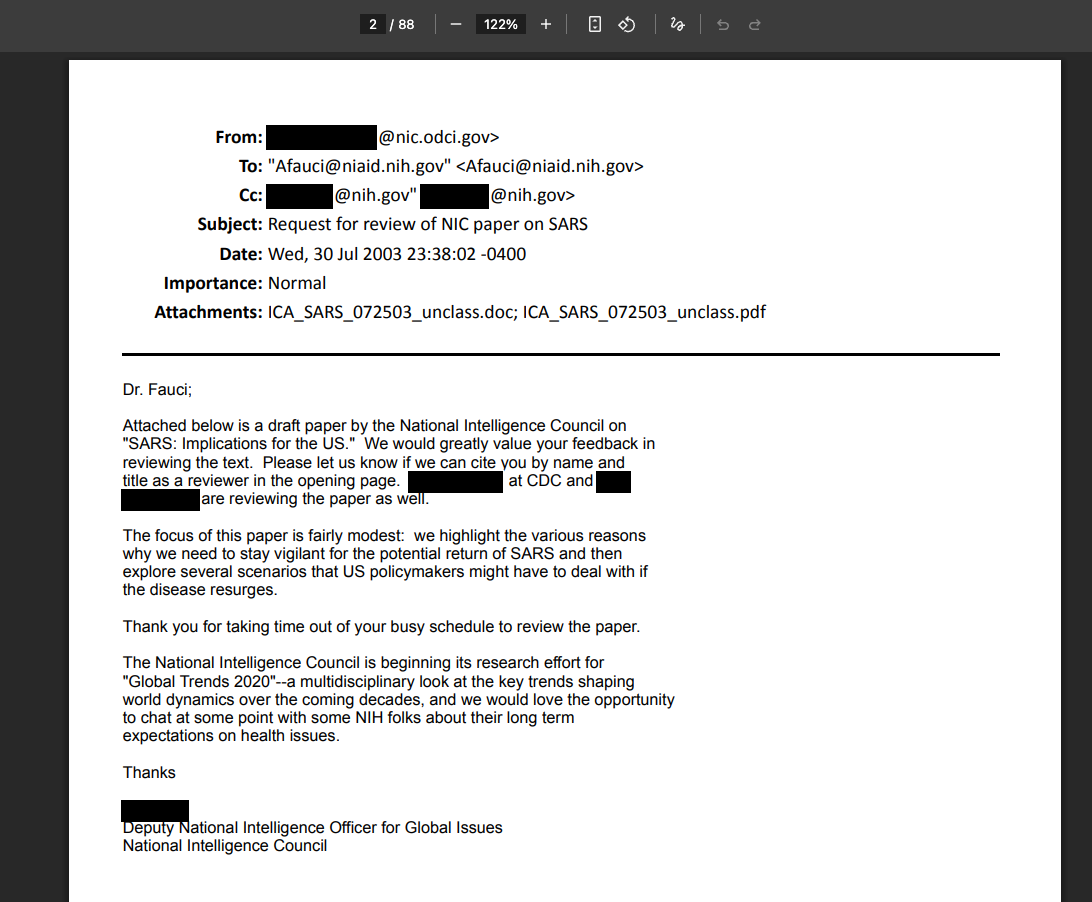
In July 2003, the National Intelligence Council (NIC) invited Dr. Anthony Fauci to review a draft intelligence assessment concerning SARS.
“We would greatly value your feedback in reviewing the text,” intelligence officials wrote.
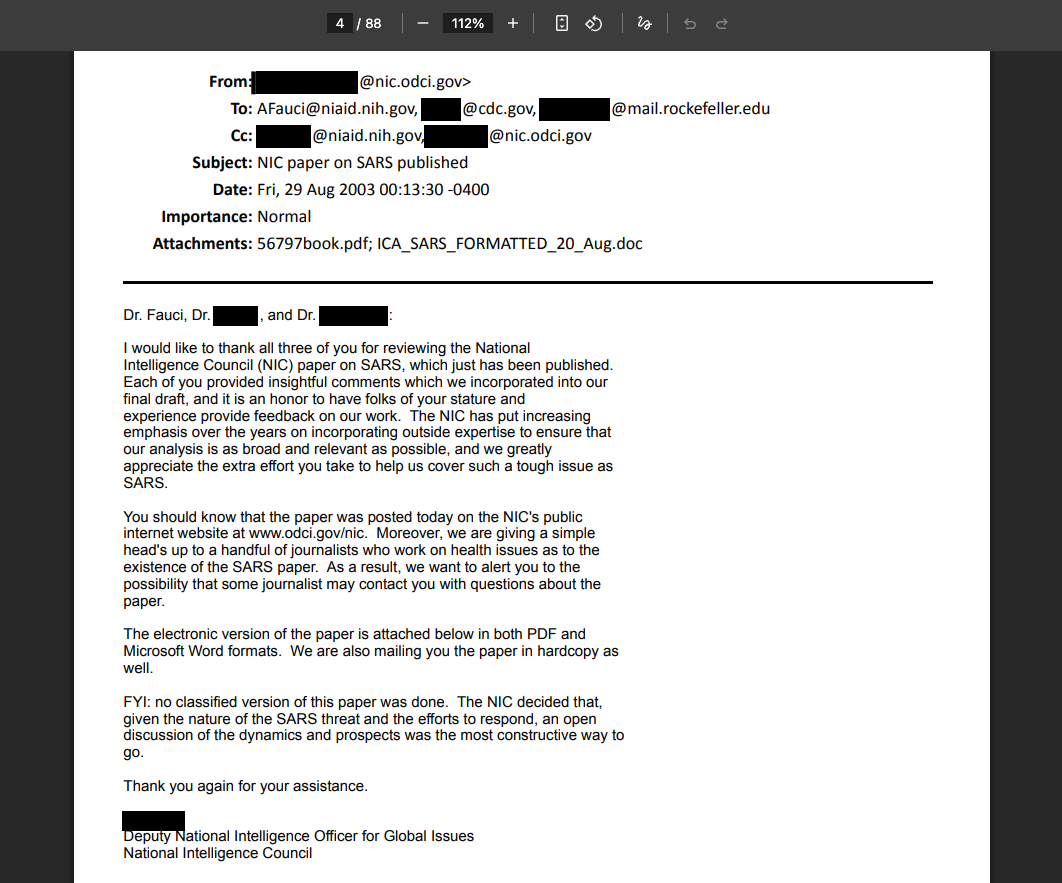
Weeks later, in August 2003, the NIC informed Fauci that his recommendations had been incorporated into the final intelligence product.
“Each of you provided insightful comments which we incorporated into our final draft.”
The exchange places Fauci inside intelligence-related coronavirus discussions nearly 17 years before the emergence of COVID-19.
The records show the relationship did not end there.
By August 2007, Fauci was being invited into Defense Threat Reduction Agency (DTRA) reviews concerning the future direction of U.S. counter-weapons-of-mass-destruction programs.
The review addressed global WMD threats, threat-reduction operations, detection capabilities, consequence management, and broader national-security priorities.
The timeline reveals a recurring pattern: intelligence agencies consulted Fauci on SARS in 2003 and continued involving him in biodefense and national-security activities years before COVID-19 emerged.
Rather than portraying Fauci as an independent public-health official operating outside government security structures, the records show him repeatedly participating in discussions involving intelligence, biodefense, and weapons-of-mass-destruction policy long before the pandemic.
CIA Called for a ‘Qualitatively Different’ Relationship with Scientists
Among the most significant records is a November 2003 CIA report titled The Darker Bioweapons Future.
The report warned that engineered biological agents could be more dangerous than known diseases, while emphasizing the difficulty of distinguishing legitimate biological research from advanced bioweapons work.
The report states:
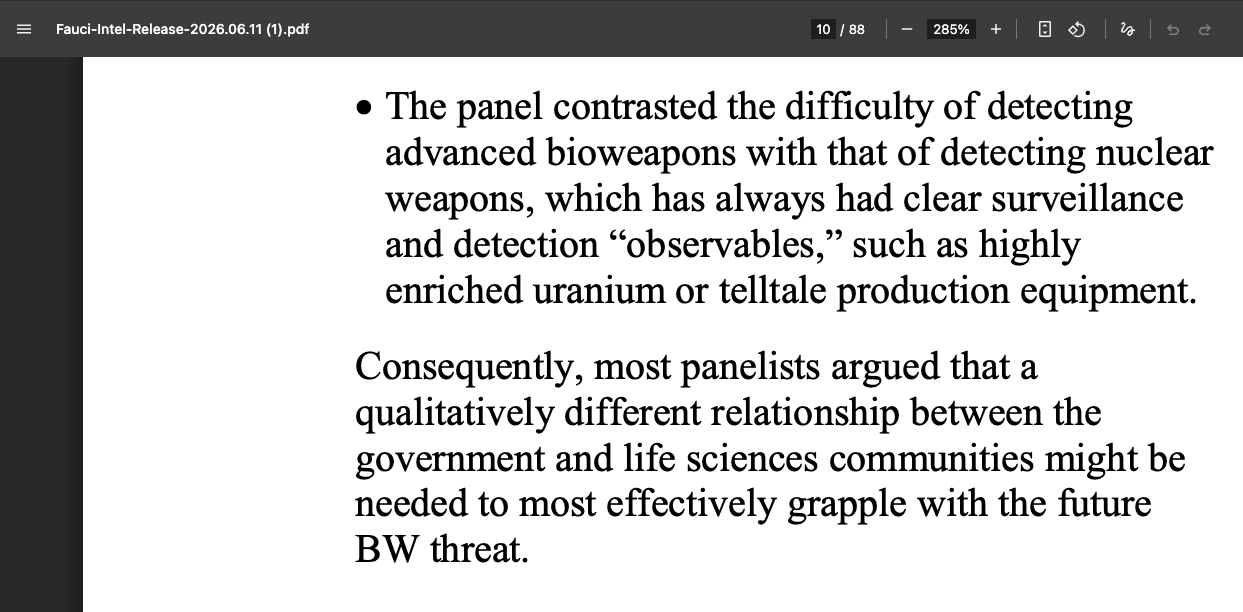
“Consequently, most panelists argued that a qualitatively different relationship between the government and life sciences communities might be needed to most effectively grapple with the future BW threat.”
The statement suggests intelligence agencies were not treating biological threats as merely scientific questions.
They were already discussing a transformed relationship between government power and the life sciences.
Intelligence agencies should work more closely with scientists.
The document linked the prospect of increasingly dangerous engineered pathogens to the need for a new government-science relationship, raising questions about whether fear of future biological threats was being used to justify expanding national-security influence within the life sciences.
Scientists Proposed as a Government-Linked ‘Living Sensor Web’
The CIA report went further.
According to the document:
“A more comprehensive vision articulated by one panelist was for the bioscience community at large to aid the government by acting as ‘a living sensor web’—at international conferences, in university labs, and through informal networks—to identify and alert it to new technical advances with weaponization potential.”
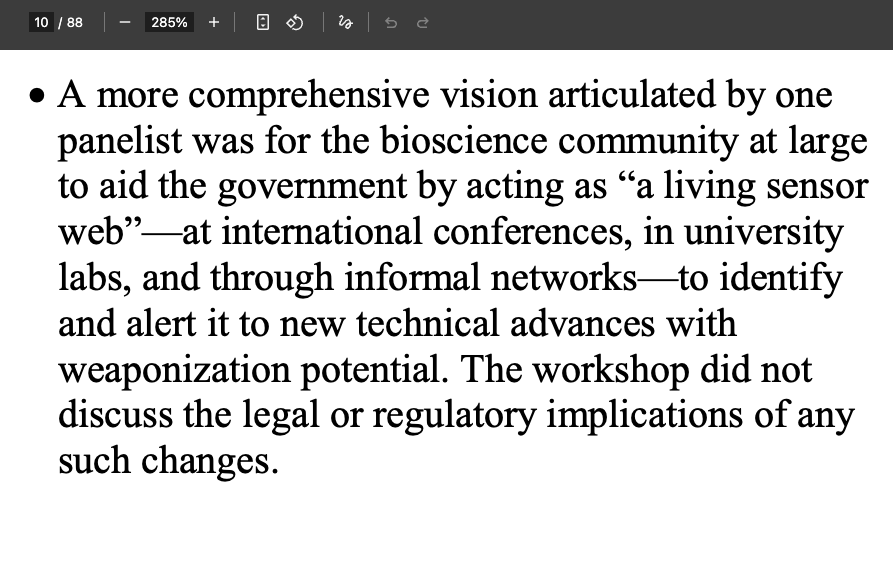
The concept envisioned scientists functioning as a distributed information-gathering network extending across universities, conferences, laboratories, and professional communities.
The proposal is significant because it reveals intelligence officials discussing ways to leverage scientific institutions as part of broader biological-threat monitoring systems years before COVID-19 emerged.
The Origins Debate Unfolded Inside Pre-Existing Intelligence Structures
The significance of the newly released records becomes clearer when viewed alongside later developments in the COVID origins investigation.
On January 31, 2020, after concerns were raised about unusual features in SARS-CoV-2, Fauci urged that if those concerns proved valid they should be reported to the FBI and MI5.
In the months that followed, Fauci participated in discussions that ultimately contributed to the drafting of The Proximal Origin of SARS-CoV-2, the influential paper arguing against laboratory engineering.
Later, following President Biden’s 2021 order directing the intelligence community to conduct a COVID origins review, Fauci received classified briefings arranged through the National Security Council and was invited to review additional reports concerning the origins question.
The newly released records therefore challenge the notion that intelligence agencies entered the COVID story only after the pandemic began.
Instead, they show intelligence institutions already operating inside many of the same coronavirus, biodefense, and public-health networks that later became central to the origins debate.
The Fauci Files Fit a Broader Pattern
The newly released Fauci records do not appear in isolation.
They emerge against a backdrop of allegations that intelligence agencies were not merely investigating COVID-19 origins but were deeply embedded within the scientific and biodefense networks surrounding the issue itself.
In November 2024, Sen. Roger Marshall (R-KS) called for an investigation into whether federal agencies took “deliberate actions” to suppress information during the government’s COVID-19 origins probe.
Marshall cited witness claims that “conflicted individuals may have censored the laboratory-origin related intelligence” during the ODNI-led investigation.
The senator also revealed that the U.S. Intelligence Community had classified access to EcoHealth Alliance’s DEFUSE proposal while conducting its origins review.
According to Marshall, the proposal could have produced “a synthetic coronavirus in 2019 with the same unique construction as SARS-CoV-2.”
Marshall further described DEFUSE as a “blueprint” for genetically engineering SARS-CoV-2 and questioned DARPA’s decision to move the previously unclassified proposal onto a classified network during the origins investigation.
According to the senator, the circumstances surrounding that classification could potentially involve “misconduct, false statements, obstruction of federal proceedings, conspiracy, conflicts of interest, or infractions of administrative or civil laws.”
Marshall’s letter also highlighted the Biological Sciences Experts Group (BSEG), a classified advisory network established in 2006 to help intelligence agencies detect and evaluate bioweapons threats.
BSEG participants are generally unknown to the public unless they voluntarily disclose their involvement.
Viewed alongside the Fauci files, a broader picture begins to emerge.
The same intelligence apparatus that was consulting secret scientific advisory networks, reviewing coronavirus-related intelligence, evaluating biological threats, and later overseeing the government’s COVID origins investigation had already been cultivating relationships with leading biomedical figures years earlier.
Rather than depicting intelligence agencies as outside observers of biological research, the combined record suggests a long-running convergence of intelligence institutions, biodefense planners, public-health officials, and scientific experts operating inside the same biological-threat ecosystem.
The implication is that the boundary between intelligence operations, biodefense planning, public-health leadership, and scientific research may have been far more porous than the public understood.
CIA Was Consulting Coronavirus Engineers Years Before COVID
The newly released Fauci files also align with previously disclosed records showing that the intelligence community was cultivating relationships with key coronavirus researchers years before the pandemic.
According to past documents cited by Sen. Rand Paul, the CIA and DNI contacted University of North Carolina coronavirus researcher Ralph Baric in September 2015 regarding a possible project involving “coronavirus evolution and possible natural human adaptation.”
The records further indicate that Baric was a member of the intelligence community’s BSEG.
Baric’s role is particularly significant because he was also a principal participant in the 2018 DEFUSE proposal, a pre-pandemic coronavirus engineering project involving EcoHealth Alliance and the Wuhan Institute of Virology that described engineering features later identified as defining characteristics of SARS-CoV-2.
Baric had already published work describing synthetic “scapegoat” viruses engineered digitally with false origin “fingerprints” to mislead investigators.
He had also developed a blueprint for computer-designed coronaviruses with no detectable assembly scars using his “no see’m” technique.
On January 29, 2020—weeks before the publication of Proximal Origin and before the lab-leak hypothesis was broadly dismissed—Baric provided ODNI with an “Origins” briefing that discussed the possibility of an accidental release from the Wuhan Institute of Virology.
If intelligence agencies were consulting leading coronavirus engineers years before COVID-19, receiving origins briefings from them in January 2020, and simultaneously participating in the government’s subsequent origins investigations, where did scientific analysis end and intelligence management begin?
The Larger Question
For years, the public has largely been presented with two competing explanations for COVID-19:
Natural spillover.
Laboratory leak.
Under both theories, intelligence agencies are typically portrayed as neutral investigators attempting to determine which explanation is correct.
The newly released records point to a different timeline.
They show intelligence agencies cultivating public-health relationships, participating in coronavirus assessments, discussing expanded integration with scientific communities, and operating through biological-threat advisory structures years before COVID emerged.
The documents show that intelligence agencies were not outsiders suddenly called upon to investigate an unexpected event.
They were already embedded in many of the same institutions, networks, and relationships that later became central to the pandemic and its competing origin narratives.
Bottom Line
The newly released Fauci files challenge one of the central assumptions underlying the COVID origins debate.
The public has largely been told that intelligence agencies entered the story after the pandemic began to determine whether COVID originated through natural spillover or a laboratory accident.
The records reveal something different.
Years before COVID emerged, intelligence agencies were already recruiting public-health leaders into coronavirus assessments, discussing expanded integration with the life sciences, developing biological-threat monitoring networks, and participating in biodefense planning.
By the time the origins debate began, the intelligence community was not examining an unfamiliar subject from the outside.
It was operating within scientific, biodefense, and public-health networks that it had spent years helping build, influence, and advise.
The documents show that the institutions later tasked with explaining the pandemic were deeply intertwined with many of the same biological-threat infrastructures, scientific networks, and public-health relationships that existed long before the pandemic itself.
That raises a question that neither the natural-origin narrative nor the lab-leak narrative fully addresses:
If intelligence agencies were already embedded throughout the biological-threat ecosystem before COVID emerged, what role did those institutions play in shaping the public understanding of the pandemic?
Copyright 2026 Jon Fleetwood