

This article originally appeared on Focal Points and was republished with permission.
Guest post by Nicolas Hulscher, MPH
A new peer-reviewed study in the International Journal of Innovative Research in Medical Science has officially documented a phenomenon embalmers have been reporting for years: unusual white fibrous structures found in the veins and arteries of deceased individuals.
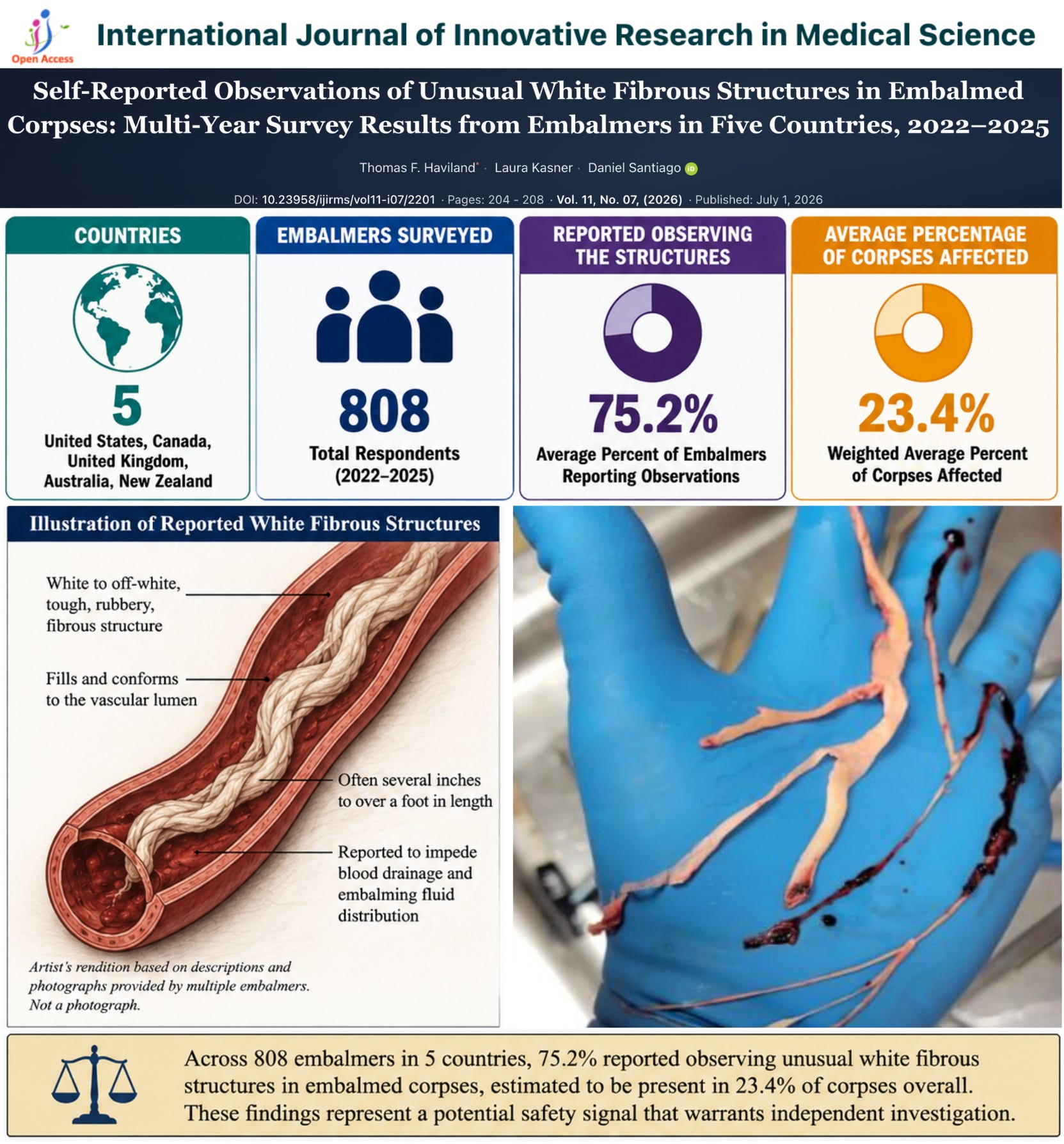
The study was led by Thomas F. Haviland, a retired U.S. Air Force Major, mathematician, and data analyst, along with Laura Kasner and Daniel Santiago, PharmD. Over four consecutive survey years from 2022 to 2025, the researchers collected responses from embalmers in the United States, Canada, United Kingdom, Australia, and New Zealand.
Across the four survey years, 808 embalmers participated.
When the multi-year results are combined, 75.2% of embalmers reported observing white fibrous clots, and the structures were estimated to be present in 23.4% of embalmed corpses overall.

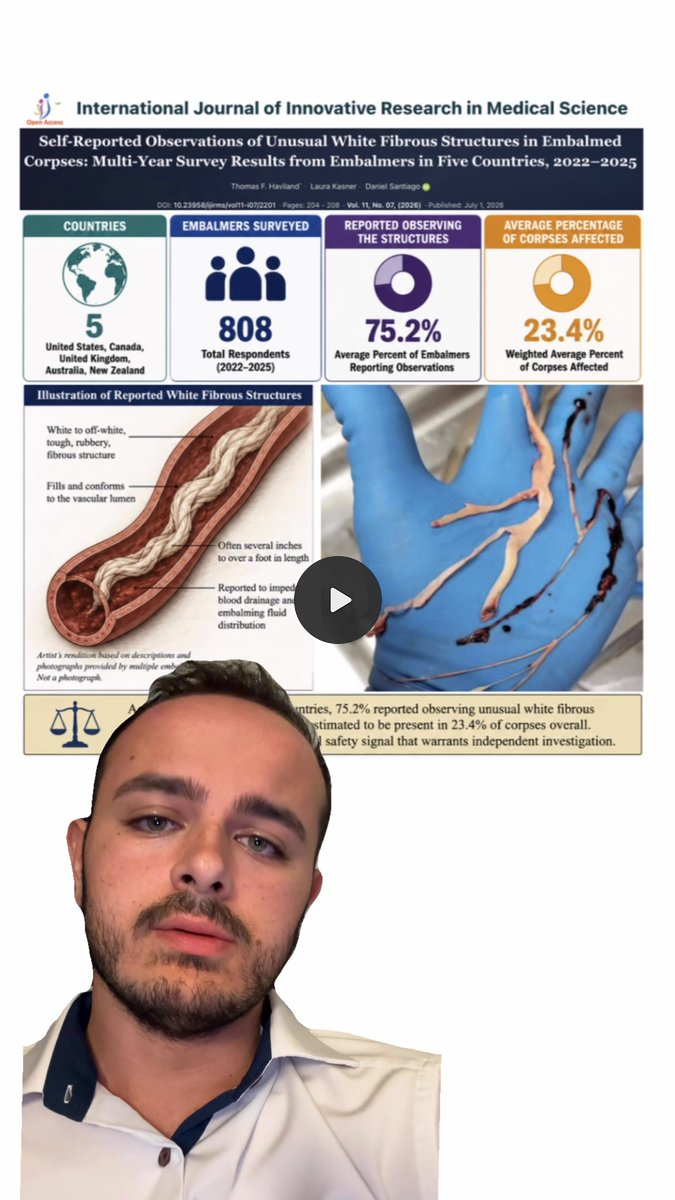

According to respondents, the structures are typically white or off-white, tough, rubbery, and often several inches to over a foot long. Many embalmers reported that they filled blood vessels, obstructed drainage, and interfered with normal embalming fluid distribution. Experienced practitioners described them as distinct from the classic “chicken-fat” and “currant-jelly” clots commonly encountered during embalming.
One of the most notable findings involved timing. In the 2022 survey, embalmers reported a marked increase in first observations beginning in 2020 and accelerating in 2021. This increase coincided with the global rollout of COVID-19 “vaccination” campaigns, during which billions of doses were administered worldwide.
A second paper published the same day went beyond survey data and performed laboratory analysis on representative samples of these fibrous structures. That study was led by Daniel Santiago, PharmD, with Greg Harrison, Miklós Veres, Mark File, and Dennis Planner, and utilized Raman micro-spectroscopy, protein quantification, and amino-acid profiling to characterize the material.
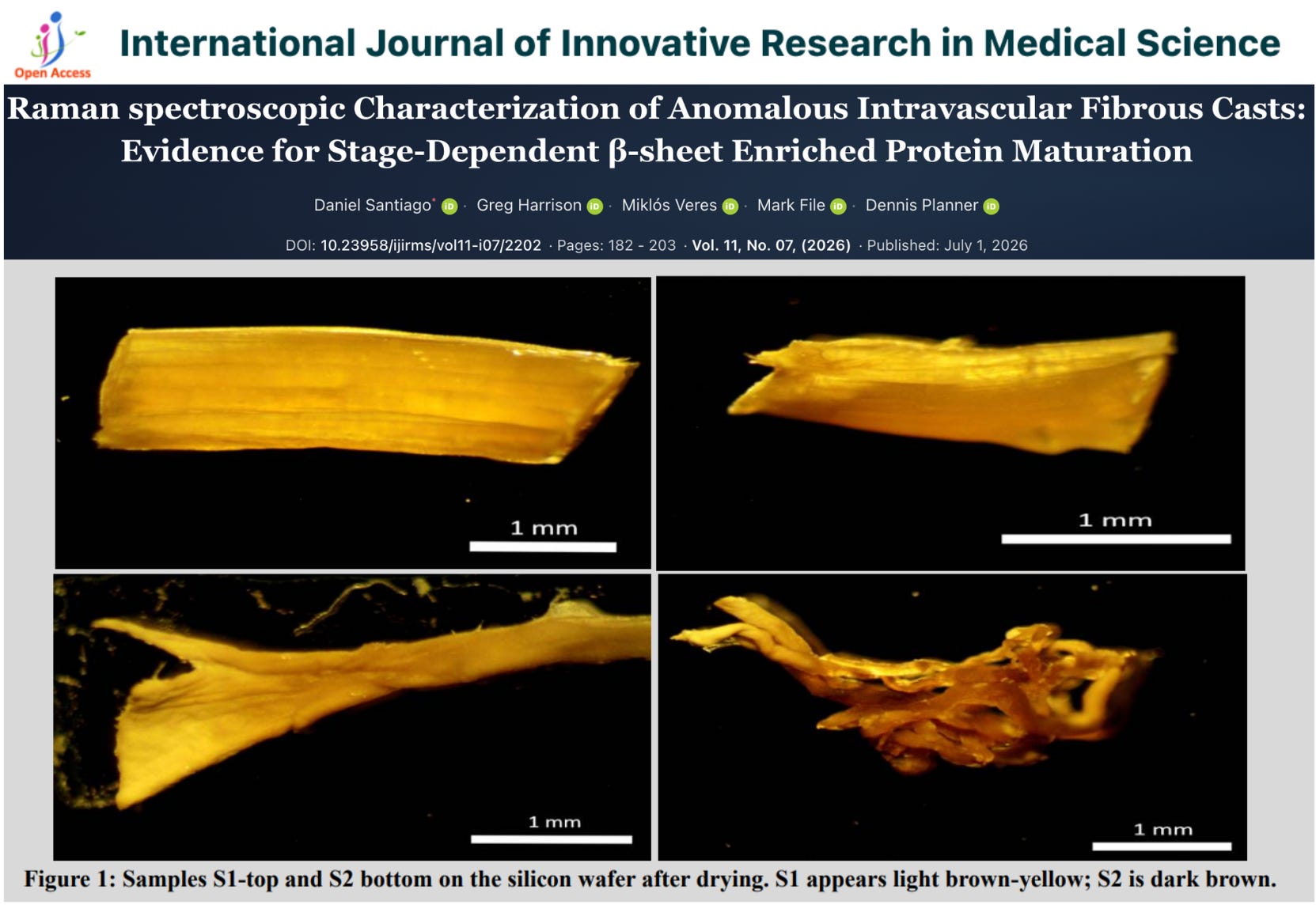
The researchers found strong protein signatures and concluded that the structures appear to represent atypical protein aggregates distinct from conventional postmortem thrombi. Spectroscopic analysis suggested a progression from a native-like α-helical state to a more advanced β-sheet-enriched configuration, consistent with stage-dependent protein aggregation.
In simple terms, the researchers found evidence that these structures are not merely ordinary blood clots. Instead, they appear to consist of abnormal protein aggregates that become increasingly organized and compact over time. This progressive structural maturation may help explain why embalmers frequently describe them as long, rubbery, resilient, and difficult to remove.
While the study found evidence of β-sheet-enriched protein aggregation—one of the hallmarks commonly associated with amyloid formation—the authors emphasized that additional testing is required before the structures can be classified as true amyloid fibrils.
These findings are especially significant when viewed alongside a previously published peer-reviewed study that found amyloid microclots in 100% of vaccinated participants, including every vaccinated “healthy control.”

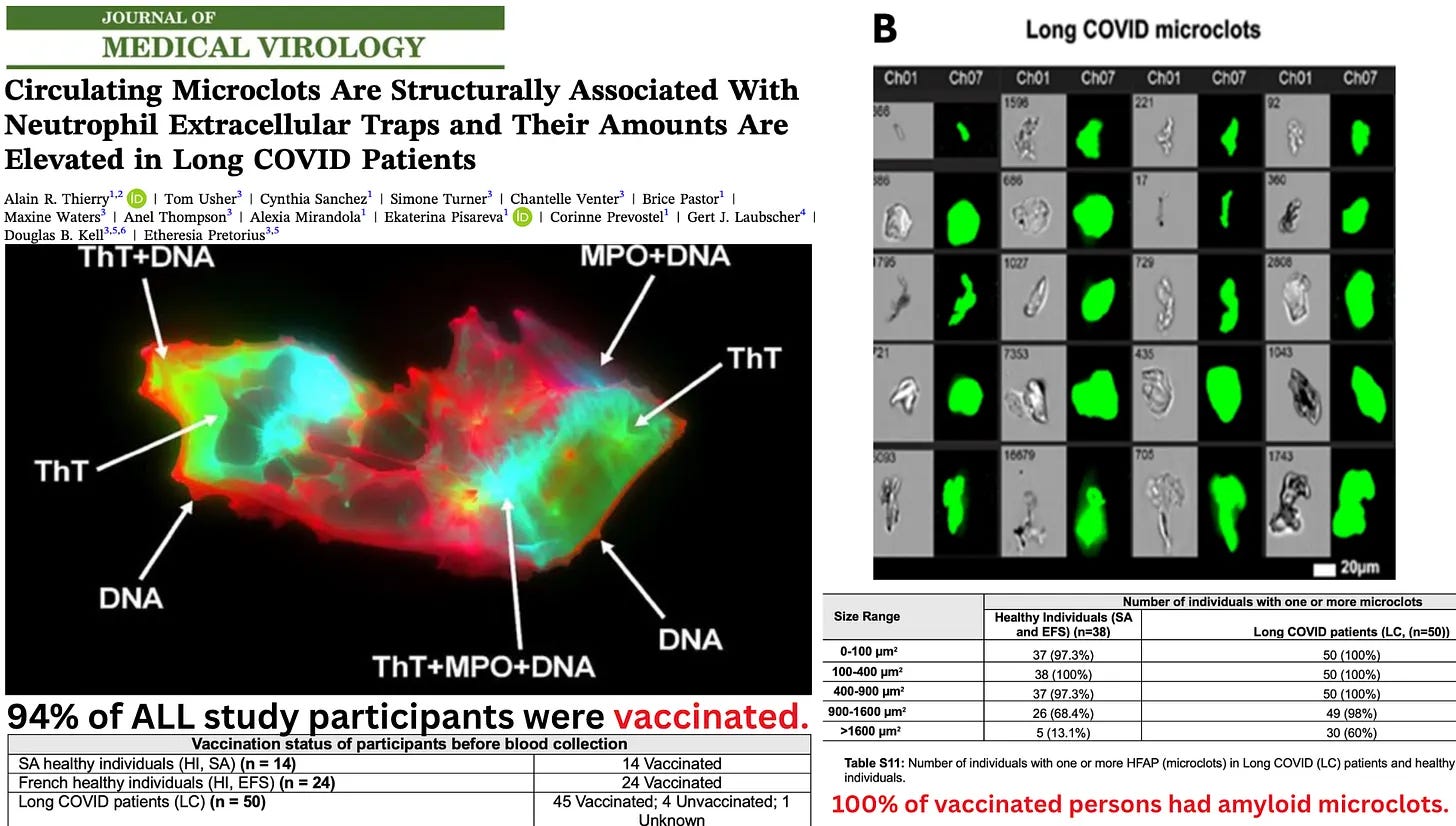
In that study, the pathological microclots were identified using Thioflavin-T, an amyloid-binding dye, and purified spike protein was shown to directly induce the formation of insoluble, fibrinolysis-resistant amyloid aggregates.
Together, these findings raise the possibility that the microscopic amyloidogenic aggregates previously documented in the blood may represent an earlier stage of the same pathological protein-aggregation process that ultimately manifests as the large, rubbery white fibrous casts now being reported by embalmers around the world.
The bottom line is simple: hundreds of embalmers across multiple countries are reporting the same unusual phenomenon, and preliminary laboratory analysis suggests these structures are not ordinary postmortem blood clots.
That must not be ignored any longer.
Epidemiologist and Foundation Administrator, McCullough Foundation
www.mcculloughfnd.org
Please consider following both the McCullough Foundation and my personal account on X (formerly Twitter) for further content.
Copyright 2026 Focal Points

It was NEVER about health! The Powers That Should Not Be were ALWAYS about they want you DEAD or a SLAVE! This is a painful truth to accept but we the people must wake up and fight back! And toxic injections/pills were/are a huge part of their arsenal!
JAB INJURIES: GROSS CALAMARI BLOOD CLOTS/AUTISM TSUNAMI/SADS/TURBO CANCER/BIZARRE TERMINAL ILLNESSES: More tragic victims of the ruling parasite genocidal enslavement agenda, sacrificed on the altar of psychopathic greed and hatred of humanity.
And BIG pHARMa is an arsenal making permanently sickly addicted slaves dependent on their products - the complete opposite of actual health.
MISTAKES WERE NOT MADE! THEY can't get rid of the 'useless eaters' fast enough!
Peddling pure poison! Folks have to wake up to reality: health comes from organic diet, daily exercise and clean living and never from a needle or a pill except in dire, rare traumatic injuries.
Proudly ANTI-VAXX! Reiterating for the sake of newbies and to support this post.
Ban all vaccine jabs! There has never been a 'safe and effective' vaccine since Edward Jenner's fraud over 200 years ago as per 'Dissolving Illusions' by Suzanne Humphries and 'Turtles All the Way Down' by Anonymous. Health can never come from a needle or pills, but from healthy eating, healthy exercise and healthy living! virustruth.net
CREATIVITY! ARTISTRY! IMAGINATION! SPIRITUALITY! HUMOR! LOVING KINDNESS! These are the best ways to fight THEM!
I also have a landline, a wired laptop and a wired monitor screen, and I never had or will have those infernal mobile devices designed to enslave you. I also use cash as much as possible, no cash is TOTAL SLAVERY.
It is heartbreaking to witness the holocausts happening and so many fellow citizens are brainwashed/bamboozled by the propaganda media, they are oblivious!
This horrifying Gates, Governor 'Gruesome Newscum', 'Lone Scum', Soros, 'Benedict' Biden and Harris and even Trump, Vance, and 'Ramaswampy' et al are blatant fully owned and operated puppets of their globalist technocrat parasite masters same as other numerous 'PUBLIC SERPENTS' infesting by design from above, the bureaucratic apparatus.
Can't say this often enough! The Military/Industrial Complex and the Biowarfare/industrial Complex, WEF agenda and the evils assaulting humanity are from one and the same source - it is the 99% against the diabolical GREED of the 0.01% who should not be in charge of anything!
The monsters in human skin suits who rule the world get a sadistic vampiric thrill and boost from perpetrating the vilest most demonic crimes against the most vulnerable (babies and small children) and then corrupting the system to get away with it scot free! We the People must stop them, there are a lot more of us than them!
Please check out this substack! ponerology.substack.com
Can't say this often enough!
SCREW THE HYPOCHONDRIA GERMAPHOBIC FEAR HYSTERIA! DO NOT CONSENT! Avian flu is for the birds! RESIST!
KEEP FIGHTING! All the perps who pushed this greatest crime against humanity, all the way down to the local level, must get their comeuppances!
Divide and rule! Agents provocateurs anyone, FALSE FLAGS, propaganda social engineering psyops? Keeping us proles at each others' throats while the globalist technocrat predators laugh all the way to the BIS and The Bank of Rothschild's!
BURN BACK BETTER!
HELL NO TO STARGATE! HELL NO TO DEEPSEEK! HELL NO TO AI! technocracy.news
Life everywhere is being assaulted by THE TECHNOCRATIC OMNIWAR! RESIST! DO NOT CONSENT TO ALL THINGS DIGITAL, 'SMART', AI, 5G, NO CASH - ALL OF IT! dhughes.substack.com Technocrat ruling class psychos get a sadistic thrill from their powers over life and death and hurting all who stand in their way and they need the resources worldwide to build their digital total slavery control grids (herd survivors into 15 minute city digital prisons)! iaindavis.substack.com
AI is designed to be anti-human/anti-life programmed by technocrat control freak psychos - garbage in = garbage out. Everyone got along just fine without all these absurd and downright satanic electronic gadgets that did not exist until recently. NOBODY NEEDS THIS AI CRAP!
PSYCHOPATHS! MEGALOMANIACS!
Bless and thank you for doing what you do.