This article originally appeared on ZeroHedge and was republished with permission.
Guest post by Tyler Durden
President Trump is once again engaged in a high risk bet in hopes that Iran will buckle to US demands after failed initial truce talks in Pakistan. The blockade now in effect as of Monday seeks to starve Iran of $200 million in daily oil revenues.
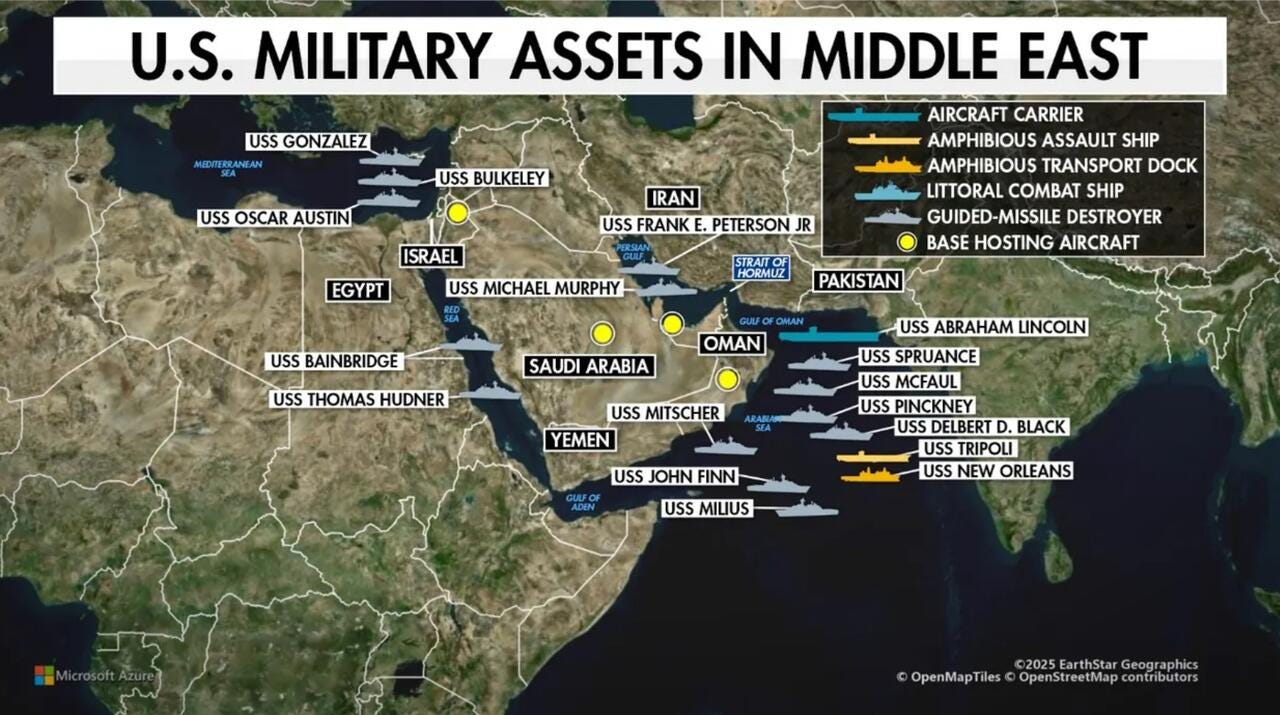
The Wall Street Journal has newly detailed that more 15 American warships are now in place to support the operation, in the Gulf of Oman and the Arabian Sea. The report further specified that “An advisory to mariners from U.K. Maritime Trade Operations, which is affiliated with Britain’s Royal Navy, said maritime-access restrictions were being enforced for Iranian ports and coastal areas along the Persian Gulf, Gulf of Oman and parts of the Arabian Sea.”
Fox News has at the same time issued a map which purports to identify 17 total naval ships deployed in the blockade area as a Monday morning. They are listed in the map and infographic below: The location of US ships around Iran as of Monday.
“Any vessel entering or departing the blockaded area without authorization is subject to interception, diversion, and capture,” a notification from US Central Command (CENTCOM) has said.
As for the advisory from the UK Maritime Trade Operations, it has warned that ships should be prepared to encounter the US blockade, and any vessels in the area must “maintain heightened situational awareness” pending more specific guidance is to follow.
It lays out that additional guidance for mariners regarding “how these measures will be applied in practice, including routing, verification and authorized transit producers, are in development”.
“These access restrictions apply without distinction to vessels of any flag engaging with Iranian ports, oil terminals, or coastal facilities,” UKMTO said of the threatened blockade.
It added: “Further clarification is expected to be provided through subsequent advisories as information becomes available.”
In the meantime Gulf states are still calling on Iran to stop using the Strait of Hormuz as leverage and as a bargaining chip. The latest Gulf leader to speak out is Qatari Prime Minister Sheikh Mohammed bin Abdulrahman bin Jassmin Al-Thani.
He announced that he said he spoke with his Iranian counterpart on the issue on Monday. “Sheikh Mohammed emphasized the need for all parties to respond positively to ongoing mediation efforts, calling for dialogue and peaceful means to address the root causes of the crisis and reach a sustainable agreement that prevents renewed escalation,” the Qatari PM’s office said in a statement.
“He also underlined the importance of keeping maritime routes open and ensuring freedom of navigation, warning against using them as a bargaining chip,” the statement continued.
“His Excellency further cautioned that any disruption to shipping lanes could have serious consequences for countries in the region, as well as for global energy and food supplies, with wider implications for international peace and security,” it added.


Soon after the blockade having taken effect, Trump issued a Truth Social message warning that if any of Iran’s ships - which he says at this point are merely small ‘fast attack ships’ - come “anywhere close to our blockade, they will be immediately eliminated.” He described this will be “the same system of kill that we use against the drug dealers” - in reference to the Caribbean and prior Venezuela operations.
Copyright 2026 ZeroHedge