
This article originally appeared on Jon Fleetwood’s Substack and was republished with permission.
Guest post by Jon Fleetwood
A new bill introduced last week in the Kansas Legislature would prohibit government agencies, employers, schools, and businesses from denying services or employment based on a person’s medical decisions, including whether they accept or refuse vaccines, tests, masks, or other medical interventions.
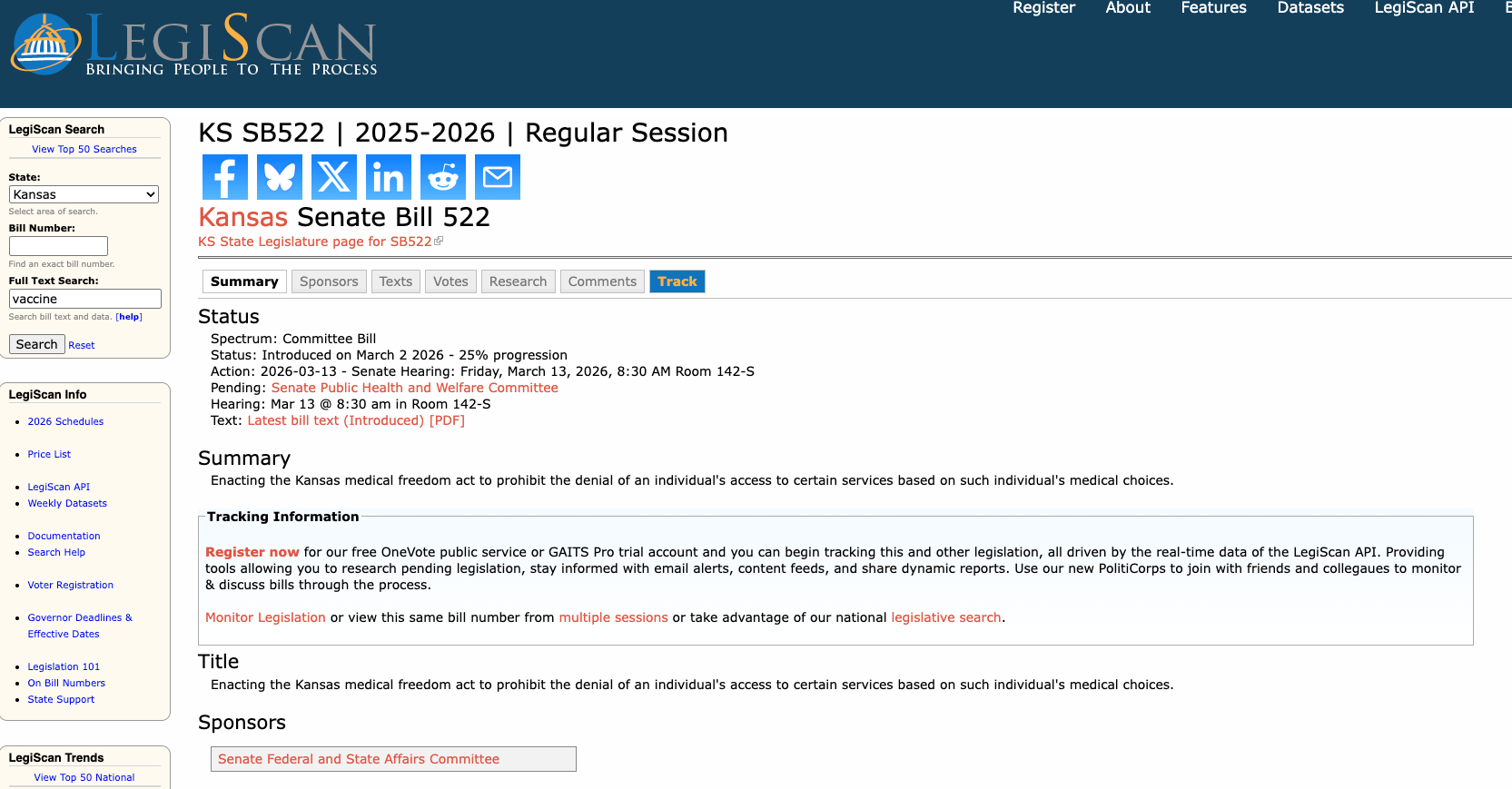
The legislation, Kansas Senate Bill 522, was introduced March 2, 2026, during the 2025–2026 legislative session and is currently pending before the Senate Public Health and Welfare Committee, where lawmakers are scheduled to consider the measure in a committee hearing.
The bill was requested for introduction by the Kansas Senate Committee on Federal and State Affairs, a legislative committee responsible for advancing policy proposals related to statewide governance and regulatory matters.
You can contact Kansas state senators here and voice your support for the bill.
What the Bill Would Do
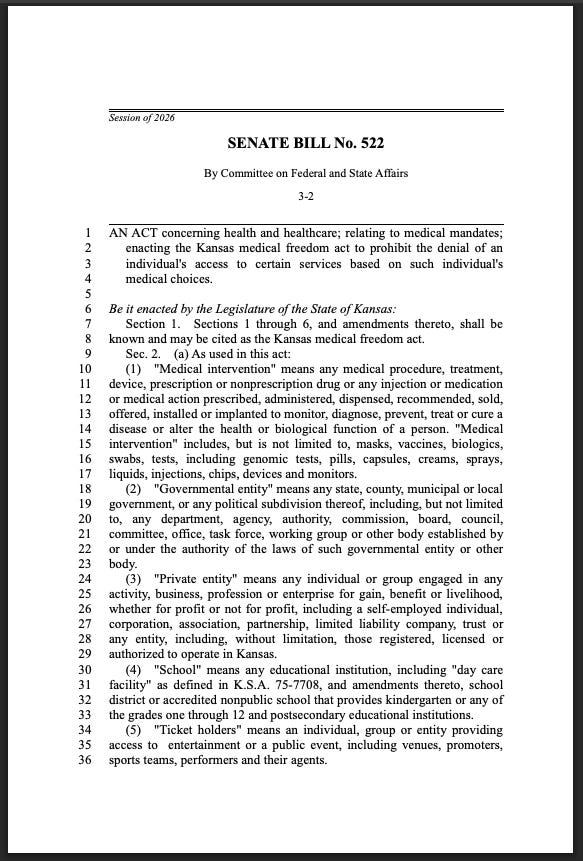
SB522 would establish the “Kansas Medical Freedom Act,” prohibiting both government and private entities from denying services, employment, access to events, or public benefits based on whether an individual accepts or refuses a medical intervention.
The legislation defines “medical intervention” broadly to include vaccines, masks, diagnostic tests, medications, devices, and other health-related treatments.
Under the proposal:
Private businesses could not deny services or access to individuals based on their use or refusal of medical interventions.
Employers—both public and private—could not require medical interventions as a condition of employment.
Schools, conferences, and educational institutions could not require medical interventions for entry or participation.
Government agencies could not condition licenses, permits, benefits, or access to public buildings or transportation on compliance with a medical intervention.
The bill also states that these protections would apply even during declared emergencies, meaning they could not be suspended during a public health crisis or state of emergency.
Individuals who believe their rights were violated under the law could file complaints with the Kansas Attorney General, who would be authorized to investigate and impose civil penalties of up to $50,000 per violation.
Strengths of the Bill—& Areas Lawmakers May Want to Strengthen
One of the strongest provisions of SB522 appears in Section 5, which states:
“The provisions of this act shall apply at all times and shall not be suspended, nullified or otherwise disregarded during any declared emergency, public health crisis or state of emergency issued by any local, state or federal authority.”
This language is significant because pandemic mandates were largely justified under emergency powers.
By stating the law cannot be suspended during emergencies—including those declared by federal authorities—the bill attempts to close the same legal pathway used during COVID-19 to impose vaccine mandates, mask mandates, and other public health orders.
At the same time, several areas could be strengthened before final passage.
First, while the bill is titled as legislation “relating to medical mandates,” its core mechanism is to prohibit the penalties used to enforce those mandates. The bill bars governments, employers, schools, and businesses from denying employment, services, or access to venues based on an individual’s acceptance or refusal of a medical intervention. By removing the primary enforcement tools used during COVID—such as job loss, service denial, or exclusion from public spaces—the legislation effectively makes medical mandates extremely difficult to enforce in practice. Lawmakers may nevertheless wish to clarify this further by explicitly stating that governments cannot impose universal mandates for vaccines, testing, masking, or other medical interventions.
Second, the bill does not address quarantine or isolation powers, which were heavily used during the COVID response. Current public health statutes often allow officials to restrict movement or isolate individuals during outbreaks. Legislators could consider adding due-process protections, such as requiring individualized medical evidence or court orders.
Third, although the bill effectively blocks discrimination tied to vaccination status, it does not explicitly prohibit vaccine passport systems. Stating this directly could remove ambiguity.
Fourth, the legislation does not address insurance or financial discrimination tied to medical decisions, such as premium surcharges or employer penalties imposed on individuals who decline certain medical interventions.
Finally, enforcement depends largely on investigations by the Kansas Attorney General, who may issue civil penalties for violations. Some lawmakers may consider adding a clearer private right of action, allowing individuals to sue directly if their rights under the law are violated.
Taken together, SB522 represents a significant attempt to prevent COVID-style medical mandates and discrimination, while leaving several areas where lawmakers could further strengthen the protections before the bill reaches final passage.
Legislative Status
SB522 was formally introduced in the Kansas Senate on March 2, 2026 and referred for further review as it moves through the legislative process.
A Senate hearing on the bill has been scheduled, where lawmakers will review testimony and determine whether the proposal advances to the next stage of consideration.
If approved in committee, the legislation would proceed to the Kansas Senate floor for debate and a vote, followed by consideration in the House of Representatives before potentially reaching the governor’s desk.
Committee Behind the Bill
The legislation was introduced by the Kansas Senate Committee on Federal and State Affairs, whose members include:
Sen. Mike Thompson–Chair
Sen. Rick Kloos–Vice Chair
Sen. Oletha Faust-Goudeau–Ranking Minority Member
Additional members of the committee include:
Sen. Chase Blasi
Sen. Cindy Holscher
Sen. Jeff Longbine
Sen. Mike Petersen
Sen. Ronald Ryckman
Sen. Alicia Straub
The committee is responsible for sponsoring and introducing certain legislation on behalf of the Kansas Senate.
Next Steps
The bill now awaits further consideration in the Senate committee process, where lawmakers will determine whether the Kansas Medical Freedom Act advances to a full Senate vote.
If enacted, the legislation would establish statewide protections against vaccine mandates and other forms of medical intervention requirements across Kansas’ public institutions and private sector.
Copyright 2026 Jon Fleetwood