This article originally appeared on Focal Points and was republished with permission.
Guest post by John Leake
Hats off to Nicholas Hulscher, Peter McCullough, Harvey Risch et al. for their newly published paper on the anti-cancer properties of Ivermectin and Mebendazole.
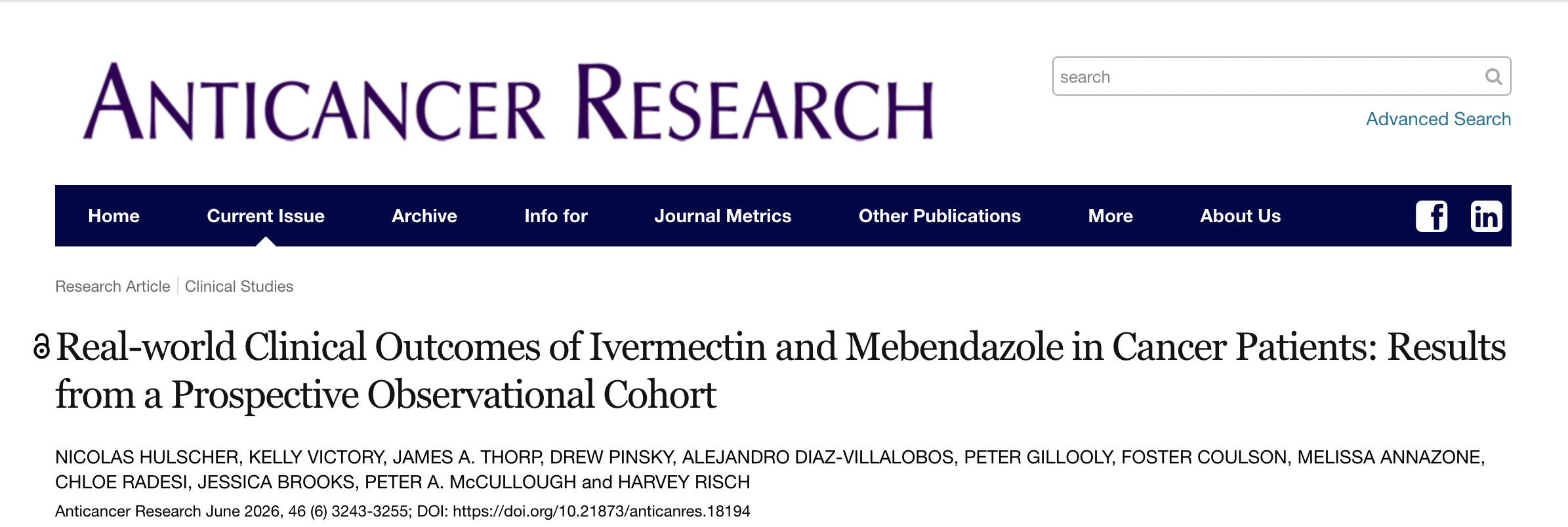
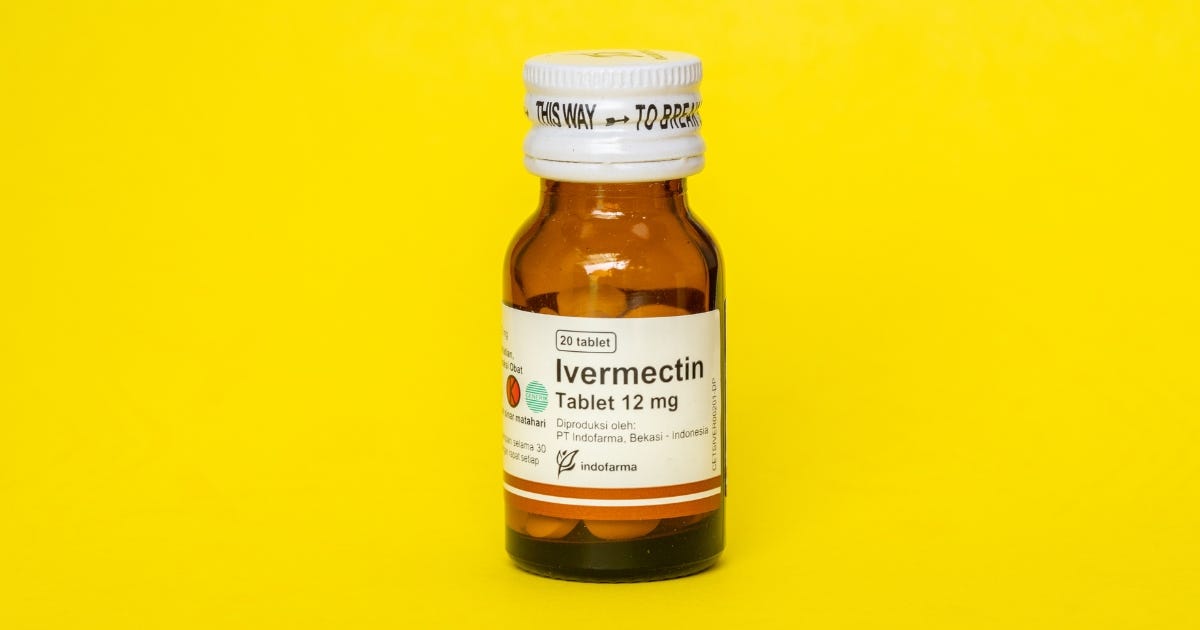
Reading the study prompted me to review the fascinating story of Ivermectin — the wonder drug with a marvelously wide range of bioactive properties.
Increasingly I wonder if the “War on Ivermectin”—as Dr. Pierre Kory described the ferocious smear campaign that was waged by government health agencies against the compound—was not only to suppress ivermectin for the treatment of COVID-19, but also to sabotage general interest in how the cheap, off-label drug could be useful against other maladies such as cancer.
Those interested in learning more about the story of ivermectin and the nihilistic war that was waged against it may enjoy reading Chapter 12 of my book (with Peter A. McCullough, MD) The Courage to Face COVID-19.
CHAPTER 12: The Wonder Drug
On April 3, 2020, while the media was fixated on President Trump’s endorsement of hydroxychloroquine and Governor Cuomo’s performances, a research team at the Monash University of Australia published a study on the anti-parasitic drug ivermectin. The team concluded:
Ivermectin is an inhibitor of SARS-CoV-2 virus in vitro. A single treatment effected approximately 5000-fold reduction in virus at 48 h in cell culture. Ivermectin is FDA-approved for parasitic infections and included on the WHO model list of essential medicines, and is thus widely available.
It would be hard to overstate the significance of this discovery. Like penicillin, derived from the Penicillium mold, ivermectin is a bioactive compound of natural origin, derived from the Streptomyces avermectinius bacterium. The discovery of this bacterium and its derivative drug, ivermectin, is one of the most fascinating in medical history. Since its large- scale human distribution began in 1989, ivermectin has cured two great scourges that had, for centuries, afflicted millions of people in the tropics— Onchocerciasis (commonly known as River Blindness) and Lymphatic filariasis (commonly known as Elephantiasis).
The Steptomyces avermectinius bacteria was discovered by the Japanese biochemist Satoshi Ōmura in woodland soil near a golf course on the southeast coast of the island of Honshu, Japan. Dr. Omura isolated the bacterium from this soil sample—the only in which it has ever been found— and sent it to his colleague William Campbell at the Merck Institute of Research in the United States. From this bacterium, Campbell derived the compound macrocyclic lactone, which he gave the name ivermectin. Quickly Campbell determined it was a potent killer of parasitic roundworms with virtually no toxicity for animals, and in the early eighties, ivermectin became a blockbuster in veterinary medicine.
Another Merck scientist, Mohamed Aziz, then worked with the World Health Organization to test ivermectin against River Blindness in humans. They found the drug to be extremely safe and effective, prompting Merck to initiate a mass donation program to countries in which the disease was endemic. Ivermectin thereby earned the rare title of “wonder drug,” protecting millions of people from River Blindness and Elephantiasis.
For their spectacular contribution to human health, Satoshi Omura and William Campbell received the Nobel Prize in Medicine in 2015,95 but the story of ivermectin didn’t end there. The February 15, 2017 issue of The Journal of Antibiotics featured a report titled Ivermectin: enigmatic multifaceted ‘wonder’$drug continues to surprise and exceed expectations. The report presented ivermectin’s therapeutic properties against an array of pathogens, including viruses.
Ivermectin has been found to potently inhibit replication of the yellow fever virus.... It also inhibits replication in several other flaviviruses, including dengue, Japanese encephalitis and tick-borne encephalitis ... Ivermectin inhibits dengue viruses and interrupts virus replication, bestowing protection against infection with all distinct virus serotypes, and has unexplored potential as a dengue antiviral. ... Ivermectin has also been demonstrated to be a potent broad-spectrum specific inhibitor of importin α/β-mediated nuclear transport and demonstrates antiviral activity against several RNA viruses by blocking the nuclear trafficking of viral proteins. It has been shown to have potent antiviral action against HIV-1 and dengue viruses ...
This 2017 report on ivermectin resembled a 2012 Israeli study on hydroxychloroquine’s array of benefits and unexplored potential. Both medicines—like penicillin and aspirin—derived from compounds found in nature. Many of the most useful drugs in history are of natural origin. Eleven percent of the WHO’s list of 252 Essential Medicines were found in flowering plants. As pharmacology professor, Dr. Ciddi Veeresham, put it in a 2012 paper.
Nature, the master of craftsman of molecules created almost an inexhaustible array of molecular entities. It stands as an infinite resource for drug development, novel chemotypes and pharmacophores, and scaffolds for amplification into efficacious drugs for a multitude of disease indications and other valuable bioactive agents.
Dr. Omura spent most of his career scouring nature for useful molecules. Ivermectin was just one of many he discovered, though it was certainly the most useful. The cheap generic drug now has a top safety profile, obtained from 250 million people who have taken it annually for decades. No wonder the Monash University research team decided to investigate the possibility that ivermectin had anti-viral potential against SARS-CoV-2.
Following the publication of their study on April 3, research teams and independent doctors all over the world studied ivermectin for the treatment of COVID-19, and soon several favorable reports were published. However, as was the case with positive reports on hydroxychloroquine in February and March, the silence of U.S. public and university research institutions about ivermectin’s promise was deafening. No hopeful mention of the drug or calls to research it on federal health agency websites or press briefings. Nothing mentioned about it on evening news shows. No op-eds in major newspapers by medical scientists.
The only public health agency that mentioned the April 3 Australian study was the FDA’s Center for Veterinary Medicine. On April 10, its Director, Dr. Steven Solomon, issued a Letter to Stakeholders: Do Not Use Ivermectin Intended for Animals as Treatment for COVID-19 in Humans. The statement expressed concern about consumers taking veterinary preparations of ivermectin and gave notice that the FDA was investigating fraudulent COVID-19 remedies for possible enforcement action. Regarding ivermectin’s apparent promise in treating Covid, Dr. Solomon stated, “Additional testing is needed to determine whether ivermectin might be safe or effective to prevent or treat coronavirus or COVID-19.”98 Implied in this statement was that some researcher might get around to testing ivermectin. However, until his test results were approved by the FDA, the public would just have to accept that there were no treatments for the disease.
A notable exception to the lack of ivermectin research in the U.S. was a study performed by Drs. Jean-Jacques and Juliana Cepelowicz Rajter—a husband and wife team who owned an independent pulmonary practice in Florida. They conducted a retrospective cohort study of 280 consecutive patients hospitalized at four Broward Health hospitals with confirmed SARS-CoV-2, of whom 173 were treated with ivermectin and 107 with usual care were reviewed. The study showed “lower mortality in the ivermectin group (15.0% versus 25.2%). Mortality was also lower among 75 patients with severe pulmonary disease treated with ivermectin (38.8% vs 80.7%).” This extremely positive study was published in preprint on the medRxiv server on June 6, 2020 and received zero public health agency or media attention. The NIH and BARDA remained silent about it. Later the study was published in the prestigious CHEST journal of pulmonary medicine, and again received no MSM or health agency attention.
In the months that followed, favorable reports about ivermectin were published all over the world. These included case studies from independent doctors, epidemiological studies in India, Peru, and Mexico, and clinical trials. These showed high safety and significant benefit from ivermectin in Covid patients. Nevertheless, this “Wonder Drug” that had relieved immense suffering from other illnesses and won its discoverers the Nobel Prize in 2015 was ignored by the US Bio-Pharmaceutical Complex until August 27, 2020, when the NIH issued a recommendation against using it.
In the six months that followed the NIH’s negative advisory, several additional high-quality studies showing ivermectin’s efficacy were published. By January 11, 2021, the tally had reached 64 controlled trials— 32 randomized, and 16 double-blinded. Nevertheless, the NIH never recommended the drug, and the FDA never approved it for COVID-19—not even under the “compassionate use” provision for sick patients for whom nothing else was working.
Copyright 2026 Focal Points