This article originally appeared on ZeroHedge and was republished with permission.
Guest post by Tyler Durden
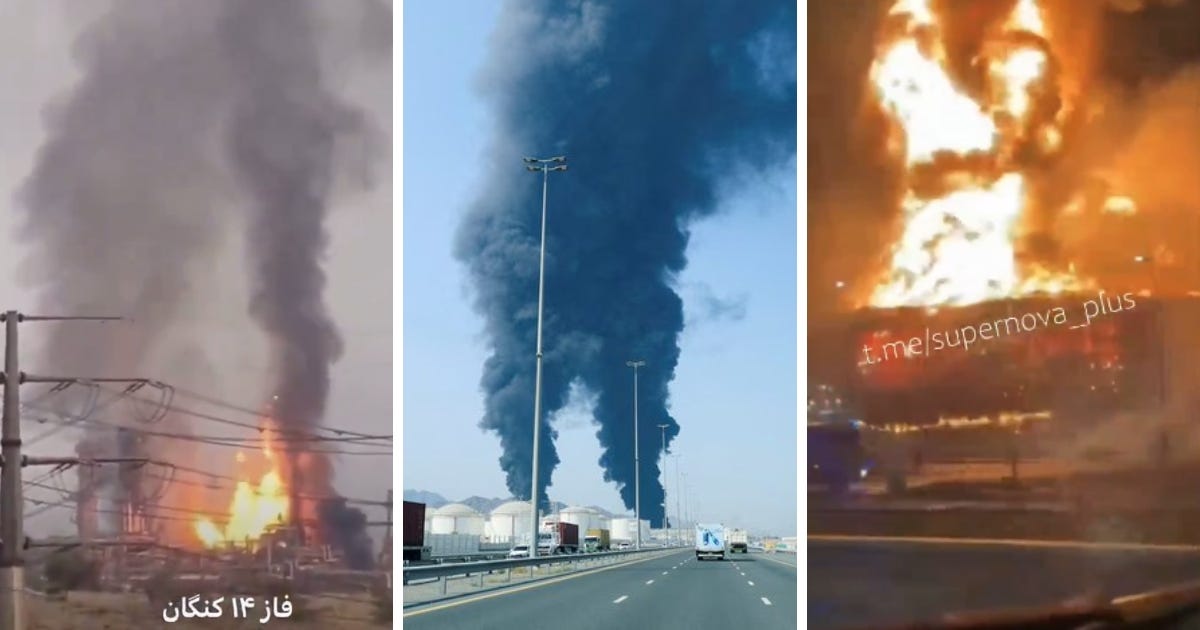
Crude oil futures rose in overnight trading, with Brent nearly reaching $105 per barrel and WTI climbing as high as $98.42 per barrel, as Iran intensified drone strikes on energy infrastructure across the Gulf.
“Further ominous developments today. For the first time, Iran successfully targeted oil and gas production facilities, rather than refining, terminals, and storage,” Bloomberg Opinion and commodities columnist Javier Blas wrote on X.
Blas listed the IRGC’s attacks on Gulf oil and gas facilities:
Oil and gas field in the UAE (Shah) hit
Oil field in Iraq (Majnoon) attacked
Plus Saudi Arabia saw large drone swarms
He explained that these attacks suggest “Iran has started a new phase of its oil war“ against Gulf states aligned with the US.


"Tehran is clearly going after the Strait of Hormuz bypass route, with Fujairah (UAE) coming under attack. But so far, the Saudi pipeline bypass hasn't been attacked, and neither the Yemeni Houthis have tried to close the Red Sea," Blas said.


The continued bombardment of Gulf energy infrastructure by IRGC forces entered its third week, with the Strait of Hormuz mostly paralyzed.


Brent crude has jumped more than 40% since the start of Operation Epic Fury in late February, but out-of-control spikes in crude markets have largely been capped so far by the IEA’s 32-nation “historic” emergency SPR release.
To begin the week, the Trump administration showed urgency to reopen the critical maritime chokepoint, the Strait of Hormuz.
Treasury Secretary Scott Bessent told CNBC’s Squawk Box on Monday morning that the US is deliberately “allowing Iranian oil tankers to transit the Strait of Hormuz” and is “fine” with some Indian and Chinese ships moving through “for now… to supply the rest of the world.”
Bessent highlighted “more and more of the fuel ships start[ing] to go through” and a possible “natural opening” the Iranians are permitting, a tactical concession to stabilize global supply while full escorts remain “militarily” off the table for now.
Last week, we highlighted JPMorgan’s head of commodity research, Natasha Kaneva, who warned that policy measures will have, at best, a limited impact on oil prices unless safe passage through the Strait of Hormuz is assured, given the potential for up to 12 mbd in losses over the next two weeks.
Kaneva noted that Strait traffic is likely to become “increasingly conditional,” with Iran permitting passage for some vessels depending on their affiliation.
“The biggest risk in the market is the Strait of Hormuz remaining constrained for a longer stretch and the market feeling the US and its allies have a limited capacity to alter the dynamic,” Pepperstone Group analyst Chris Weston said.
Trump’s move to reopen the Hormuz chokepoint with a naval coalition largely fell flat at the start of the week. Allied countries, including Australia, Germany, and Japan, said they weren’t planning to send their warships through the critical waterway to shadow commercial tanker traffic.
In the US, the effects of an energy shock from the Middle East, according to new AAA data, show regular gas at the pump has jumped the most for any single month on record, up 25% so far in March.
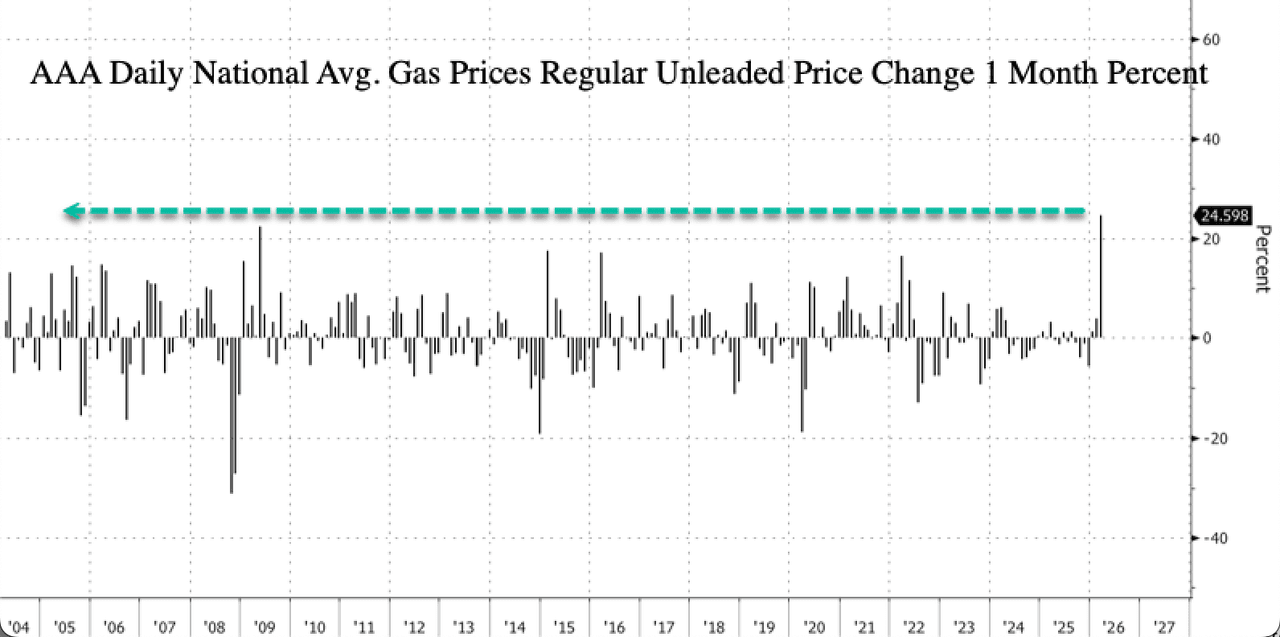
The US national average for regular gas could very well be headed for the politically sensitive $4 mark.
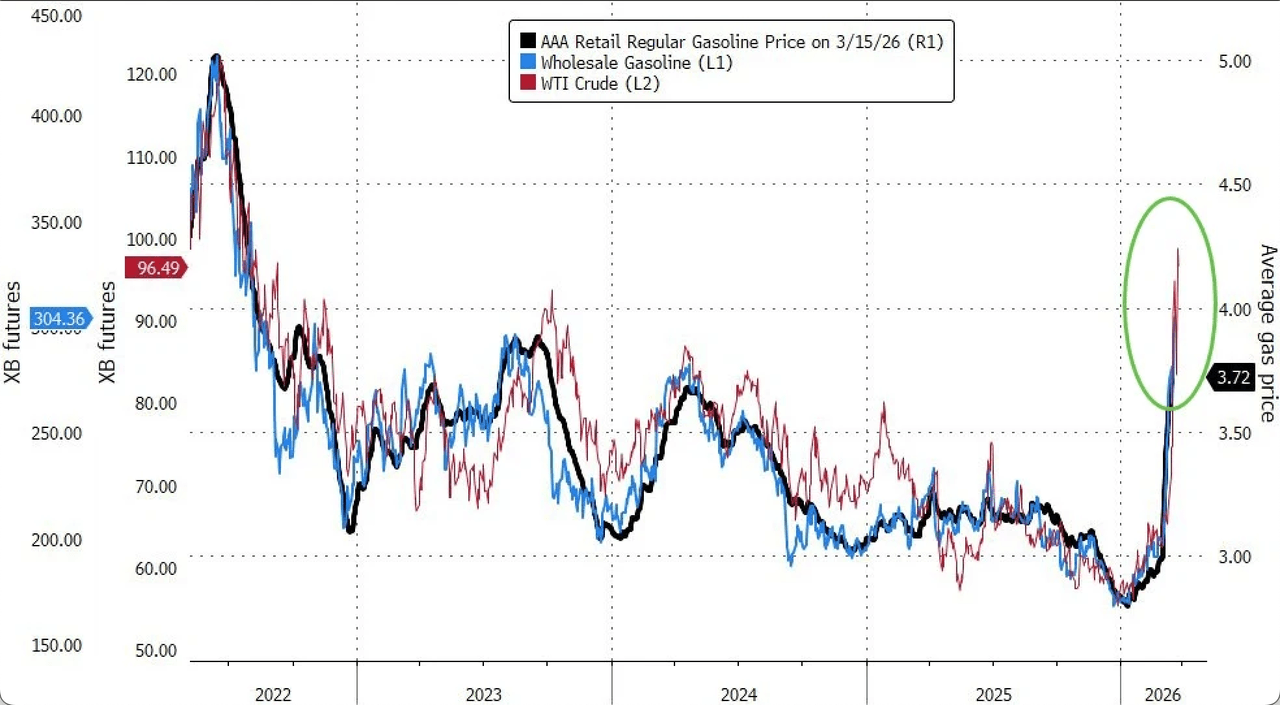
AAA data also showed the nationwide average retail price for diesel hit $5 a gallon, for the first time since December 2022.

On Monday, JPMorgan analysts asked, “Is there an off-ramp?” to the Middle East conflict. That answer remains unclear at the moment. While the Trump administration is searching for an off-ramp, that may take a few more weeks.
Copyright 2026 ZeroHedge