This article originally appeared on The Defender and was republished with permission.
Guest post by Brenda Baletti, Ph.D.
“There is a struggle brewing” over the science behind the Hep B vaccine, said Children’s Health Defense Senior Research Scientist Karl Jablonowski after a report this week that Hep B vaccination rates plummeted 10 percentage points over two years. Health officials in the West African country of Guinea-Bissau canceled a controversial study designed to test the safety of the vaccine.
“There is a struggle brewing” over the science behind the hepatitis B (Hep B) vaccine, said Children’s Health Defense (CHD) Senior Research Scientist Karl Jablonowski after a report this week showed that Hep B vaccination rates plummeted 10 percentage points over two years.
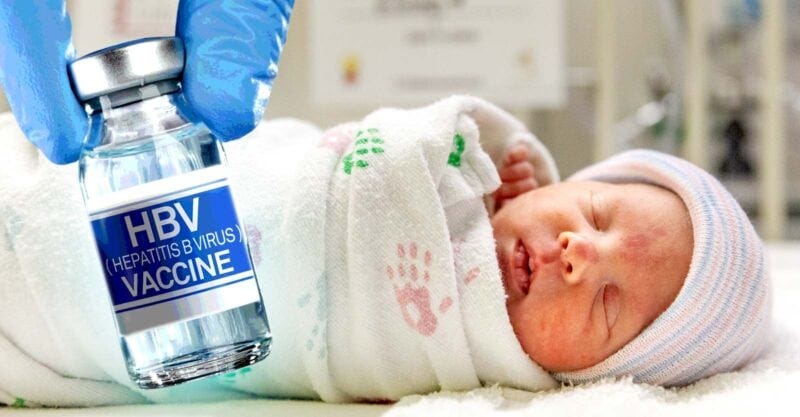
Birth-dose Hep B vaccination rates rose from 67.5% in January 2017 to a peak of 83.5% in February 2023 — then fell sharply to 73.2% by August 2025, according to an analysis of electronic health records published in a Feb. 23 JAMA Research Letter.
The decline occurred before December 2025, when the Centers for Disease Control and Prevention (CDC) ended its universal recommendation that newborns receive the Hep B vaccine within 12-24 hours of birth.
The medical freedom movement insists that adequate research has not been done on the vaccine’s safety, Jablonowski said. On the other side, mainstream public health officials maintain the shot is “safe and effective” and “the science is settled.”
“Onlookers and pediatricians are rightly confused,” Jablonowski told CHD.TV host Polly Tommey. “The ‘safe-and-effective’ crowd is really well-organized and well-funded.” He said public health officials have been actively trying to bolster public confidence in the vaccine’s safety.
Canceled Guinea-Bissau study: ‘missed opportunity for science to do science’
A $1.6 million grant from the Centers for Disease Control and Prevention (CDC) to study the short- and long-term health effects of the Hep B vaccine in 14,000 newborns in Guinea-Bissau triggered a cascade of criticism that led officials in the West African country to shut down the study this month.
“It’s not going to happen, period,” Foreign Minister Joao Bernardo Vieira told Reuters. Vieira said the study was canceled in response to criticism from researchers and members of the U.S. Congress.
The CDC awarded the non-competitive grant in December 2025 to researchers Peter Aaby and Christine Stabell Benn from the University of Southern Denmark.
The researchers planned to give the vaccine to half of the newborns in the trial and withhold it from the other half.
Guinea-Bissau, which has a high rate of adult cases of hepatitis B, does not currently administer the Hep B vaccine to newborns. The country plans to standardize the use of the birth dose — but not until 2028.
Critics attacked the study because they said it was unethical to give only half of the infants the vaccine, even though the vaccine won’t be available for newborns in Guinea-Bissau until 2028.
When news first broke about the study, Rolling Stone attacked the study and the U.S. Department of Health and Human Services (HHS), citing calls by U.S. mainstream public health experts to cancel the study.
Rolling Stone cited internal CDC emails between officials who called the study a “funding priority.” The article accused HHS of funding the study to generate scientific justification for HHS Secretary Robert F. Kennedy Jr.’s plan to end the Hep B birth dose recommendation.
Rolling Stone quoted prominent vaccine developer and promoter Dr. Paul Offit, who called the study “Kennedy’s ‘own Tuskegee experiment.’”
But the researchers said that if the study had gone forward, they wouldn’t have been withholding the vaccine from any children. They just planned to track outcomes among those who get the additional birth disease as the transition happens.
Currently, children in Guinea-Bissau receive the Hep B vaccine at 6, 10 and 14 weeks of age.
“The most ethical and sound time to study vaccinated versus unvaccinated infants is when a country is transitioning from one policy to another,” Jablonowski said. “But doing a study like that, during that transition period, is when it’s also the most threatening to the ‘safe and effective’ narrative.”
Jablonowski called the cancellation of the study a “missed opportunity for science to do science.”
He added:
“The interference of non-science actors and uninformed ethicists, who seem completely unaware that the birth dose is not currently given in Guinea-Bissau, is preventing knowledge. It is not a mere red flag or a warning sign that science could be under assault. It is an act of information warfare with the aim of, in their own words, ‘support for their preordained conclusions about the hepatitis B birth dose.’”
The World Health Organization (WHO) recommends the Hep B vaccine at birth in low-income settings, but there is limited evidence about the broader health effects of the vaccine, such as its effects on morbidity and mortality, autoimmune issues, and other health outcomes, according to the proposal for the now-canceled study.
Critics challenge Hep B review by Vaccine Integrity Project
The Vaccine Integrity Project launched in April 2025 in a bid to “shore up U.S. vaccination policy,” which the project’s founders said is under threat from HHS and Kennedy.
The organization says it is dedicated to “safeguarding vaccine use in the U.S.” Funding comes from an unrestricted gift from iAlumbra, a nonprofit founded by Walmart heiress and philanthropist Christy Walton.
Former CDC Director Rochelle Walensky is the Vaccine Integrity Project’s adviser of medical affairs. In 2022, Walensky admitted the CDC gave false information about COVID-19 vaccine safety monitoring.
Just before the December 2025 meeting of the Advisory Committee on Immunization Practices (ACIP) — when the committee was slated to discuss the Hep B vaccine — the Vaccine Integrity Project released its own review of the vaccine.
The review supported vaccinating all newborns at birth, rather than delaying the vaccine in cases where the mother tests negative for hepatitis B.
Walensky and colleagues published a corresponding op-ed in JAMA advocating for the Hep B birth dose, based on their findings from the review.
Project’s reviewed studies that ‘never should have been included’
In February, they published a version of their report as a review article in the journal Pediatrics. The review study included 17 articles, “most of which had really small sample sizes or a really short outcome window, or both,” according to Jablonowski.
Jablonowski is analyzing the validity of the studies, which he said showed high numbers of adverse event reports and large study drop-out rates.
He said a 2004 study in the Pediatric Infectious Disease Journal “never should have been included.” The study, part of the Vaccine Safety Datalink Project, used a cohort of over 350,000 live births at Kaiser Permanente in California between 1993 and 1998 to examine whether receiving a Hep B vaccine at birth was associated with neonatal death.
The researchers matched vaccinated and unvaccinated babies among the 1,363 neonatal deaths recorded to compare health outcomes. They said they found no significant difference in the proportion of Hep B vaccinated (31%) and unvaccinated (35%) neonates dying of unexpected causes.
Jablonowski said that when the researchers matched vaccinated and unvaccinated infants for the study, they did not match them by key factors such as gestational age or birth weight. Infants in the vaccinated group were overall healthier, larger and older than those in the unvaccinated group.
“It’s not an unvaccinated versus vaccinated comparison,” Jablonowski said. “It’s a full-term vs. extremely premature and low birthweight babies comparison.”
Still, the Vaccine Integrity Project researchers summarized the study as showing “no increase in infant deaths attributed to Hep B vaccination,” he said, “which you cannot conclude from this study.”
‘Hep B birth dose has never been shown to be safe’
Even the strongest study included in the review had major limitations, Jablonowski found. It was a WHO Bulletin retrospective study comparing 818 vaccinated and unvaccinated infants.
For example, all of the infants were extremely premature, making them outlier cases not appropriate for extrapolating to all infants, Jablonowski said.
The authors concluded that the vaccine was not linked to any change in all-cause mortality. However, they based their conclusion on a cohort size that is “too small by orders of magnitude to make such claims with statistical validity,” he said.
Because the study was retrospective, not a clinical trial, there were also differences in the infants whose families had decided to vaccinate them.
Similar to the 2004 study, vaccinated children had higher birth weight, less congenital heart disease, were born to younger mothers and were less likely to be born to indigenous people. All of those factors can affect health outcomes.
The broad claims made in the article based on very limited data from a small and unique group are extremely questionable, according to Jablonowski.
“I don’t know what’s more abhorrent, the authors concluding with ‘our findings provide support to existing WHO recommendations to immunize all infants’ — or that Walensky leans on it to assert the safety of the Hep B birth dose,” he said.
The review article is “deliberately one-sided, blinded to any notion of hazard, and timed to influence policy — meeting the definition of propaganda,” Jablonowski added.
He said:
“It does not objectively review the literature and draw reasonable conclusions, invalidating any notion that this is science.
“Scientists lose their objectivity when they attempt to influence policy. That loss of objectivity did not allow the authors to acknowledge what is obvious from their own collection of safety studies: that the Hep B birth dose has never been shown to be safe.”
Related articles in The Defender
CDC Vaccine Panel Votes to End Universal Hep B Vaccine for Newborns
Sparks Fly as ACIP Members Debate Hep B Vaccine for Newborns, Delay Vote Again
Medical Establishment Mounts PR Blitz Amid Reports CDC Plans to Scrap Hep B Vaccine for Newborns
Safety Data on Hepatitis B Vaccine for Newborns ‘Sadly Lacking’
CDC Plan to Review Hep B Vaccine for Babies Sends Mainstream Media into Tailspin
CDC Vaccine Advisers May Roll Back Recommendation for Hep B Shot at Birth
Hep B Vaccines Come With High Risk, Little Benefit — Why Does CDC Recommend Them for Every Newborn?
Key Takeaways From Last Week’s Meeting of New CDC Vaccine Advisers
Donate to Children’s Health Defense