This article originally appeared on ZeroHedge and was republished with permission.
Guest post by Tyler Durden
Update on the latest negotiations to keep the Department of Homeland Security funded beyond next Friday, which requires at least 60 votes to pass unless the filibuster is done away with.
Recall: Congress passed five out of six appropriations packages on Feb. 3, ending a brief partial government shutdown that began on Jan. 31 - while giving DHS, which controls ICE, a lifeline until Feb. 13 as Democrats and Republicans hash out reforms to Immigration and Customs Enforcement (ICE) and Customs and Border Protection (CBP) after two white knight protesters were shot while interfering with lawful ICE operations.’
Democrats have a list of 10 ‘non-negotiable’ reforms that they insist must be included in any DHS funding bill, including;
Requiring judicial warrants signed by a judge before agents can make arrests in homes or private spaces.
Mandating body-worn cameras for all enforcement actions - though serious pushback has emerged from the left over fears that facial recognition technology will be used to catalogue and track protesters.
Democratic lawmakers are now seeking to ban ICE and CBP from using facial recognition and other biometric ID technologies altogether. [ZH: Things are always interesting when the shoe is on the other foot, but why stop at DHS / CBP? Maybe protect all of us from this shit?]
Prohibiting agents from wearing masks or face coverings during operations to ensure identification.
Implementing new use-of-force standards to prevent excessive violence.
Ending racial profiling in enforcement activities.
Requiring clear identification of DHS officers (e.g., visible badges and agency markings).
Other provisions for “real accountability,” such as oversight mechanisms and restrictions on certain tactics.
Republicans are pushing to attach their own priorities to the DHS bill - primarily the Safeguard American Voter Eligibility (SAVE) Act, which would require proof of citizenship to register to vote and presentation of ID to cast ballots.
The SAVE Act, which was passed by the House in April and is currently stalled in the Senate - would require voters to present an eligible photo ID, while also requiring proof of citizenship be presented in person when registering to vote, such as a passport or birth certificate. It would also require states to remove non-citizens from existing voter rolls.
GOP leaders like Speaker Johnson and Rep. Anna Paulina Luna arguing it’s necessary for election integrity. Some Republicans also want restrictions on “sanctuary cities” that limit cooperation with federal immigration enforcement, and broader measures to crack down on illegal immigration.
Democrats Melt Down Over Voter ID
For some strange reason, Democrats are vehemently opposed to election integrity - and have brought back the well worn trope that voter ID disenfranchises people who are somehow able to produce ID to open a bank account, buy alcohol or tobacco, and obtain welfare (in states that require it!), despite scant calls to reform those activities over disenfranchisement.

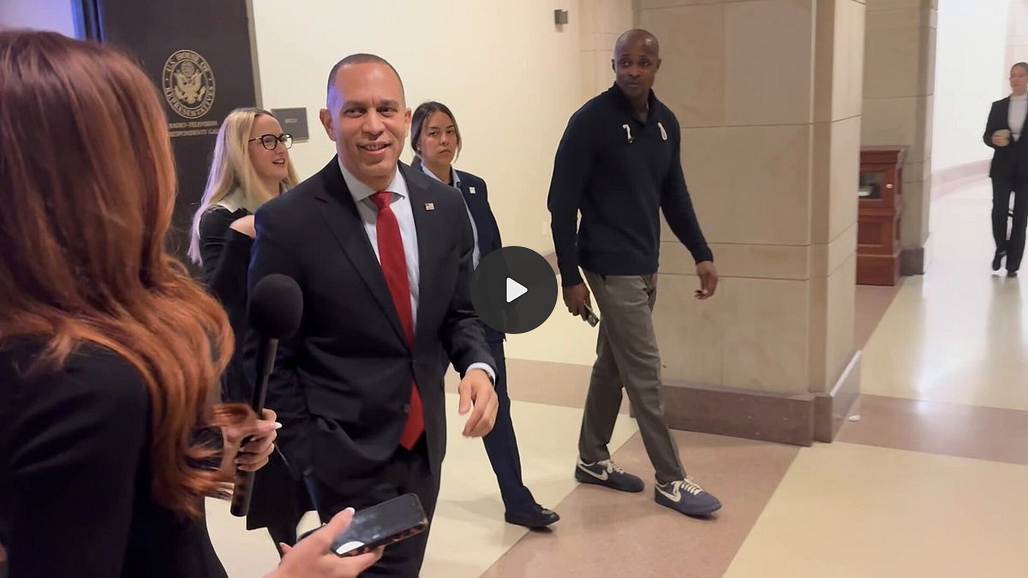
Senate Minority Leader Chuck Schumer (D-NY) last week called the SAVE Act ‘Jim Crow 2.0 across the country,’ and says that the Democrats are “going to do everything we can to stop it.”
“It’s really important for us to be clear that we should be making it easier, more accessible for Americans, for U.S. citizens, to vote,” said Rep. Adelita Grijalva (D-AZ). “The SAVE Act is far from a bill that’s actually making it more possible for people to vote, and when you’re suppressing so many people, especially because of their last name, because of women, because of many reasons, I think that it makes it really difficult for us to want to support a bill like that.”
Yet, there is broad support for voter ID, including among blacks and hispanics.
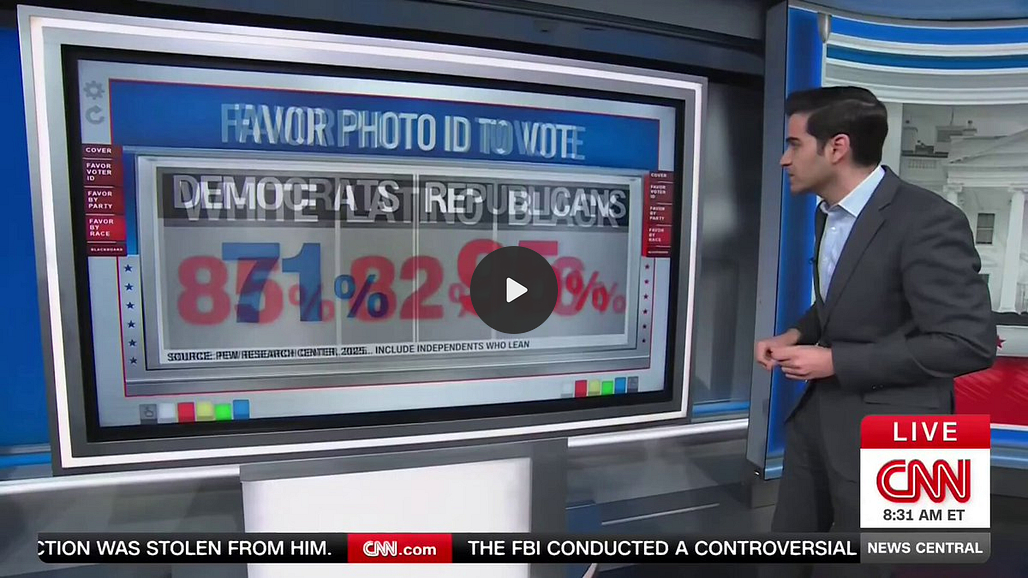
Democrats in both chambers struggled to reconcile their diehard opposition when 82% of Hispanic voters and 76% of Black voters support a photo ID requirement at the polls, according to a Pew Research Center survey last year.
The survey also found that 85% of White voters and 77% of Asian American voters support requiring a government-issued photo ID to vote.
While a photo ID requirement is more popular among Republican voters, 95%, Democratic voters also widely support it, at 71%. -Washington Times
Even CNN noticed.

Assuming this impasse remains... an impasse, eliminating the Senate filibuster - aka, the ‘nuclear option,’ would allow Republicans to bypass the 60-vote threshold to invoke cloture (ending debate) on most legislation. With Republicans currently holding a 53-47 majority in the Senate, the nuclear option would allow them to pass the SAVE Act along with overall DHS funding.
The filibuster isn’t in the Constitution - it’s a Senate rule (primarily Rule XXII) that can be changed via the nuclear option, a procedural maneuver requiring only a simple majority. This has been used before: by Democrats in 2013 for executive and lower-court nominations, and by Republicans in 2017 for Supreme Court nominees. Here’s the step-by-step process, which could be applied to appropriations bills like DHS funding or election-related legislation like the SAVE Act:
Here’s what that process would look like to push through appropriations bills such as the DHS funding bill with the SAVE Act attached;
Introduce the Bill: Senate Majority Leader John Thune (R-SD) brings the DHS funding bill (potentially with the SAVE Act attached) to the floor via a motion to proceed. Democrats begin filibustering by extending debate.
Raise a Point of Order: A Republican senator (e.g., during debate on the motion to proceed or cloture) raises a point of order, asserting that the Senate rules should be interpreted to allow cloture on this type of bill (e.g., appropriations or election integrity measures) with a simple majority of 51 votes, rather than 60.
Ruling by the Presiding Officer: The presiding officer (typically the Vice President, JD Vance in this case, or a Republican senator) rules on the point of order. If they rule in favor (agreeing cloture needs only 51 votes), it sets a new precedent. More commonly, they rule against it to follow tradition, forcing the next step.
Appeal the Ruling: If the presiding officer rules against the point of order, a Republican senator appeals the decision. This appeal is non-debatable (no filibuster possible here).
Vote to Overrule: The Senate votes on the appeal. A simple majority (51 votes) is needed to overrule the chair and establish the new precedent that cloture requires only 51 votes for the specified category. With 53 Republicans, this would pass along party lines.
Invoke Cloture and Pass the Bill: With the new precedent, Republicans move to invoke cloture with 51 votes, ending debate. They then pass the bill with another 51-vote majority. The bill goes to the House (where Republicans also hold a majority) for concurrence, then to President Trump for signature.
Clock’s ticking...
Copyright 2026 ZeroHedge