
This article originally appeared on The Defender and was republished with permission.
Guest post by Michael Nevradakis, Ph.D.
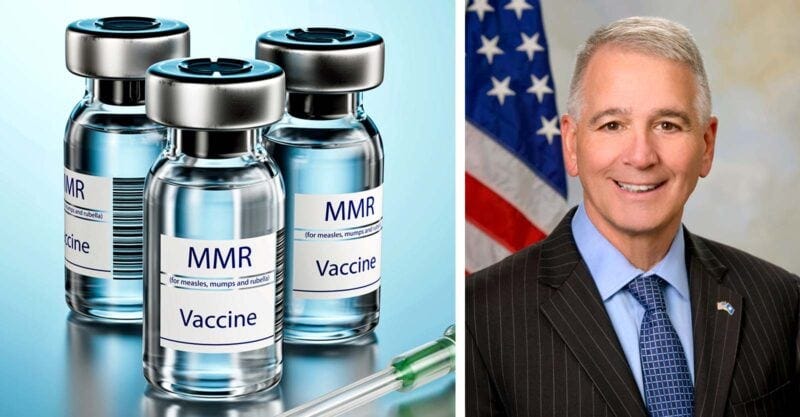
In a Feb. 1 letter to The Wall Street Journal, Dr. Ralph Abraham, principal deputy director of the CDC, wrote that in a recent Colorado measles outbreak “linked to an infectious international air traveler, four of nine secondary measles transmissions occurred among fully vaccinated travel-related contacts.” Abraham cited the CDC’s latest “Morbidity and Mortality Weekly Report,” which confirmed the numbers.
Vaccination doesn’t guarantee immunity against measles, according to a key official with the Centers for Disease Control and Prevention (CDC).
Dr. Ralph Abraham, principal deputy director of the CDC, made the statement just days after the agency released a report showing that some of the people infected during an outbreak of the disease in Colorado last year had been vaccinated.
In a Feb. 1 letter published by The Wall Street Journal (WSJ), Abraham wrote, “although immunization coverage for measles is superior in the U.S. compared to peer countries, we can’t rely exclusively on vaccination.”
Abraham’s letter followed last week’s edition of the CDC’s “Morbidity and Mortality Weekly Report,” which published details about the May-June 2025 measles outbreak in Colorado.
According to the report, the outbreak started with an unvaccinated person who arrived in Denver on an international flight, leading to the infection of 10 people in Colorado — nine secondary cases, or people who had direct contact with the infected person, and one tertiary case, resulting from contact with a secondary case.
Of the secondary cases, four occurred “among persons who had received 2 doses of measles, mumps, and rubella [MMR] vaccine before exposure,” according to the CDC. Four other cases involved people who were unvaccinated. All recovered.
“Although vaccinated individuals are at low risk of acquiring measles, breakthrough infections can still happen. This was the case for four vaccinated air travelers,” the CDC wrote in a post on X earlier this week.

In a statement provided to The Defender, Emily G. Hilliard, press secretary for the U.S. Department of Health and Human Services (HHS), said, “Current outbreaks are largely concentrated in close-knit, under-vaccinated communities with prevalent international travel that raises the risk of measles importation.”
“The CDC’s focus remains on measles prevention and treatment education and targeted public health interventions to protect communities and provide clear, accurate information to all Americans,” Hilliard said.
Brian Hooker, Ph.D., chief scientific officer for Children’s Health Defense (CHD), called Abraham’s statement “encouraging” but “incomplete.”
“U.S. residents need complete public health messages, not just vaccine commercials by the CDC, using federal tax dollars,” Hooker said.
Data on MMR vaccine effectiveness ignores ‘waning immunity over time’
According to CDC data, a single dose of the MMR vaccine provides 93% protection against measles, while two doses increases protection to 97%.
The Epoch Times reported that these estimates are based on a 2013 paper published by the CDC that cites five earlier studies, including a 1999 study from the CDC.
Hooker said these figures may no longer be accurate and don’t take into account declines over time in vaccine-induced immunity.
“This number has never been corrected historically and doesn’t reflect waning immunity over time. Some estimates show that the measles portion of the MMR vaccine will cause the vaccinated to lose about 4% per year of their durable immunity,” Hooker said.
Karl Jablonowski, Ph.D., senior research scientist for CHD, said the Colorado outbreak calls into question the safety and efficacy of the MMR vaccine. He said:
“Considering one infected person led to the infections of 10 others, five of whom were fully vaccinated and one more of unknown status, it does not appear that the vaccine is particularly effective.
“Indeed, of the four infected individuals who shared the same flight, three were fully vaccinated adults and one was a lap infant. Either the measles vaccine is not as effective as it purports to be, or there was an amazing coincidental confluence of vaccine failure.”
Pediatrician Dr. Michelle Perro said the CDC’s report shows that “measles vaccination reduces, but does not entirely prevent infection” and that “breakthrough cases are real, diagnosable and often underdetected.”
‘Vaccination is driving wild-type measles evolution’
Other experts suggested that widespread measles vaccination may have led to the evolution of the virus, contributing to breakthrough infections.
“Vaccination is driving wild-type measles evolution,” Jablonowski said. “The vaccine strain has largely remained unchanged since the 1950s, while wild-type strains have exploded over the past few decades,” Jablonowski said.
Physician Dr. Ben Edwards cited studies that have confirmed the prevalence and growth of wild-type measles infections. He said the CDC’s “statements regarding the possibility of measles outbreaks in vaccinated populations” represent “historical fact.”
According to one such study, published in 2017, of the 194 measles virus specimens collected and analyzed in 2015, “73 were determined to be vaccine-strain.”
In her statement, Hilliard said, “Vaccination remains the most effective way to prevent measles.” She said HHS Secretary Robert F. Kennedy Jr. “has been clear and consistent on this point.”
But in his letter, Abraham wrote that, under Kennedy’s leadership, the CDC has moved away from a sole emphasis on vaccination and instead has “surged resources, including vaccines and therapeutics, nationwide to support state and local response efforts and contain outbreaks.”
Perro said the messaging from Kennedy and HHS reflects “an honest stance at a time when public health communication is fractionated.”
“By acknowledging that vaccines, including the MMR, are not foolproof and that breakthrough infections occur, he is re-centering the conversation on scientific rigor and evidence-based transparency rather than propaganda,” Perro said.
Edwards said that while the MMR vaccine does lower the overall incidence of measles, this protection may come at a cost. He said discussions about measles should focus on “the best way to overcome measles in terms of total health consequences.”
“We must keep in mind the totality of all-cause morbidity and mortality,” Edwards said. He suggested that public health policy must take into consideration the potential association of MMR vaccination with conditions like SIDS (sudden infant death syndrome), cancer, heart disease or autism and balance the risk against the benefits of vaccination in preventing measles.
‘Framing measles as an American policy failure is inaccurate and misleading’
According to the CDC, the U.S. recorded 2,255 measles cases last year, its highest figure since 1992. An additional 588 cases were recorded in the U.S. so far this year, according to CDC data as of Jan. 29.
The increase in measles cases has included outbreaks in South Carolina, Florida, Utah and Washington, and an outbreak in Texas last year that was blamed for the deaths of two children.
Last week, NPR reported that the increase in cases has also meant that the U.S. is in danger of losing its measles elimination status — defined as remaining measles-free for a full year.
In his letter, Abraham pushed back on narratives suggesting that these outbreaks are solely due to the unvaccinated or due to Kennedy’s policies as health secretary. He pointed out that Canada and Mexico “reported substantially more measles cases in 2025 than the U.S. … despite having significantly smaller populations.”
“Across porous borders with high regional caseloads, repeated reintroductions of a common strain make precise attribution of outbreak sources difficult,” Abraham wrote.
Abraham wrote that his letter was a response to a Jan. 23 WSJ editorial criticizing the CDC’s measles policy in the face of outbreaks in several U.S. states over the past year.
“Framing measles as an American policy failure is inaccurate and misleading,” Abraham said.
In remarks shared with NPR, Abraham downplayed the potential loss of measles elimination status and defended the choice of some people to remain unvaccinated.
“You know, the president, Secretary [Kennedy], we talk all the time about religious freedom, health freedom, personal freedom. And I think we have to respect those communities that choose to go a somewhat of a different route,” Abraham said.
Canada lost its measles elimination status late last year, while Mexico lost this status last month — as did the U.K.
In her statement, Hilliard called measles “a global challenge,” and said the U.S. “continues to have a lower overall measles burden than Canada (which in November 2025 lost its measles elimination status), Mexico, and much of Europe.”
“Current outbreaks are largely concentrated in close-knit, under-vaccinated communities with prevalent international travel that raises the risk of measles importation. For South Carolina, most cases are occurring in an under-vaccinated immigrant community in the Spartanburg area,” Hilliard said.
Edwards said that narratives blaming the deaths of two children in Texas last year on measles are misleading:
“In 2026, nobody should die from complications of measles in my opinion. We have too many tools, both conventional and integrative, at our disposal to allow a child in America to die from complications of measles.
“As we saw in the two children who passed away last year during the Gaines County, Texas, outbreak, lack of adequate antibiotic coverage led to secondary bacterial infection complications. These can be easily avoided with proper clinical skills.”
Hooker said the CDC has barely acknowledged the possibility of such bacterial infections — or effective non-vaccine treatments for measles.
“There has been very little information released by the CDC regarding measles infection treatment, including high-dose vitamin A for the first two days of symptoms and budesonide/albuterol treatments for breathing difficulties,” Hooker said. “Neither is there any mention of the possibility of secondary bacterial infections that can cause pneumonia. All of this is extremely irresponsible.”
Related articles in The Defender
South Carolina Measles Outbreak Spurs Renewed Debate About MMR Vaccine
8-Year-Old in West Texas Died From Hospital-acquired Pneumonia, Medical Records Show
‘Medical Error’ Led to Death of 6-Year-Old Who Developed Pneumonia After Measles Diagnosis
Exclusive: ‘Just Normal Doctoring’ — a Texas Doctor’s Eyewitness Report on Measles Outbreak
Texas Reports 8-Year-Old Died of ‘Measles Pulmonary Failure,’ CHD Requests Medical Records
‘I Just Get So Angry’: Dad of West Texas Child Who Died Talks to CHD.TV
New Mexico Health Officials Mum on Whether Adult Died From — or With — Measles
Donate to Children’s Health Defense

Given the data that we've found out (after, you know, decades of this bs), it's actually a reasonable position to think that these vaccines that are given to millions/billions of people are at best ineffective and at worst, harmful for people, especially children.
Consider that Big Pharma is losing their shit because they're being asked to produce REAL scientific studies that show their concoctions are efficaceous. That tells you everything you need to know right there.
When you consider the huge betrayal of trust that's happened with Big Pharma, it makes sense to not trust them at all.